
Kingdom: Plantae
Clade: Angiosperms
Clade: Eudicots
Order: Gentianales
Family: Apocynaceae
Genus: Pachypodium
Species: Pachypodium rosulatum Baker
General: Elephant’s Foot, Bottle Tree
Madagascar: Local regional names vary; often referenced simply as a pachypodium
Horticulture: Elephant Foot Pachypodium, Rosette Pachypodium
Collector Trade: Caudiciform Pachypodium
Pachypodium rosulatum is a striking caudiciform succulent shrub recognized for its swollen, sculptural trunk and bright yellow flowers. The base forms a thickened, water-storing caudex that often appears cracked or textured with age, giving the impression of weathered stone or an exposed root system lifted above the soil line.
Branches emerge irregularly from the upper portion of the plant and are armed with sharp spines arranged in clusters. At the tips, narrow lance-shaped leaves form rosettes during the active growing season. In dormancy, the plant may shed much of its foliage, leaving behind a stark architectural silhouette.
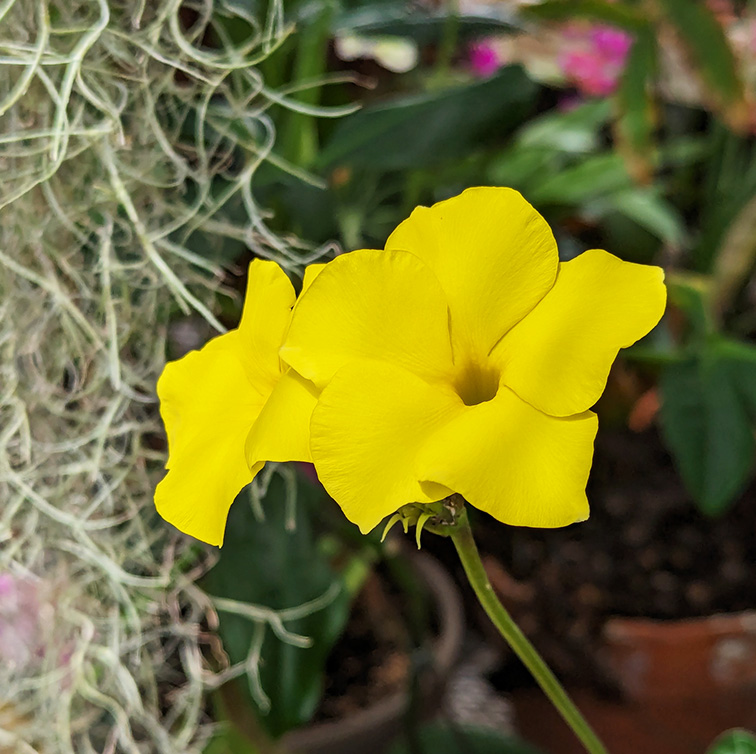
The flowers are vivid yellow, funnel-shaped, and produced in clusters near branch tips. Their saturated color contrasts dramatically with the muted trunk and dry-season form, creating an effect that feels both delicate and resilient.
Growth is slow, with specimens taking years to develop mature form.
Native to: Madagascar
Habitat:
The species is adapted to environments defined by alternating wet and dry seasons. Its swollen trunk stores water, allowing survival through prolonged drought.
Its survival strategy reflects long evolutionary pressure toward efficiency rather than speed.
Light: Full sun to very bright light
Soil: Extremely well-drained, mineral-heavy mix
Water: Deep but infrequent; allow full drying between watering
Temperature: Warm conditions preferred; sensitive to frost
Maintenance:
Landscape / Container Use:
Pachypodium rosulatum is often mistaken for a cactus because of its spines and drought tolerance, but it belongs to the dogbane family (Apocynaceae), making it a relative of plants like plumeria and oleander.
Its growth reflects patience rather than productivity. Well-grown specimens become living sculptures over decades, shaped as much by restraint as by care.
Pachypodium rosulatum feels like geology deciding to bloom.
It stores time as much as water — growing slowly, enduring heat, waiting through scarcity without complaint.
The plant does not chase abundance.
It prepares for absence.
In systems built around constant motion and output, its form suggests another approach:
Build reserves.
Stand still when necessary.
Flower when conditions are right — not when demanded.
The lesson is quiet but clear: resilience is often slow, deliberate, and visibly rooted in survival itself.
Content published by the Cernunnos Foundation is intended to support education, creative work, and independent learning. Material may be referenced or adapted for educational and artistic purposes with attribution.