
Kingdom: Plantae
Subkingdom: Tracheobionta
Superdivision: Spermatophyta
Division: Magnoliophyta
Class: Liliopsida
Subclass: Liliidae
Order: Liliales
Family: Liliaceae
Genus: Tulipa
Species: Tulipa gesneriana
Cultivar: ‘Didier’
Didier’s Tulip
Garden Tulip
Common Tulip
Dark Tulip (informal descriptive name)
Spring Garden Tulip
Because it is a cultivated ornamental, the cultivar name ‘Didier’ is the most precise designation used by horticulturists and collectors.
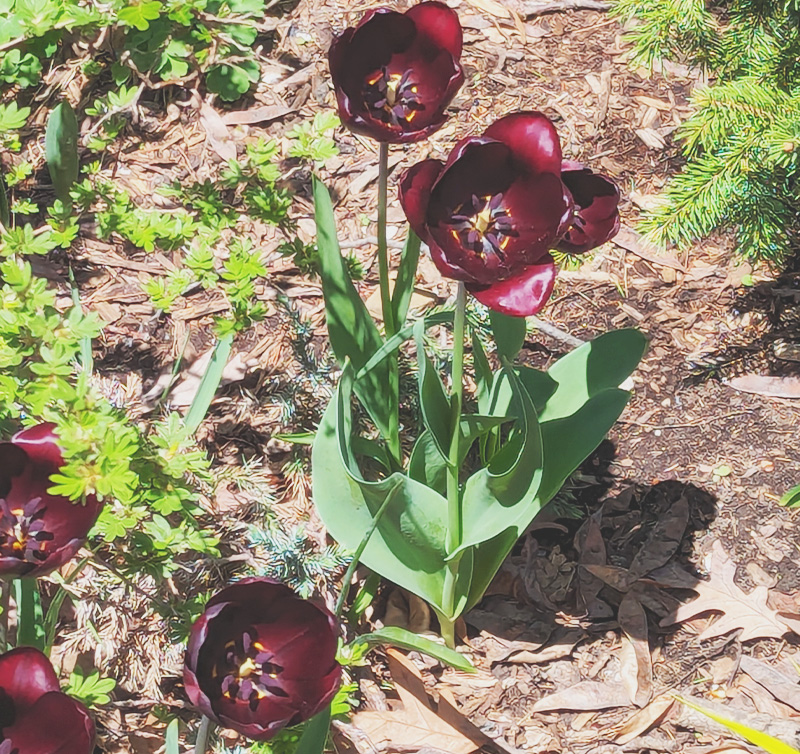
Tulipa gesneriana ‘Didier’ is a cultivated garden tulip known for its dramatic, very dark blooms. The flowers appear deep burgundy to nearly black in strong sunlight, creating one of the most striking visual contrasts in spring garden plantings.
Like most tulips, it grows from a bulb and produces a clean architectural form consisting of a central flowering stem surrounded by smooth basal leaves.
Plants typically reach 30–50 cm (12–20 inches) in height depending on soil, climate, and growing conditions.
The flowers are large, upright, and cup-shaped.
Characteristics include:
Tulip flowers open widely during warm daylight hours and may close partially in cooler or overcast conditions.
Leaves emerge from the base of the plant and are typically:
The foliage serves as the plant’s primary photosynthetic engine, replenishing energy into the bulb after flowering.
The wild ancestry of Tulipa gesneriana originates from Central Asia and regions surrounding the Caucasus and Anatolia.
However, the cultivar ‘Didier’ exists only in cultivation and is grown in temperate gardens worldwide, especially in:
Garden tulips thrive wherever winters provide sufficient cold dormancy and springs provide moderate moisture.
Garden tulips prefer:
They perform best in soils that do not remain saturated during winter.
Tulips are commonly planted in:
Many gardeners treat cultivated tulips as short-lived perennials or annual displays, replanting fresh bulbs each autumn for the most consistent blooms.
Tulips reproduce primarily through bulb division in cultivated settings.
After flowering:
Tulips can also reproduce by seed, but this method is slow and rarely used for maintaining cultivar traits because seedlings may not match the parent plant.
Common challenges for tulips include:
Warm or overly wet climates may shorten the lifespan of tulip bulbs.
Tulips are among the most historically significant ornamental flowers in the world.
They became symbols of wealth, beauty, and horticultural mastery during the Ottoman Empire and later during the famous Dutch Tulip Era of the 17th century.
Dark tulip cultivars like ‘Didier’ are particularly valued for their dramatic appearance. Their deep coloration absorbs light rather than reflecting it, producing an almost velvety effect in sunlight.
These varieties are often used to create contrast with lighter spring flowers such as daffodils, hyacinths, and white tulips.
This plant profile is part of the Cernunnos Foundation open knowledge archive.
All photographs and accompanying materials produced by the Foundation are released free for educational and artistic use, provided attribution to the Cernunnos Foundation is maintained when possible.
The purpose of this archive is to encourage curiosity about the natural world and to provide accessible, well-structured information about plants and animals for students, educators, artists, and lifelong learners.