
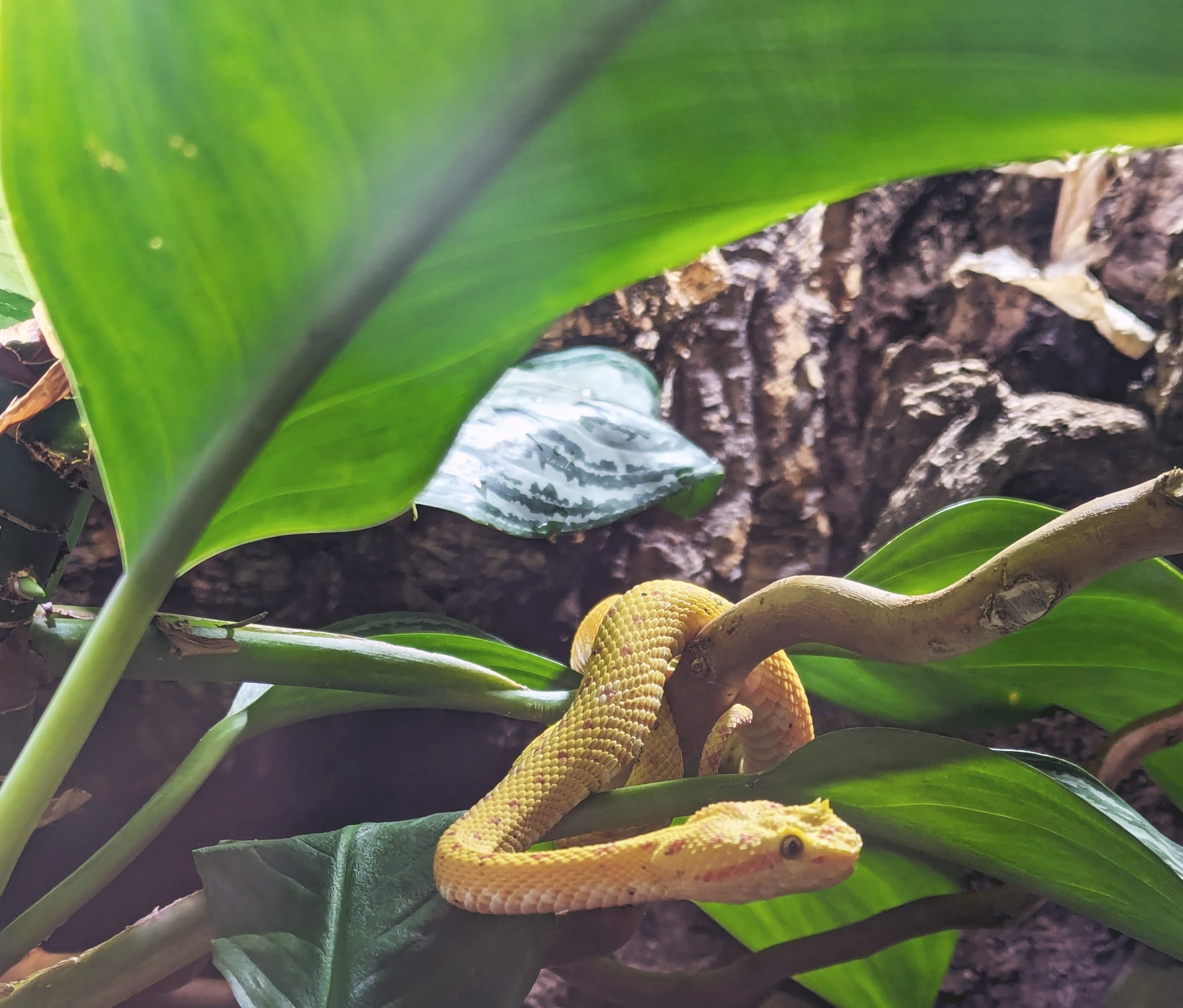
Kingdom: Animalia
Phylum: Chordata
Class: Reptilia
Order: Squamata
Suborder: Serpentes
Family: Viperidae
Subfamily: Crotalinae
Genus: Bothriechis
Species: Bothriechis schlegelii
Eyelash Viper
Eyelash Palm Pit Viper
Schlegel’s Palm Viper
Bocaracá (Costa Rica)
Oropel (yellow morph name in parts of Central America)
Terciopelo de pestañas (Spanish)
The Eyelash Viper is a small to medium-sized arboreal pit viper famous for the distinctive scales that rise above each eye like tiny eyelashes. These scales are modified supraocular scales and are thought to help break up the outline of the snake when resting among leaves.
Adults typically reach 55–75 cm (22–30 inches) in length, though some individuals can grow slightly larger.
The body is relatively slender with a triangular viper head, vertical pupils, and a short prehensile tail used for gripping branches.
This species is notable for its extreme color polymorphism.
Individuals may appear in many colors, including:
One particularly famous form is the “oropel” morph, a vivid golden-yellow snake often seen in Costa Rica.
These color variations allow individuals to blend into:
Like other pit vipers, Bothriechis schlegelii possesses heat-sensing pits between the eyes and nostrils. These organs detect infrared radiation and allow the snake to locate warm-blooded prey even in darkness.
This makes the species a highly effective nocturnal ambush predator.
The Eyelash Viper is native to Central and northern South America.
Its range includes:
It is most commonly associated with humid tropical forests.
This species prefers lowland rainforests and cloud forests, though it may also occur in:
Unlike many snakes, the Eyelash Viper is strongly arboreal, spending much of its life:
During the day it often remains motionless, relying on camouflage.
Eyelash Vipers are opportunistic ambush predators.
Common prey includes:
Juveniles may feed more heavily on amphibians and small reptiles.
The snake typically strikes quickly and releases prey, allowing venom to immobilize it before swallowing.
The species is venomous, using a hemotoxic venom typical of pit vipers.
Bites can cause:
However, serious human encounters are relatively uncommon because the snake:
Nevertheless, it should always be treated with caution.
The Eyelash Viper is ovoviviparous, meaning the female gives birth to live young rather than laying eggs.
Typical reproduction characteristics:
Newborn snakes are fully independent and capable of hunting immediately.
Young individuals often display dramatic color patterns, sometimes different from their parents.
Natural predators likely include:
Primary threats today include:
In some regions the species persists well in protected rainforest reserves.
The Eyelash Viper is one of the most photographed snakes in the Neotropics due to its striking colors and calm resting posture.
Its “eyelashes” are not actual hair-like structures but modified scales that likely serve as camouflage by disrupting the snake’s silhouette among leaves.
Because individuals often remain still for long periods, hikers occasionally notice them only inches away along forest trails.
Despite its reputation, the species generally relies on camouflage and stillness rather than aggression as its primary defense.
As a wild species, the Eyelash Viper requires no human management in natural ecosystems.
Conservation priorities include:
Protected rainforest reserves throughout Central and South America remain the most effective safeguard for the species.