
Kingdom: Plantae
Clade: Angiosperms
Clade: Eudicots
Order: Ericales
Family: Ericaceae
Genus: Rhododendron
Species: Rhododendron calendulaceum
Flame Azalea
Orange Azalea
Appalachian Flame Azalea
Wild Honeysuckle (regional colloquial use)
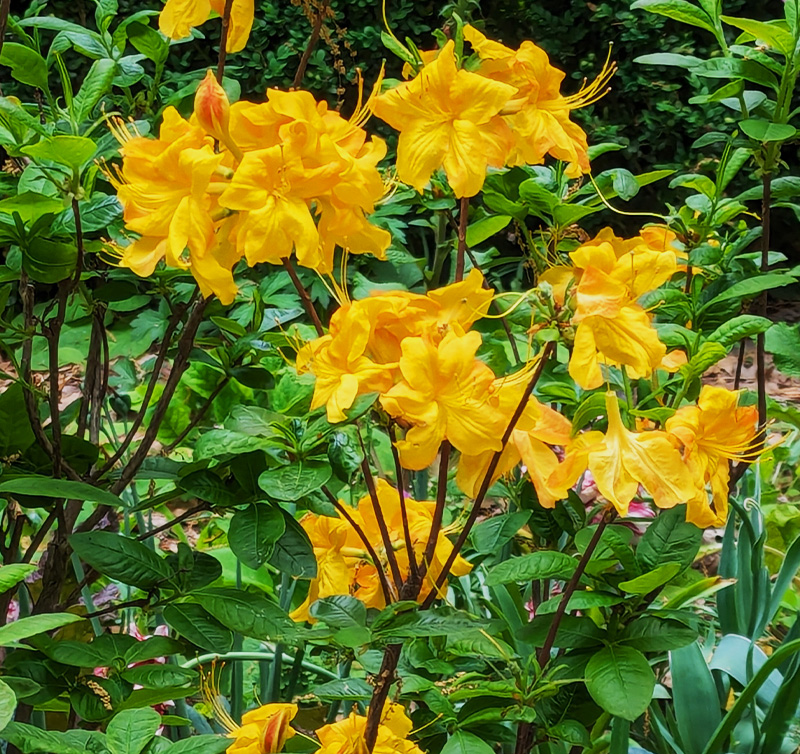
Flame Azalea is a deciduous flowering shrub native to eastern North America, particularly the mountainous regions of the eastern United States. It typically grows 4–8 feet (1.2–2.4 m) tall and spreads outward in loose clusters.
Unlike many cultivated azaleas, Flame Azalea blooms before or alongside leaf emergence, making its flowers appear to float above the branches in early spring.
Leaves are elliptical to oblong and medium green, typically 2–3 inches long. They emerge after flowering and form a dense canopy during the growing season.
In autumn the foliage may turn shades of yellow, orange, or bronze, adding seasonal interest even after flowering has ended.
The defining feature of Rhododendron calendulaceum is its brilliant cluster of trumpet-shaped blossoms.
Flower colors range widely through warm tones including:
• deep orange
• flame red
• golden yellow
• apricot
• peach
Individual flowers are 1.5–2 inches long with dramatically extended stamens that give the blossoms a fiery, radiating appearance.
Blooming typically occurs April through June, depending on elevation and latitude.
Flame Azalea is native to the Appalachian Mountains and surrounding highlands.
Its natural range includes:
Pennsylvania
West Virginia
Virginia
North Carolina
South Carolina
Georgia
Alabama
Tennessee
Kentucky
It thrives particularly well along woodland edges, mountain slopes, and forest clearings where filtered sunlight reaches the understory.
In its natural habitat Flame Azalea prefers:
• well-drained acidic soils
• partial shade to full sun
• moist but not waterlogged conditions
It often grows in association with oak, pine, and mixed hardwood forests.
Because it is adapted to mountain environments, the species benefits from cooler temperatures and good air circulation.
Flame Azalea reproduces through:
• seed production following pollination
• layering, where low branches contact soil and root
• nursery propagation through cuttings
Seeds are very small and wind-dispersed, allowing the plant to slowly colonize suitable woodland habitats.
Potential threats include:
• root rot in poorly drained soils
• lace bugs affecting foliage
• deer browsing young shoots
• habitat loss from development
Wild populations remain locally common but can be sensitive to disturbance in their native mountain ecosystems.
Flame Azalea is widely considered one of the most spectacular native shrubs of the Appalachian region. Its vivid colors often appear suddenly along mountain roadsides and woodland edges, lighting the forest like small bursts of fire.
The species is part of the native azalea group, a collection of North American rhododendrons that have contributed significantly to modern azalea breeding.
Because of its beauty and ecological value, Flame Azalea is frequently used in native plant landscaping and restoration projects.
In cultivation:
• plant in acidic soil (pH 4.5–6)
• avoid heavy fertilization
• provide mulch to maintain soil moisture
• prune only lightly after flowering
Once established, the plant is relatively low maintenance and highly valued in woodland gardens.
In spring, certain hillsides of the eastern mountains briefly appear to burn.
The forest itself has not caught fire.
Instead, the understory erupts in the brilliant orange blossoms of Flame Azalea—one of the quiet signatures of the Appalachian landscape.