
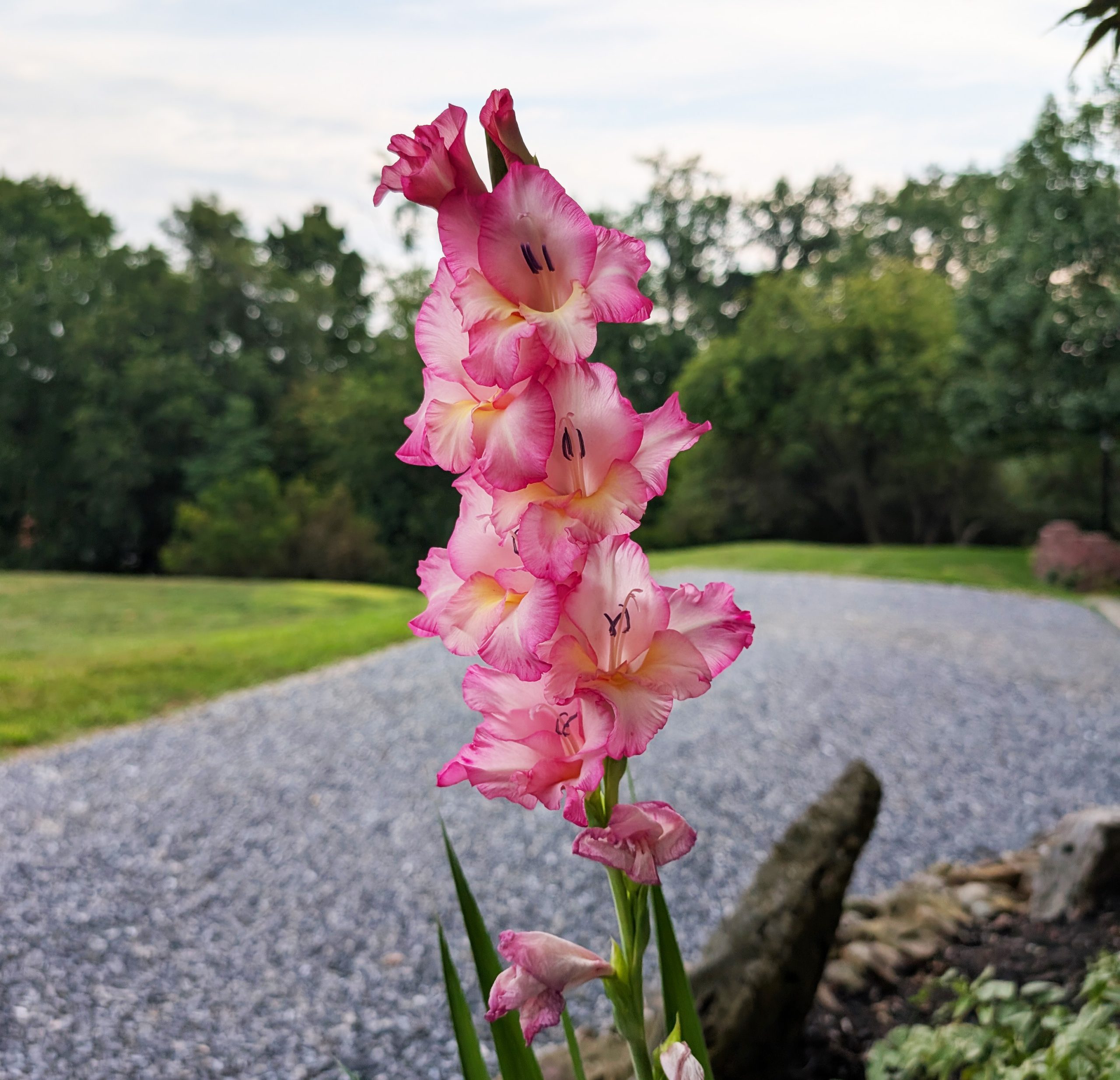
A tall, stately, upright herbaceous perennial grown from corms. Typically reaches 3–4 feet in height under average garden conditions, with well-supported stems capable of exceeding 4 feet. Growth is strongly vertical and linear, with foliage forming a tight, sword-like fan from which the flowering spike emerges.
Leaves are long, narrow, and keeled — the characteristic sword-shaped gladiolus foliage. Color is medium to bright green. Leaves emerge in a flat, overlapping fan arrangement from the corm and remain upright through the growing season, providing architectural structure even before bloom.
The defining characteristic of ‘Priscilla’ is its extraordinary bloom color and form. Florets open in succession from the base of the spike upward, with 12–20 individual florets per stem possible under good growing conditions. Petal coloration is a soft, warm pink — described variously as shell pink, blush pink, or rose-cream depending on light conditions. The base of each floret displays a creamy white to pale yellow throat that fades outward into the pink tones, producing a luminous, almost glowing quality in full bloom. Ruffling of the petal edges is moderate to pronounced, contributing to the cultivar’s refined, elegant appearance. Floret size is large, as expected of large-flowered hybrid gladiolus, with individual blooms measuring 4–5 inches across at peak opening. Bloom season is mid-summer, with timing adjustable via staggered planting. Each flower spike provides a long vase life of 7–10+ days, making ‘Priscilla’ highly prized as a cut flower.
Corms are firm, flattened-globose, and covered in a fibrous tan to brown tunic. They produce cormels (small offset corms) at the base each season, which can be harvested and grown on to flowering size over 1–2 seasons.
Gladiolus × hybridus cultivars, including ‘Priscilla,’ are of complex hybrid origin — derived from multiple wild Gladiolus species native primarily to South Africa and East Africa. As a cultivated hybrid, ‘Priscilla’ has no natural range. It is grown throughout temperate regions worldwide wherever climate permits summer cultivation. Hardy in USDA Zones 8–11 as a perennial. In colder zones (including Zone 6, covering much of Pennsylvania), corms are typically lifted after the first frost and overwintered indoors, then replanted in spring.
Light: Full sun; minimum 6 hours of direct sun daily for best bloom Soil: Well-drained, fertile loam; will not tolerate waterlogged conditions Moisture: Regular watering during active growth; reduce after foliage begins to die back Planting Depth: 4–6 inches; deeper planting improves stem stability Spacing: 6–8 inches between corms Staking is recommended for tall cultivars in exposed sites, as flower spikes can become top-heavy. Planting in groups of 5–7 corms provides mutual support and a stronger visual mass. Corms should be planted after the last frost date in spring. In Pennsylvania, this is typically mid-April through May.
Primary propagation is vegetative through corm and cormel division. Lift corms in fall after foliage yellows following first frost Cure in a warm, dry location for 2–3 weeks Remove dried foliage and separate cormels from the parent corm Store in dry peat moss, vermiculite, or paper bags at 35–45°F through winter Replant in spring; cormels reach blooming size in 1–2 seasons Seed propagation is not used for named cultivars, as seedlings will not replicate ‘Priscilla’ characteristics.
Thrips (Frankliniella species) — primary pest; causes silvery streaking on petals and foliage; monitor and treat early Botrytis (gray mold) — fungal issue in humid, wet conditions; ensure good air circulation Fusarium corm rot — avoid planting in waterlogged soils; inspect corms before storage Aphids — occasional; manageable with insecticidal soap Deer and voles may consume corms and foliage in some regions Thrips are the most significant pest threat to exhibition-quality gladiolus and should be actively monitored throughout the growing season.
Cut flower harvest: Cut when the lowest 1–2 florets are beginning to open; remaining florets will open successively in the vase. Stake tall stems in windy or exposed locations Water at the base; avoid wetting foliage when possible Fertilize at planting and again when the flower spike first emerges Allow foliage to remain until naturally yellowed before lifting corms Label corms at storage to maintain cultivar identity Staggered planting every 2 weeks from late April through June provides a succession of blooms extending well into late summer.
‘Priscilla’ has held strong popularity among both home gardeners and commercial cut flower growers for decades, owing to its exceptional color consistency, large floret size, and superior vase life. The cultivar is a reliable performer in the mixed border, cottage garden, and cutting garden alike. Its soft pink coloration provides strong versatility in floral arrangements, pairing well with whites, creams, lavenders, and deeper roses. Gladiolus as a genus carries significant cultural symbolism — associated with remembrance, strength of character, and faithfulness. The name derives from the Latin gladius, meaning sword, a reference to the distinctive leaf form. As a large-flowered hybrid, ‘Priscilla’ represents the culmination of over a century of gladiolus breeding, with primary hybrid ancestry tracing to G. dalenii, G. cardinalis, G. oppositiflorus, and other Cape species.
Photographed in cultivation during peak mid-summer bloom. Subject exhibited strong vertical spike development with full, well-formed florets opening in the characteristic basal-to-tip succession. Coloration observed consistent with cultivar description — soft shell pink with a warm, luminous quality in natural light. Petal ruffling visible and well-defined. No pest damage or disease signs observed on photographed specimen. Stem height at photography: approximately 36–40 inches from soil level. Florets fully open to mid-spike at time of image capture.
All images and written content published on this site are provided freely for educational and artistic use. Attribution appreciated but not required. Knowledge grows when shared.