
Kingdom: Plantae
Clade: Tracheophytes
Clade: Angiosperms
Clade: Eudicots
Order: Asterales
Family: Asteraceae
Genus: Ratibida
Species: Ratibida columnifera
Prairie Coneflower
Mexican Hat
Upright Prairie Coneflower
Longhead Coneflower
Thimbleflower
An upright, herbaceous perennial wildflower. Typically grows 1–3 feet tall, occasionally taller in fertile soils. Forms loose clumps and can naturalize in open areas.
Basal and lower leaves are pinnately divided into narrow, threadlike segments. Upper leaves smaller and less divided. Gray-green coloration with a slightly rough texture.
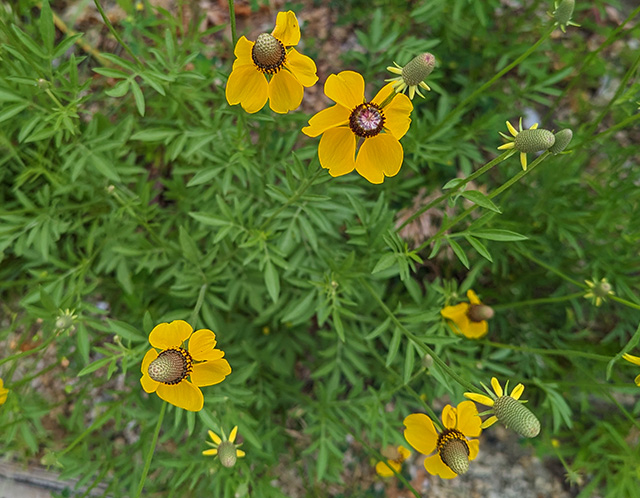
Distinctive composite flower with drooping ray florets and a prominent central disk.
Ray florets are typically yellow with reddish-brown bases, though fully yellow forms occur. Rays angle downward, giving the characteristic “sombrero” or “Mexican hat” appearance.
Central disk is elongated, columnar, and dark brown to purplish, becoming more pronounced as the flower matures.
Blooms from late spring through mid-summer, often extending into early fall under favorable conditions.
Elongated central cone persists and hardens as seeds develop. Seeds readily disperse and contribute to natural reseeding in suitable habitats.
Native to North America, widely distributed across the central and western United States and extending into parts of Canada and Mexico.
Common in prairie systems, roadside margins, disturbed soils, and open fields.
Frequently cultivated beyond its native range, including Pennsylvania and the northeastern United States.
Light: Full sun required for best growth and flowering
Soil: Well-drained soils; tolerant of poor, sandy, or rocky conditions
Moisture: Drought tolerant once established; prefers dry to moderate conditions
Thrives in open, disturbed ground and prairie-style plantings
Highly tolerant of heat, wind, and low fertility soils.
Seed (primary method; readily self-seeds)
Division of established clumps
Direct sowing in fall or early spring produces best results
Seeds require light for germination; minimal soil coverage recommended.
Generally pest-resistant
Occasional aphids
Root rot in poorly drained soils
Overwatering is the primary cultivation risk
Highly resilient in naturalized settings.
Low maintenance species
Deadheading can prolong bloom period but is not required
Allowing seed set encourages natural spread
Cut back in late fall or early spring if managing appearance
Suitable for pollinator gardens, meadow restoration, and low-input landscapes.
A highly valuable pollinator plant, attracting bees, butterflies, and other beneficial insects.
Its drought tolerance and adaptability make it a key species in xeriscaping and prairie restoration efforts.
The distinctive flower form makes it easily recognizable even at a distance.
Observed in open, sunny roadside and field-edge environments. Strong vertical central disk with downward yellow rays showing red pigmentation at the base.
Plants exhibited drought tolerance and were actively attracting pollinators during peak bloom.
Identification confirmed by characteristic columnar disk and ray orientation.
All images and written content published on this site are provided freely for educational and artistic use. Attribution appreciated but not required. Knowledge grows when shared.