
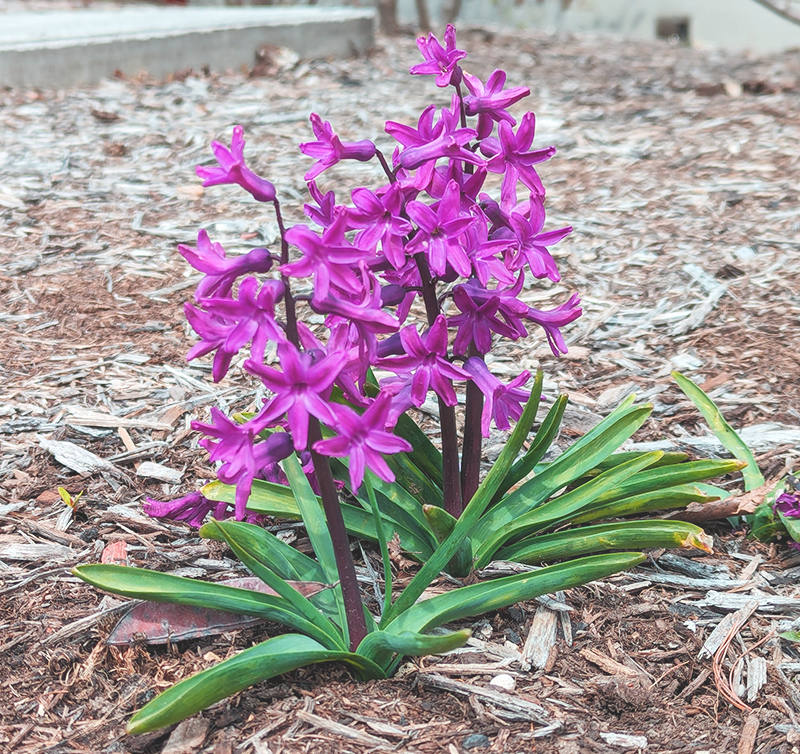
Kingdom: Plantae
Clade: Tracheophytes
Clade: Angiosperms
Clade: Monocots
Order: Asparagales
Family: Asparagaceae
Subfamily: Scilloideae
Genus: Hyacinthus
Species: Hyacinthus orientalis L.
General / Europe & North America: Violet Hyacinth, Garden Hyacinth
Mediterranean / Western Asia (historic range): Hyacinth
Horticulture Trade: Dutch Hyacinth, Common Hyacinth
Cultural / Literary Use: Hyacinth (classical and poetic references)
Bulb-forming perennial with an upright, compact growth form.
Emerges early in spring, completing most of its life cycle before summer heat sets in.
Growth is structured, vertical, and deliberate rather than spreading.
Height: Typically 8–12 inches (20–30 cm) in bloom
Spread: 4–6 inches (10–15 cm) per bulb
Forms tight, vertical clumps when planted in groups.
Leaves are thick, fleshy, and strap-like.
Glossy medium green with a smooth surface and blunt tips.
Leaves rise directly from the bulb base and frame the flower stalk.
Dense, upright flower spikes composed of many tightly packed, bell-shaped florets.
Color ranges from soft lavender to deep royal violet depending on cultivar.
Highly fragrant—sweet, rich, and persistent.
Bloom period is early to mid-spring, often coinciding with the first reliable warming days.
Produces small, inconspicuous seed capsules.
In cultivated settings, seed production is rare and generally not emphasized.
Eastern Mediterranean and western Asia, including regions of modern-day Turkey, Syria, and Lebanon.
Widely cultivated throughout Europe and North America as a spring ornamental.
Common in gardens, containers, and forced indoor displays.
Prefers full sun to partial shade.
Performs best with strong early-season light before canopy trees leaf out.
Moderate water needs during active growth and flowering.
Bulbs require dry conditions during summer dormancy.
Sensitive to waterlogged soils.
Requires well-drained soil.
Prefers sandy or loamy substrates with moderate fertility.
Bulbs rot quickly in heavy clay or persistently wet ground.
Hardy in USDA Zones 4–8.
Requires winter chilling for proper bloom development.
Tolerates average outdoor humidity.
Indoor forcing benefits from good air circulation to reduce fungal issues.
Primarily propagated by bulbs and bulb offsets.
Offsets develop slowly and may require several seasons to reach flowering size.
Seed propagation is uncommon and slow.
Generally resistant to most pests.
Occasional problems include bulb rot, gray mold, and basal rot in poorly drained soils.
Rodents may dig or consume bulbs if unprotected.
Exceptionally strong fragrance—among the most intense of spring-flowering bulbs.
Violet coloration adds depth and visual weight to early-season plantings.
Reliable performance makes it well suited for indoor forcing and formal displays.
Provides early nectar for emerging pollinators.
Primarily ornamental rather than a keystone species.
Low maintenance once established.
Allow foliage to yellow and die back naturally after flowering.
Avoid cutting or binding leaves prematurely.
Best suited to borders, formal beds, containers, and spring focal points.
Violet hyacinth does not announce itself with brightness first.
It leads with presence.
The fragrance arrives quietly, then stays.
The color is deeper, steadier, less playful than blue.
The spike stands firm, composed, almost reserved.
This is a plant that favors gravity over sparkle.
It blooms early, speaks clearly, and withdraws without ceremony.
No excess.
No clutter.
No lingering.
It understands that richness does not require volume.
Timing matters.
So does restraint.
—
Blue Ribbon Team field notes are observations, not edicts.
Learn the place first.
Then decide what it needs.