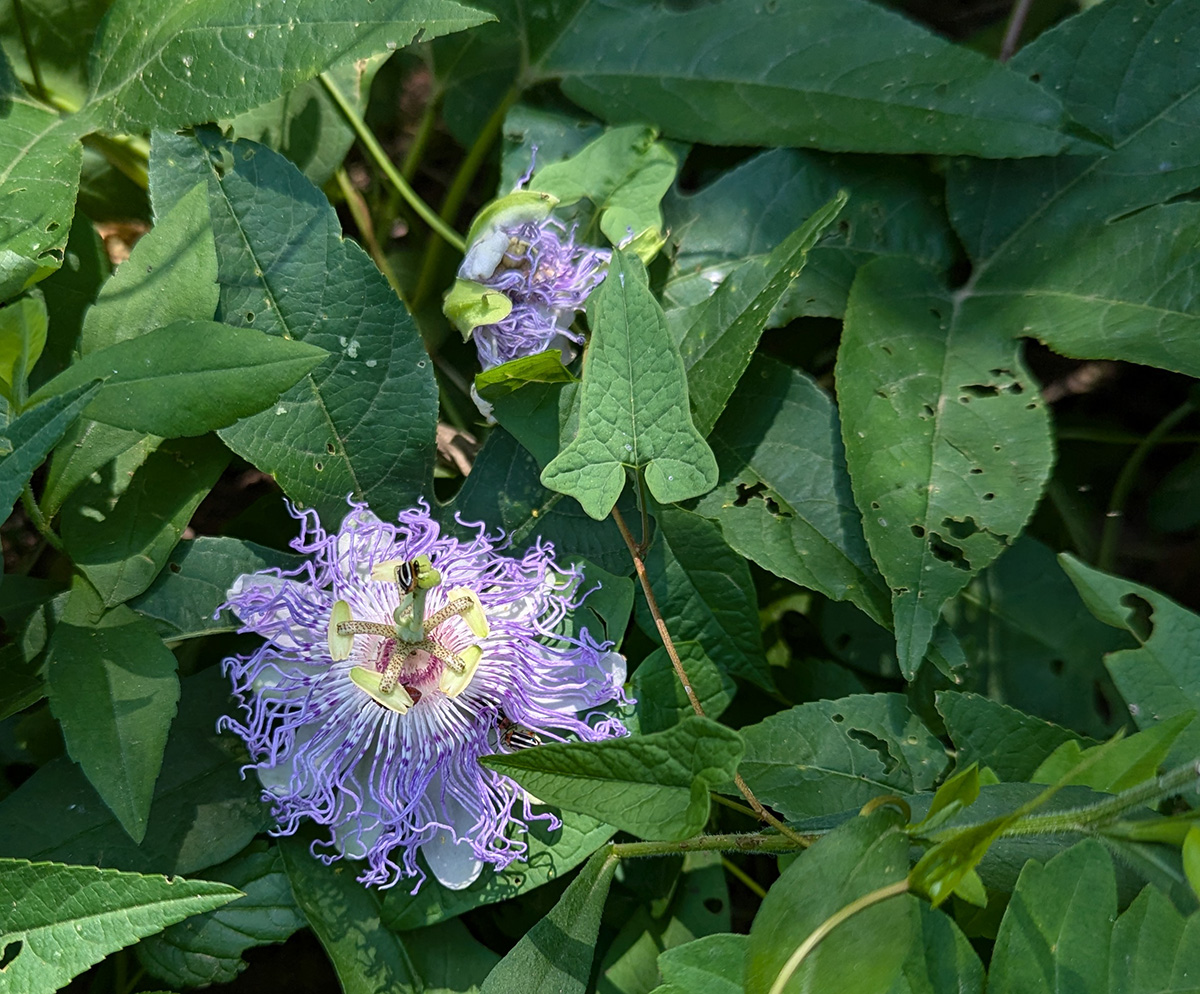
Purple Passionflower
Passiflora incarnata
Taxonomy
Domain: Eukaryota
Kingdom: Plantae
Subkingdom: Tracheobionta
Superdivision: Spermatophyta
Division: Magnoliophyta
Class: Magnoliopsida
Clade: Eudicots
Clade: Rosids
Order: Malpighiales
Family: Passifloraceae
Genus: Passiflora
Species: Passiflora incarnata
Common Names by Region
- United States / Canada: Purple passionflower, maypop, wild passion vine, apricot vine, holy-trinity flower
- United Kingdom / Ireland: Wild passion flower (garden trade)
- Continental Europe: Local-language equivalents referencing the “passion” iconography (e.g., French fleur de la passion, German Fleischfarbene Passionsblume)
Description
Quick ID
- Growth form: Herbaceous perennial climbing vine, sprawling 6–25 feet by tendrils. Dies back to the root each winter and resprouts, so it reads as a fresh seasonal vine rather than a woody one.
- Flowers: Showy, 2–3 inches across, borne singly from leaf axils. Ten pale petals/sepals form the backing plate; over that sits the diagnostic corona — a dense fringe of wavy, threadlike filaments banded purple, white, and pale blue.
- Center details: The floral column is the tell. Five yellow-green anthers hang below three prominent, club-tipped styles (the “three nails” of the passion iconography), all raised on a central stalk above a banded pink-and-white floor.
- Leaves: Deeply three-lobed, finely serrated, alternate, palmately veined — the classic maypop silhouette running through this frame.
- Tendrils: Unbranched, coiling from the leaf axils. One is caught mid-curl at lower right.
Blooming
- July into September, each bloom lasting roughly a day. This photo dates to August 23, squarely mid-window, with a spent flower fading in the upper background and a green fruit forming.
Look-alikes
- Yellow passionflower (Passiflora lutea): Much smaller, greenish-yellow flowers under an inch, leaves shallowly lobed. No purple corona.
- Blue passionflower (Passiflora caerulea): Cultivated ornamental with a flatter, more open blue-and-white corona and a woodier, evergreen habit; not a native and not reliably hardy here.
- Cultivated hybrids: Garden passion vines run to deeper reds and purples with tighter coronas; the pale, wild, slightly untidy look here reads native.
Known Range
- Native: Southeastern and south-central United States, from Texas and Oklahoma east to Florida and north up the Atlantic and Ohio Valley corridors into Pennsylvania. Reaches roughly the northern edge of its range in our latitude.
- In Pennsylvania: Present but uncommon in the wild, favoring warm, disturbed, well-drained sites — field edges, old fields, roadsides, railway ballast, and reclaimed ground. A natural fit for sunny, south-facing slopes in the Conemaugh corridor.
Care / Habitat
Light
- Full sun for best flowering and fruit set. Tolerates part shade but blooms sparsely in it.
Soil
- Well-drained and not fussy — sandy, loamy, or rocky all work. Tolerates lean ground; dislikes soggy, compacted soil.
Water
- Moderate. Drought-tolerant once established. The deep root system carries it through dry spells.
Typical Habitat (when naturalized)
- Warm, open, disturbed ground: field margins, fencerows, roadsides, thickets, and pioneer edges with sharp drainage and long sun exposure.
Propagation / Reproduction
- Root suckers (primary spread): Runs aggressively from underground rhizomes and will colonize a patch. Where you find one flower you’ll usually find a stand.
- Seed: Sets in the egg-shaped maypop fruit; germination is slow and erratic, often needing scarification and a cold period.
- Cuttings: Softwood cuttings root in warm months.
- To contain it: site it where the rhizomes can’t overrun neighbors, or sink a root barrier.
Pests / Diseases / Threats
- Generally vigorous and trouble-free once established.
- Host plant, by design — fritillary caterpillars (Gulf fritillary and variegated fritillary) graze the foliage. Chew marks are a feature of a working host plant, not a problem to spray.
- Occasional aphids or scale; rare leaf spot in humid, crowded conditions.
- Winter dieback is normal at this latitude; mulch the crown to protect the root through hard freezes.
Additional Notes
Ecology & Use
- A high-value native pollinator and larval-host plant. Carpenter bees and bumblebees are the main pollinators; the flower is built for their weight and reach.
- Larval host for Gulf fritillary and variegated fritillary butterflies — one of the most productive butterfly plants a native garden can carry.
- The ripe maypop fruit is edible, tart and aromatic; the pulp has a long history of home use. The plant is also the source of the herbal passionflower long used as a mild calmative.
- The flower’s structure gave it its name: early missionaries read the corona, column, and three styles as a catechism of the Passion — the “holy-trinity flower.”
Management
- Want it to stay? It largely manages itself; let the rhizomes run and a few fruits ripen.
- Want it held? Sink a root barrier and pull suckers outside the intended footprint. Cut back spent vines in late fall.
Open Reference / Educational Use (CF Standard)
This profile is provided for open educational reference, field identification support, and art/illustration reference in the spirit of the Cernunnos Foundation field guide project. Reuse is encouraged with attribution to CF and your on-site page as the source.
Views: 213