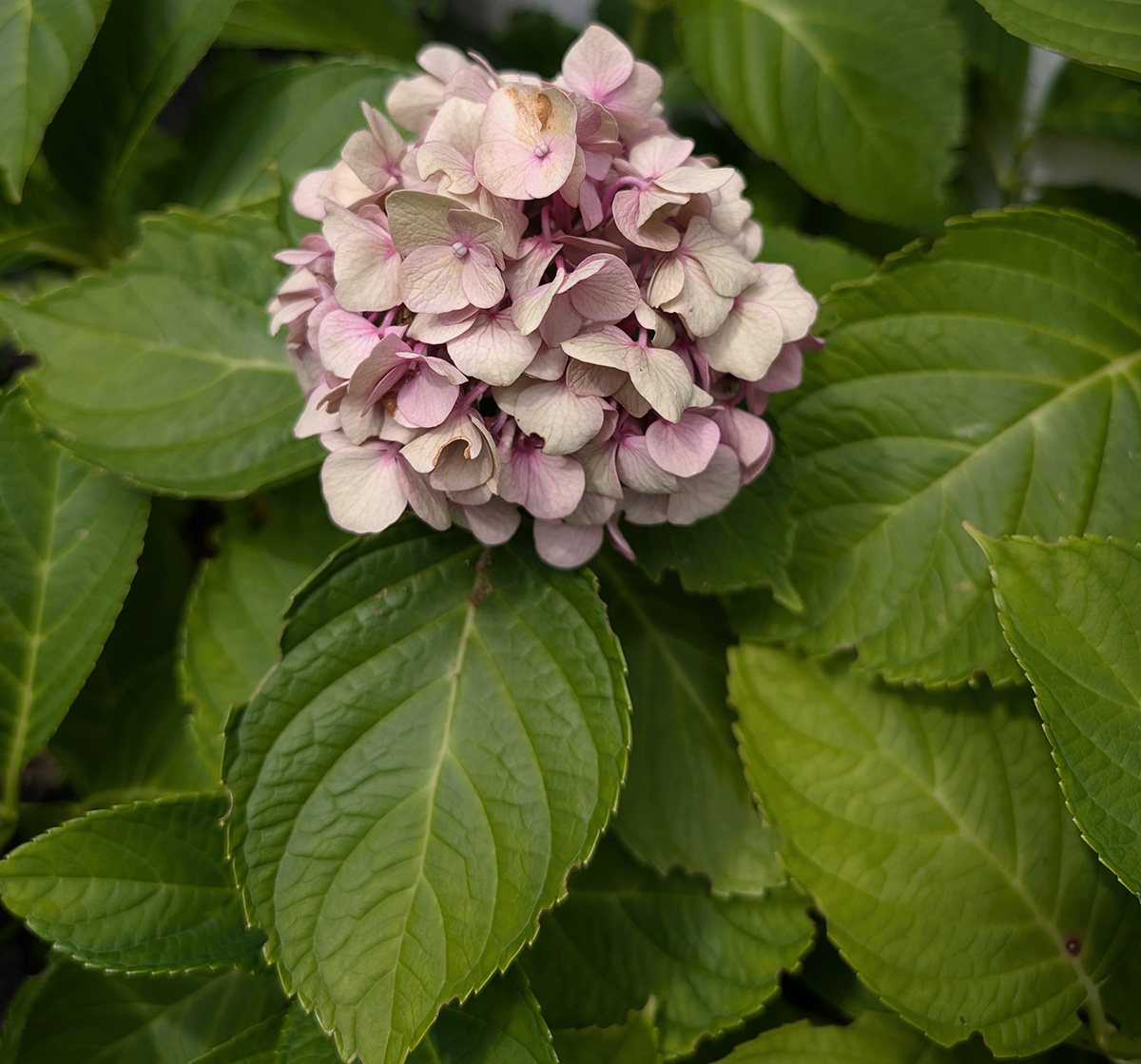
Hydrangea macrophylla
Taxonomy
Domain: Eukaryota
Kingdom: Plantae
Subkingdom: Tracheobionta
Superdivision: Spermatophyta
Division: Magnoliophyta
Class: Magnoliopsida
Clade: Eudicots
Clade: Asterids
Order: Cornales
Family: Hydrangeaceae
Genus: Hydrangea
Species: Hydrangea macrophylla
Common Names by Region
- United States / Canada: Bigleaf hydrangea, French hydrangea, mophead hydrangea, hortensia
- United Kingdom / Ireland: Hortensia, common hydrangea
- Japan (native range): Ajisai (紫陽花) — a long-cultivated and culturally significant garden plant
- Continental Europe: Hortensia and local-language equivalents; long a staple of French and Dutch nursery breeding
Description
Quick ID
- Growth form: Rounded, multi-stemmed deciduous shrub, 3–6 feet tall and wide, on stout stems. Reads as a classic foundation or border shrub.
- Flowers: Borne in large, dense, rounded heads (corymbs) at the stem tips. This is the mophead (Hortensia) form — a full globe of showy florets. Each “flower” shows four broad, petal-like sepals around a tiny true flower; the sepals are the color, not petals.
- Color: In the transitional pink-to-mauve range here, with parchment fade and light browning on the older florets. H. macrophylla is the famous color-changer: blue in acidic soil (available aluminum), pink in alkaline soil, with mauve and purple in between. The color is a readout of soil chemistry as much as cultivar.
- Leaves: Large, opposite, glossy, thick, oval, with coarsely toothed (serrated) margins and a pointed tip. The “macrophylla” — big leaf — is diagnostic.
- Distinguishing note: No flat lacecap ring here; the fully filled globe marks it as the mophead type.
Blooming
- Early summer into fall. This photo dates to August 22, catching a head that’s been open a while and beginning to age — the parchment tones and spot browning are late-bloom character, not disease.
Look-alikes
- Lacecap hydrangea (H. macrophylla, lacecap group): Same species, but a flat ring of showy florets around a center of tiny fertile ones — not a filled dome.
- Mountain hydrangea (H. serrata): Very similar but smaller and hardier, with narrower leaves; often lacecap.
- Smooth hydrangea (H. arborescens, e.g. ‘Annabelle’): Native, with white heads and thinner, matte, heart-based leaves — no pink/blue color shift.
- Panicle hydrangea (H. paniculata): Cone-shaped (not rounded) white-to-pink heads on a larger, later-blooming shrub.
Known Range
- Native: Japan and coastal eastern Asia, in woodland edges and moist, sheltered ground.
- In cultivation: One of the most widely planted ornamental shrubs in the temperate world. Common across the United States, including as a foundation and border planting throughout Pennsylvania. Reliably hardy here, though the flower buds — set on old wood — can be lost to hard late frosts, which is the usual reason a plant grows well but fails to bloom.
Care / Habitat
Light
- Morning sun with afternoon shade is ideal. Full sun scorches the foliage and wilts the heads in summer heat; deep shade cuts flowering.
Soil
- Moist, rich, well-drained ground high in organic matter. Soil pH sets the flower color: acidic (low pH) → blue, alkaline (high pH) → pink. Gardeners shift it with soil amendments (aluminum sulfate for blue, lime for pink).
Water
- Consistent moisture. The name comes from the Greek for “water vessel,” and the plant means it — it wilts fast when dry and wants steady watering through heat. Mulch to hold moisture.
Typical Habitat (when cultivated)
- Sheltered beds, foundation plantings, shaded borders, and courtyards — moist, protected, part-shade sites out of harsh afternoon sun and drying wind.
Propagation / Reproduction
- Softwood or hardwood cuttings root readily — the standard way to increase a named plant true to type.
- Layering works well: pin a low stem to the ground and it roots where it touches.
- Division of established clumps in spring or fall.
- Seed is possible but slow and won’t come true from cultivars.
Pests / Diseases / Threats
- No blooms despite healthy growth is the classic complaint — usually old-wood flower buds killed by late frost or lost to poorly timed pruning, not a pest.
- Powdery mildew, leaf spot, and botrytis show up in humid, crowded, or overhead-watered conditions.
- Aphids, spider mites, and scale turn up; damage is usually cosmetic.
- Toxicity note: All parts contain cyanogenic compounds and are toxic if eaten — worth flagging for households with pets or small children.
Additional Notes
Ecology & Use
- The showy mophead florets are sterile — bred for display, they offer little to pollinators. Lacecap and native species carry the real pollinator value in this genus; the fertile florets of a lacecap draw bees and hoverflies far better than a mophead globe.
- A premier cut and dried flower. Cut mature heads late in the season and they dry to lasting muted tones — the parchment shades already starting here.
- The color-change trick makes it a standing garden science demonstration: the same plant, different soil, different color.
- Prune on the right wood. Most bigleaf types bloom on old wood (last year’s stems), so prune right after flowering, not in spring — spring pruning cuts off the coming season’s buds. (Reblooming lines like the Endless Summer series flower on both old and new wood and are more forgiving.)
Management
- Want blue? Acidify the soil. Want pink? Sweeten it with lime. Mauve sits in between.
- Want reliable bloom? Site it out of frost pockets, prune just after flowering, and keep it evenly watered.
Views: 213