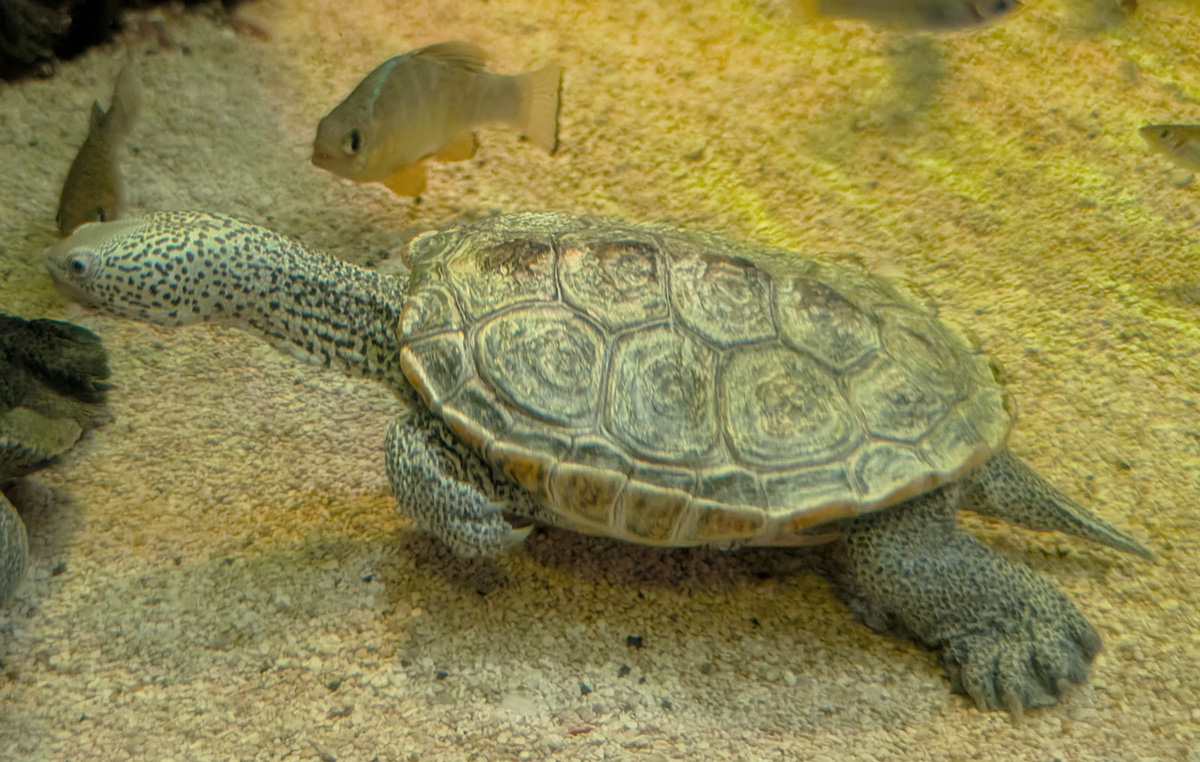
Malaclemys terrapin
Taxonomy
- Domain: Eukaryota
- Kingdom: Animalia
- Phylum: Chordata
- Class: Reptilia
- Order: Testudines
- Suborder: Cryptodira
- Family: Emydidae
- Subfamily: Deirochelyinae
- Genus: Malaclemys
- Species: Malaclemys terrapin
Common Names by Region
- United States (Atlantic & Gulf coasts): Diamondback terrapin, diamond-backed terrapin
- Regional / historical: Salt marsh terrapin, tidewater terrapin; the name terrapin itself comes from an Algonquian word for the animal
- Aquarium / exhibit trade: Diamondback terrapin
Description
Quick ID
- Skin: Pale gray to bluish-white, stippled all over with fine black flecks and spots — the diagnostic marking. No other North American turtle wears this peppered-skin pattern.
- Carapace: Ridged, gray-brown to nearly black, each scute stamped with concentric, diamond-shaped growth rings — the source of the common name.
- Head: Broad, with a pale, dark-spotted face and a light “mustache” marking on some individuals. Strong crushing jaws for hard-shelled prey.
- Size / sex: Marked sexual dimorphism — females are much larger (to ~9 in. shell) with broad heads; males stay small (~5 in.).
- Feet: Strongly webbed for a life spent swimming in tidal water.
Range
- Coastal eastern and southern United States, from Cape Cod south around Florida and west along the Gulf to Texas — a narrow ribbon following the salt marshes of the Atlantic and Gulf coasts. Several regional subspecies are recognized across that span.
Habitat & Behavior
- The brackish-water specialist. The diamondback terrapin is the only North American turtle that lives exclusively in brackish water — salt marshes, tidal creeks, estuaries, and lagoons. Not freshwater, not open ocean, but the tidal in-between.
- Salt physiology: It manages the salt load with specialized lachrymal (tear) glands that shed excess salt, and it will seek out fresher water to drink, including sipping the freshwater lens off the surface after rain.
- Basks on mudflats and marsh banks, forages on the falling and rising tide, and burrows into the mud to overwinter through the cold months.
Diet
- Carnivorous, built for hard-shelled marsh prey: periwinkle snails, marsh crabs, mussels, clams, and small fish. The heavy jaws crush shells that most predators can’t.
- Ecologically important as a check on marsh snail populations that, unchecked, can overgraze cordgrass and degrade the marsh itself.
Reproduction
- Nests in early to mid-summer, females coming ashore to dig in sandy dune and upland edges above the tide line.
- Lays clutches of roughly 4–18 eggs; incubation runs a couple of months.
- Temperature-dependent sex determination — warmer nests skew female, cooler nests male, a trait that ties the species’ future to a warming, shifting coastline.
- Slow to mature and long-lived, which makes population recovery slow once a local stock is knocked back.
Pests / Threats / Conservation
- Crab-pot bycatch is a leading modern threat — terrapins enter submerged crab traps to feed and drown. Bycatch reduction devices (BRDs) fitted to trap openings are the standard fix.
- Road mortality of nesting females crossing coastal roads, and loss of nesting habitat to bulkheads, development, and sea-level rise.
- Historical food trade: terrapin stew was a prized delicacy into the early 20th century, and commercial harvest crashed populations coast-wide before it faded.
- Listed as a species of conservation concern across much of its range; regional status varies from stable to threatened.
Additional Notes
Ecology & Significance
- A flagship species for salt-marsh health. Because it depends on intact tidal marsh across its whole life cycle, the terrapin’s presence is a working indicator of a functioning estuary.
- Its niche is genuinely singular among North American turtles — the only one to have committed fully to brackish water, sitting in the ecological seam between the freshwater emydids it descends from and the marine sea turtles.
- The state reptile of Maryland, and the long-standing mascot of its state university — a rare case of a marsh turtle carrying real cultural weight.
In Exhibits
- Kept in public aquariums in salt or brackish setups rather than standard freshwater tanks, often alongside estuarine fish — the mixed-species exhibit context of this photograph. Their salt requirement makes them a specialist husbandry animal, not a casual pet.
Open Reference / Educational Use (CF Standard)
This profile is provided for open educational reference, field identification support, and art/illustration reference in the spirit of the Cernunnos Foundation field guide project. Reuse is encouraged with attribution to CF and your on-site page as the source.
Views: 190