
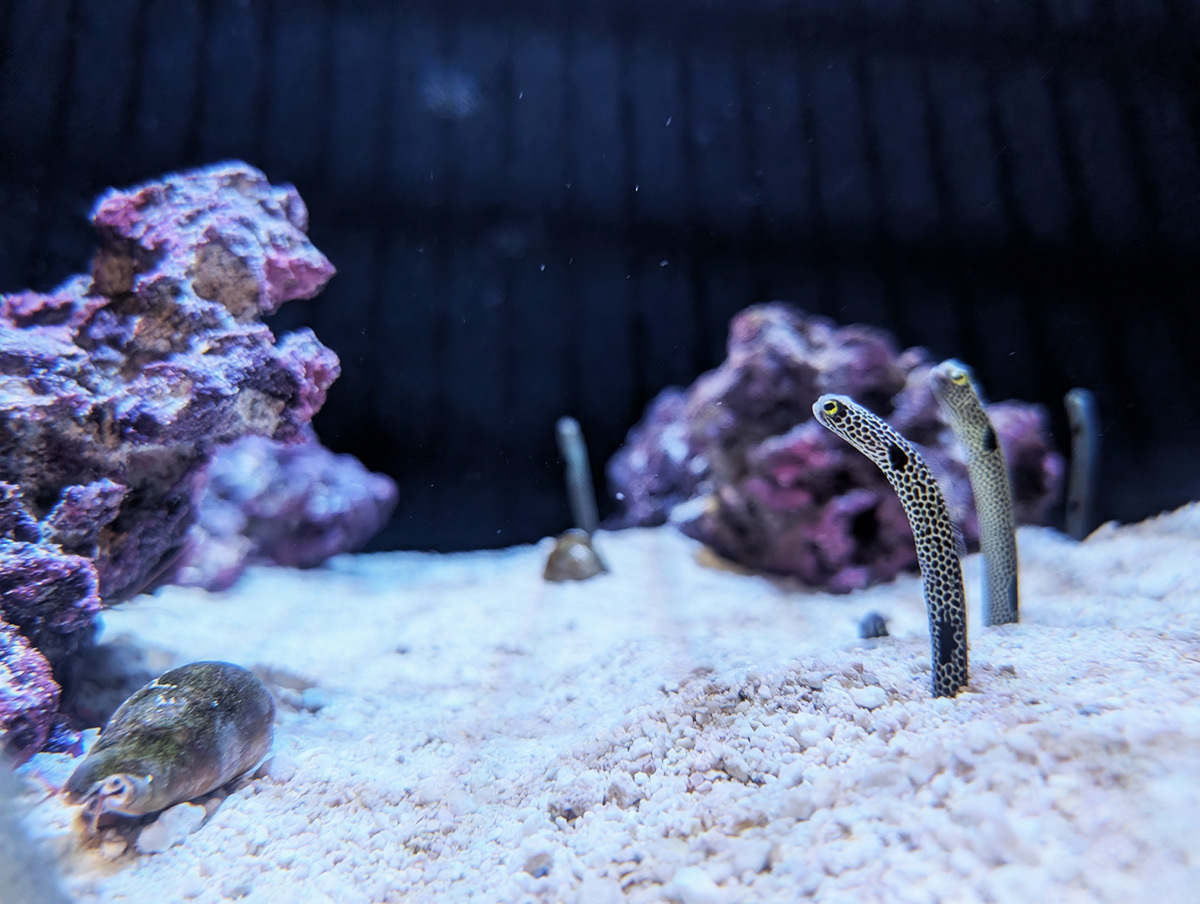
General Appearance
Heteroconger hassi is a slender, elongated marine eel that spends virtually its entire adult life with the rear two-thirds of its body anchored vertically in a sandy seafloor burrow, the forward portion extended upright into the water column to feed on passing zooplankton. At rest — which is to say, at work — a colony of spotted garden eels presents one of the more surreal spectacles available to a reef diver: dozens to hundreds of pale, spotted tubes rising from open sand, all swaying gently in the current, all oriented into the flow, all retracted simultaneously when approached. The effect is of a field of periscopes operated by creatures that have collectively decided the surface world is not worth the risk.
Up close, the body is smooth, cylindrical, and tapered at both ends, with a blunt, slightly upturned snout, prominent yellow-ringed eyes positioned well forward on the head, and a continuous dorsal fin running most of the body length. Coloration is pale cream to white with a regular pattern of dark brown to black spots, the largest of which form a distinctive mid-lateral stripe. The overall impression is of something that has been solving the same problem — how to eat while remaining mostly buried — for a very long time, and has arrived at an arrangement it finds satisfactory.
Size
Total Length: 35–40 cm (14–16 inches) Body Diameter: 1–1.5 cm at widest point Burrowing Depth: Up to 40 cm of body typically anchored below substrate
The visible portion above the substrate varies considerably with threat level, current strength, and feeding activity. A fully extended, relaxed animal in good current may expose 15–20 cm of body. The same animal at the approach of a diver may be fully retracted in under two seconds.
Coloration and Markings
The base color is white to cream, covered in a regular pattern of dark brown to black spots of varying size. Three particularly large, oval black patches occur consistently — one on the gill region, one approximately mid-body, and one near the anal fin — and serve as a reliable identification feature distinguishing this species from similar congeners. The eyes are striking in close view: large, yellow-irised, and forward-facing enough to give the head an alert, slightly quizzical expression that photographs well and reads as oddly personable for an animal that is mostly a tube.
Quick ID
Native Range
Heteroconger hassi ranges across the Indo-Pacific, from the Red Sea and East Africa east through the Indian Ocean, throughout Southeast Asia and the Coral Triangle, north to southern Japan, and east across the Pacific to the islands of Micronesia and Polynesia. It is one of the most widely distributed garden eels in the world and the species most likely to be encountered by divers across the tropical Indo-Pacific reef zone.
Habitat
Open sandy substrates adjacent to coral reefs, typically at depths of 7–45 meters, in areas with consistent moderate to strong current. Colonial aggregations may number from a few dozen to several hundred individuals and can occupy sandy patches of considerable size. The species does not occur on the reef itself — it requires open, unobstructed sand with sufficient depth for full burrow construction and reliable planktonic food delivery via current.
Habitat: Open sandy seafloor adjacent to coral reef, 7–45 m depth, in areas of consistent current Activity: Diurnal; retracted and inactive at night Social: Highly colonial
Heteroconger hassi is among the most thoroughly sedentary vertebrates on the reef. Each individual constructs and maintains a mucus-lined burrow in the sand substrate, into which it retreats tail-first at any perceived threat and in which it spends the night. The burrow is a permanent residence — garden eels do not relocate casually, and a colony occupying a given sandy patch may persist in that location for years.
Feeding occurs entirely from the burrow. The eel extends its body into the water column and intercepts zooplankton — copepods, small crustacean larvae, fish eggs, and similar items — carried past by the prevailing current. All individuals in a colony orient into the current simultaneously, producing the characteristic synchronized swaying that defines the colony’s appearance. When a threat approaches, individuals retract progressively as the disturbance nears, creating a wave of disappearance that moves through the colony ahead of the approaching diver, predator, or surge.
Reproduction in garden eels involves a behavioral complexity unusual for such apparently limited animals. Males and females in adjacent burrows court by extending toward each other and eventually intertwining the forward portions of their bodies above the substrate — the longest physical contact most of them will ever have with another individual. Fertilized eggs are released into the water column and develop as pelagic larvae before settling and establishing new burrows.
Diet
Diet Type: Carnivore; planktivore
Heteroconger hassi feeds exclusively on zooplankton intercepted from the water column while anchored in its burrow. No active pursuit of prey occurs. The eel is entirely dependent on current to deliver food and on the density of the local planktonic community to sustain it. This dietary constraint explains the species’ strict habitat requirement for current-exposed open sand — a sheltered, calm sandy bottom, however otherwise suitable, provides nothing to eat.
Breeding Season: Not seasonally restricted in tropical range Fertilization: External; pelagic egg and larval development Parental Care: None following egg release
Courtship involves neighboring males and females extending from their burrows and physically intertwining in the water column — behavior that requires both individuals to remain partially exposed during a period of elevated vulnerability. Pair bonds appear to form between consistent neighbors. Eggs are released into open water and develop as planktonic larvae, which settle to suitable sandy substrates and begin burrow construction upon metamorphosis. Sexual maturity is reached after one to two years. Lifespan in the wild is estimated at 35–40 years — a remarkable figure for an animal of this size, and consistent with the generally extended lifespans of sedentary, low-metabolism reef animals.
Conservation Status: Least Concern (IUCN)
Primary threats are habitat-related: sedimentation and physical disturbance of sandy substrates adjacent to reefs, destructive fishing practices including bottom trawling and blast fishing, and reef degradation that reduces the planktonic productivity on which the species depends. Garden eels are not targeted by commercial fisheries but are collected for the marine aquarium trade, where they are notoriously difficult to maintain — captive individuals rarely feed successfully and typically decline over months. The ethical case for wild collection is weak. Natural predators include various reef fish species and, occasionally, octopus.
Not recommended for home aquarium keeping despite the species’ availability in the trade. Heteroconger hassi requires a very deep, fine sand substrate — at minimum 50 cm — unobstructed open space above the substrate, consistent gentle current, a reliable supply of live or frozen zooplankton delivered directly to the animals by current simulation, and the near-complete absence of disturbance. Even under optimal conditions, captive garden eels are highly stress-prone and frequently refuse to feed. Experienced marine aquarists with purpose-built systems have achieved long-term success, but this is the exception. The species is best observed in the wild, where it thrives without intervention and where a colony at full extension in good current is one of the genuinely memorable sights available on a coral reef.
The genus name Heteroconger derives from Greek roots meaning “different” and “conger eel,” distinguishing this group from the true conger eels of the family Congridae to which they nonetheless belong. The species epithet hassi honors Hans Hass, the Austrian marine biologist and pioneering underwater filmmaker whose expeditions to the Red Sea and Indo-Pacific in the 1940s and 1950s produced some of the earliest systematic documentation of coral reef ecology and brought reef life to a broad public audience for the first time. It is a fitting tribute — Hass was among the first people to see and describe these animals alive in their natural habitat, and the eel named for him has since become one of the most photographed and recognized residents of the Indo-Pacific reef flat.
The colony behavior — the synchronized swaying, the wave of retraction preceding a diver’s approach, the long-distance courtship between burrow-bound neighbors — has made garden eels a recurring subject of behavioral ecology research and a favorite of underwater photographers. The image of a sandy flat populated by dozens of attentive, spotted tubes, all turned into the current, all watching the world go by from their permanent addresses, is one that tends to stay with people.
Field Notes (CF Observation)
Photographed in what appears to be a well-maintained marine aquarium setting — white fine-grain sand substrate, live rock with coralline algae growth, dark background consistent with controlled lighting. Two individuals clearly visible in the foreground, both extended to moderate height from their burrows, both oriented similarly and alert. The spotted patterning and distinctive yellow-irised eyes are visible on the nearer individual. A third individual is partially visible in the background. A small gastropod snail is visible in the left foreground, and a second snail or hermit crab visible at the lower left — typical reef cleanup crew members in a maintained system. Tube-like structures visible rising from the sand in the background are consistent with additional garden eel burrow openings or possibly small worm tubes.
The animals appear healthy and in appropriate posture for a colony in moderate current. The aquarium setting, while noted, represents a well-constructed habitat for this challenging species. Identification as Heteroconger hassi is consistent with the spotting pattern, the three characteristic large oval patches visible on the nearer individual, and the body proportions and coloration of both animals.
All images and written content published on this site are provided freely for educational and artistic use. Attribution appreciated but not required. Knowledge grows when shared.