
Kingdom: Plantae
Clade: Angiosperms
Clade: Eudicots
Order: Asterales
Family: Asteraceae
Genus: Cosmos
Species: Cosmos caudatus Kunth
General: Ulam Raja, King’s Salad
Southeast Asia: Ulam Raja (Malaysia, Indonesia)
English (Horticulture / Culinary): Wild Cosmos, King’s Cosmos
Traditional Use: Salad Cosmos
Cosmos caudatus is a tall, fast-growing annual herbaceous plant with a loose, branching habit and finely divided, aromatic foliage. Plants commonly reach 3–6 feet in height, often leaning or weaving gently through surrounding vegetation rather than standing rigidly upright.
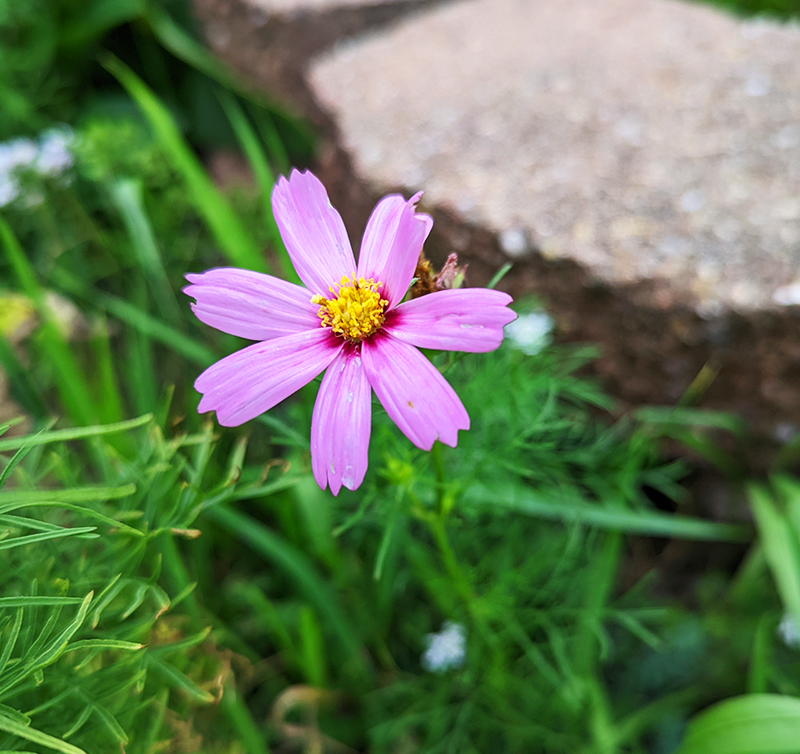
The flowers are daisy-like, with narrow to moderately broad ray petals ranging from soft pink to deeper rose-purple, surrounding a bright yellow central disk. Compared to ornamental cosmos, the blooms are simpler and less uniform, emphasizing function and vitality over symmetry.
The foliage is pinnately divided and distinctly fragrant when crushed, with a sharper, more herbal scent than Cosmos bipinnatus. Leaves are edible and have been used traditionally as a fresh green.
Native to: Mexico and Central America
Widely cultivated and naturalized in: Southeast Asia and tropical regions worldwide
Habitat:
Cosmos caudatus thrives in heat and full sun and tolerates poor soils exceptionally well. Excess fertility produces lush foliage at the expense of flowers.
Its open growth habit allows light penetration and movement, supporting diverse understory species.
Unlike many ornamental cosmos, Cosmos caudatus is edible.
The plant is valued as much for nourishment as for beauty.
Light: Full sun
Soil: Well-drained; tolerant of low fertility
Water: Moderate; drought-tolerant once established
Maintenance:
Landscape Use:
Cosmos caudatus responds poorly to over-management. Heavy fertilization, frequent pruning, or rigid spacing disrupt its natural form and reduce flowering.
It prefers room to lean, wander, and intermingle.
Cosmos caudatus blurs boundaries.
It is food and flower.
Wild and intentional.
Useful without being optimized.
It does not ask to be improved — only allowed to grow.
In a world that insists every system justify itself through yield or control, Cosmos caudatus offers a gentler argument:
that usefulness and beauty can coexist,
and that resilience sometimes smells like green leaves and warm sun.