
Kingdom: Plantae
Clade: Tracheophytes
Clade: Angiosperms
Clade: Eudicots
Order: Rosales
Family: Rosaceae
Subfamily: Rosoideae
Tribe: Roseae
Genus: Rosa
Species: Rosa setigera
Climbing Rose
Prairie Rose
Climbing Wild Rose
Illinois Rose
Setigera Rose
Rosa setigera is a native climbing or scrambling wild rose known for its long arching canes, hooked prickles, and open pink flowers. Unlike many shrubby wild roses, this species readily climbs through surrounding vegetation, hedgerows, fence lines, and woodland edges, sometimes reaching impressive lengths when supported by neighboring plants.
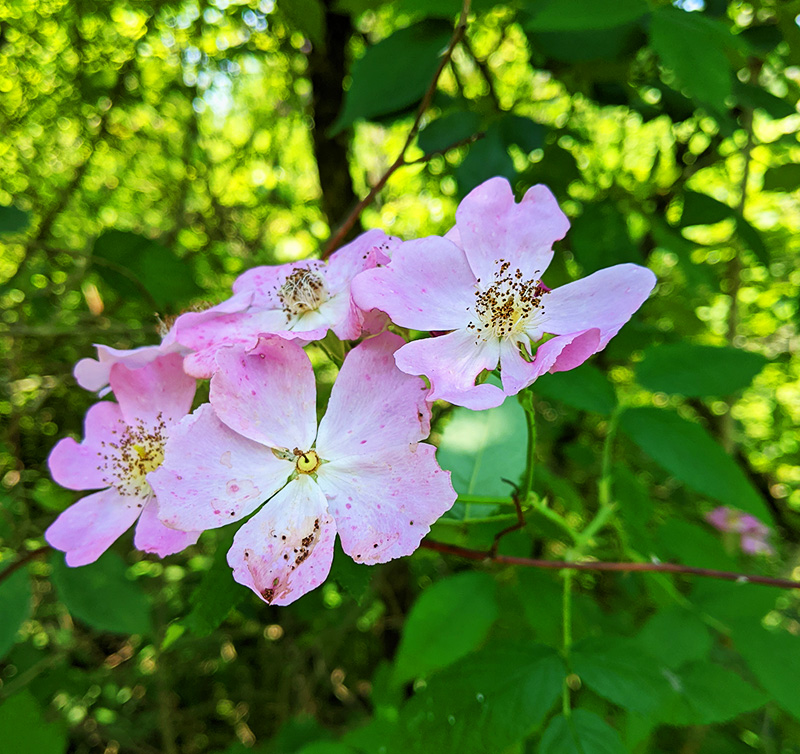
The flowers are typically soft pink to rose-pink with five broad petals, a pale center, and a cluster of yellow stamens. Blooms are usually borne in loose clusters and are often larger and more open-faced than those of many other native roses. Individual flowers have a light, pleasant fragrance, though usually not as strong as heavily bred ornamental roses.
Leaves are compound, usually with three to five leaflets, though sometimes more may occur. Leaflets are oval to lance-shaped with serrated edges. The canes are long, flexible, and armed with curved prickles that help the plant hook into surrounding growth rather than stand fully upright on its own.
This species is best understood as a scrambler rather than a true vine. It climbs by leaning, catching, and sprawling through nearby shrubs and small trees. In the right setting it forms dense, thorny tangles that provide excellent shelter for wildlife.
Rosa setigera is native to eastern and central North America. Its natural range includes much of the Midwest, lower Great Lakes region, and portions of the eastern United States, extending into parts of the South and lower Plains.
It is especially associated with:
In the wild, climbing rose prefers:
It is highly suited to:
It tolerates a range of soils but performs best where it gets plenty of light and some structural support from nearby vegetation.
Rosa setigera reproduces by:
Its flowers attract pollinators, and after blooming it produces rose hips that may be eaten and dispersed by wildlife. As with many roses, seed germination may improve after cold stratification.
Like other wild and cultivated roses, this species may be affected by:
In natural conditions it is generally resilient, though dense shade and poor air movement can increase fungal issues. Habitat clearing and removal of hedgerows reduce the places where it naturally thrives.
Rosa setigera is one of the few North American native roses with a distinctly climbing habit. That alone makes it stand out in the field. Where many roses remain shrubs, this one reaches outward and upward, weaving itself into the surrounding landscape.
It has considerable ecological value:
It also carries the rough, half-wild elegance that makes native roses so appealing: beautiful blooms paired with a tough, protective growth form that clearly belongs to the edge between field and forest.
If used in a managed landscape, this species benefits from:
It is best treated as a structural native edge plant rather than a tightly controlled formal rose.