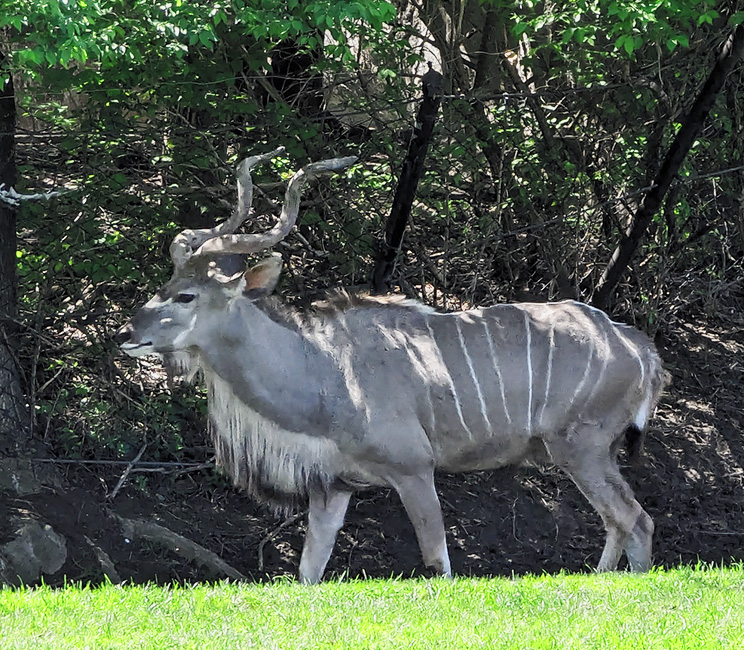
Tragelaphus strepsiceros
Taxonomy
- Domain: Eukaryota
- Kingdom: Animalia
- Phylum: Chordata
- Class: Mammalia
- Order: Artiodactyla
- Family: Bovidae
- Subfamily: Bovinae
- Tribe: Tragelaphini
- Genus: Tragelaphus
- Species: Tragelaphus strepsiceros
Common Names by Region
- United States / exhibit trade: Greater kudu, kudu
- Southern Africa (native range): Koedoe (Afrikaans); iqude and related names across Bantu languages
- General: Greater kudu (to distinguish it from the smaller lesser kudu, Tragelaphus imberbis)
Description
Quick ID
- Horns (males only): Long, spectacular, open corkscrew spirals — the signature feature. A mature bull’s horns carry two and a half twists and, straightened, are among the longest of any antelope. Females are hornless.
- Coat: Gray-brown to reddish (bulls grayer, cows more tawny), marked with 6–10 thin white vertical stripes down the body.
- Face: A distinct white chevron between the eyes, with white cheek spots.
- Throat / crest: Bulls carry a pronounced throat mane and dewlap fringe and a crest of hair along the spine — both visible here.
- Size: A large antelope — bulls stand around 5 feet at the shoulder and can exceed 600 pounds, considerably bigger than cows.
- Ears: Large, rounded, and mobile — acute hearing is a primary defense.
Range
- Native to eastern and southern Africa, across a wide band of savanna woodland, hills, and scrub — from Chad and the Horn of Africa south through East Africa to South Africa and Namibia.
Habitat & Behavior
- A browser of woodland, thicket, and broken hilly country rather than open plains — it uses cover, not distance, to stay safe.
- Camouflage and stillness first: its striped gray coat blends into brushy shade, and a startled kudu often freezes rather than bolts. When it does run, it’s a powerful jumper, clearing high fences with ease.
- Social structure: cows and calves form small herds; bulls are more solitary or form loose bachelor groups, joining females mainly in the breeding season.
- Crepuscular — most active in the cooler hours of morning and evening.
- Bulls spar by interlocking horns in dominance contests; the spirals occasionally lock so tightly that rival bulls can’t separate, a known and sometimes fatal risk.
Diet
- Browser, not a grazer. Feeds on leaves, shoots, forbs, flowers, fruit, and seed pods from a wide range of trees and shrubs, taking some grass in the wet season.
- Its browsing breadth lets it use dry, marginal country where grazers struggle, and it can go long periods getting most of its water from food.
Reproduction
- Typically a single calf after a gestation of around eight to nine months, often timed to the wet season when browse is richest.
- The cow hides the newborn calf in vegetation for its first weeks, visiting to nurse — a “lying-out” strategy common to woodland antelope — before it joins the herd.
- Bulls take several years to reach the full horn development that signals prime breeding age.
Threats / Conservation / Notes
- Overall classified as Least Concern — widespread and reasonably numerous — but populations are patchy and locally reduced by habitat loss, hunting, and disease.
- Rinderpest historically devastated kudu in parts of their range, and they remain susceptible to some livestock diseases.
- Heavily featured in trophy hunting and game-ranching economies in southern Africa, which cuts both ways — pressure in some areas, funded habitat and population maintenance in others.
Additional Notes
Ecology & Significance
- One of the iconic spiral-horned antelopes of Africa, and a member of the tribe Tragelaphini that includes the bushbuck, nyala, bongo, and eland — the striped, spiral-horned browsers.
- Those horns are pure sexual selection: carried only by bulls, used in display and in horn-wrestling contests, and a running advertisement of a male’s age and fitness.
- A well-known example of defense through concealment over speed — a big antelope that would rather vanish into the brush than outrun a predator, its stripes and stillness doing the work.
- Culturally prominent across its range and a favorite of wildlife photographers and hunters alike, the greater kudu is often called one of the most handsome of all antelope.
In Exhibits
- Kept in spacious, well-fenced browse enclosures in zoos and safari parks — the grassy, tree-backed setting here. Their fence-jumping ability means enclosures need real height. Calm and browse-fed in captivity, bulls like this one are popular display animals for exactly the reason he stops the eye: those horns.
All Cernunnos Foundation materials are free to use for any educational purpose.
Views: 260