
Kingdom: Animalia
Phylum: Chordata
Class: Mammalia
Order: Primates
Family: Hominidae
Genus: Gorilla
Species: Gorilla gorilla
Subspecies: Gorilla gorilla gorilla (Savage, 1847)
Western Lowland Gorilla — international / scientific use
Lowland Gorilla — common shorthand in zoological collections
Gorille des plaines de l’ouest — French, used across most of the range states (Cameroon, Gabon, Republic of Congo, Central African Republic)
Gorila occidental de llanura — Spanish, Equatorial Guinea
The western lowland gorilla is the smallest of the four recognized gorilla subspecies and by a wide margin the most numerous. It is also the gorilla nearly everyone has actually seen: almost every gorilla in a zoological collection anywhere in the world belongs to this subspecies.
Adult males reach roughly 5 to 5.5 feet standing and commonly weigh 300 to 450 pounds. Females run smaller, around 4 to 4.5 feet and 150 to 250 pounds. Western animals carry a browner, grayer coat than the eastern subspecies and often show an auburn or rust-colored cap over the crown, which is one of the more reliable field marks separating them from eastern gorillas at a glance.
Broad, with a heavy supraorbital ridge and a wide, flattened nose. The sagittal crest — the ridge of bone along the midline of the skull that anchors the jaw muscles — develops with age and is far more pronounced in mature males, giving the adult head its distinctive peaked profile. Ears sit small and close.
The pattern of wrinkles on the bridge of the nose above the nostrils is unique to each animal and stable for life. Researchers and keepers use these nose prints to identify individuals the way one would use a fingerprint, and they remain the standard method of telling apart animals in wild study populations.
Barrel-chested and deep through the torso, with a substantial gut. Gorillas process an enormous daily volume of fibrous plant material, and the digestive tract is sized accordingly. Coat is coarse and covers the whole body except the face, ears, palms, soles, and chest. Mature males develop the saddle of silver-gray hair across the back and hips that gives the silverback its name, arriving somewhere around twelve to fifteen years of age.
The arms are longer than the legs and considerably more powerful, with an arm span exceeding standing height. Gorillas move on the ground as knuckle-walkers, bearing weight on the middle phalanges of the hand while the fingertips stay curled and protected. Thumbs are opposable, and the hands are dexterous enough for fine manipulation of food items — stripping a stem, peeling bark, turning a single piece of produce over to inspect it.
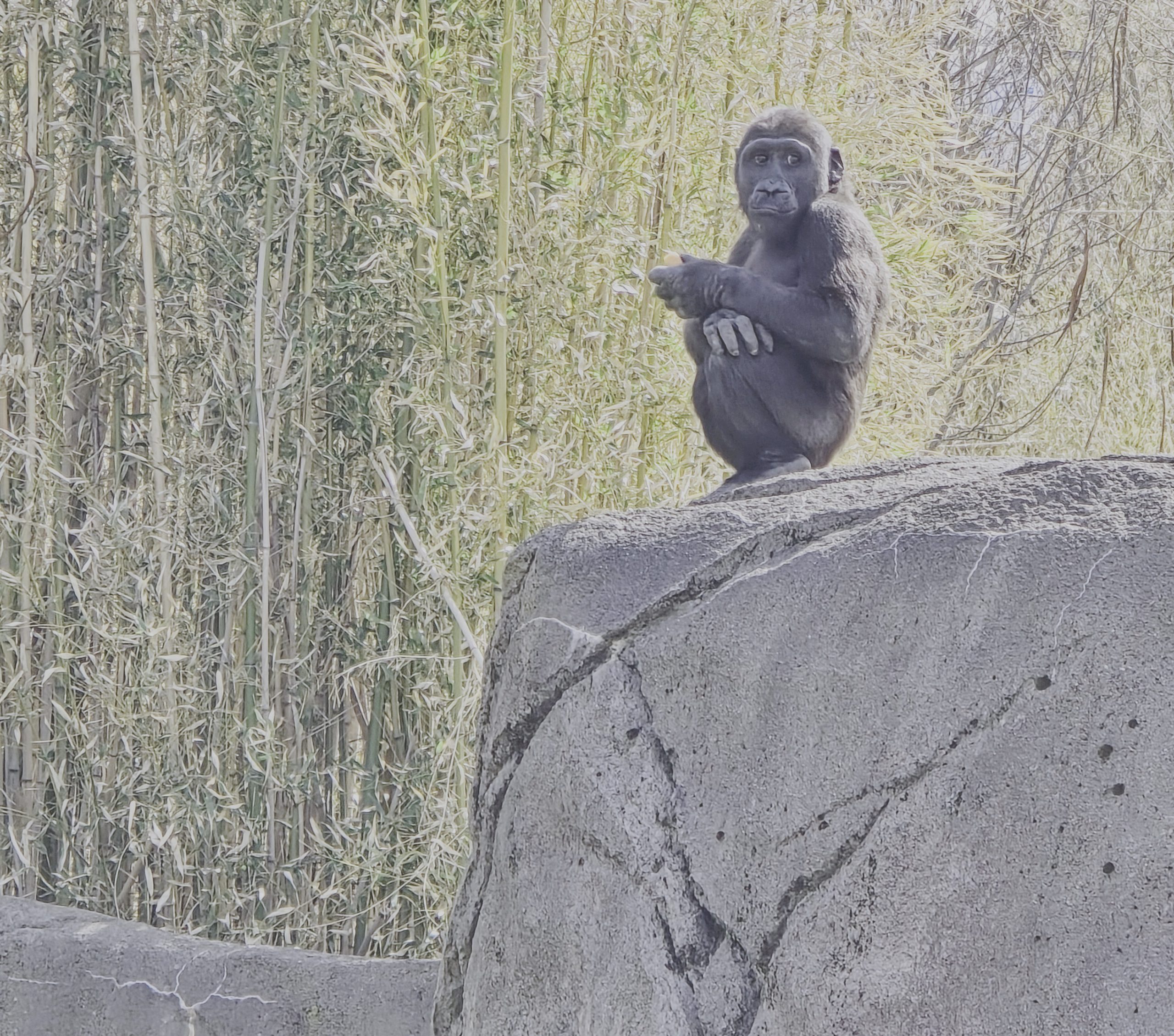
A juvenile, sitting upright on a rock outcrop with a food item held in one hand. Several features place the age:
Juveniles also climb more than adults do. Adult males spend the bulk of their time on the ground; the young and the females take to the vertical structure of a habitat far more readily, which is why elevated perches like this rock get used the way they do.
Native to the lowland tropical forests of west equatorial Africa, spanning Cameroon, Gabon, Equatorial Guinea, the Republic of the Congo, the Central African Republic, and the Angolan exclave of Cabinda. Populations formerly present in the far western Democratic Republic of the Congo are now considered likely extirpated.
The subspecies occupies a range roughly bounded by the Atlantic coast to the west and the Congo River system to the east. Of the four gorilla subspecies, western lowland gorillas hold the largest individual home ranges, a consequence of depending on seasonal fruit that forces the group to travel further to stay fed.
Preferred habitat is dense primary lowland rainforest, but the subspecies uses a considerably wider set of conditions than that suggests: swamp forest, riverine forest, secondary regrowth, forest edge and clearing, and abandoned agricultural ground reverting to bush. Open canopy suits them, because the herbs, shrubs, and vines they depend on grow best where light reaches the floor.
Groups gather at forest clearings known as bais — open, often swampy patches where mineral-rich sedges grow — which serve as feeding grounds and as one of the few places wild gorillas can be observed in the open.
Diet is predominantly herbivorous, with a strong fruit component when it is available:
Social structure is a stable group, usually a single mature silverback with several adult females and their offspring. The silverback makes the movement decisions, mediates disputes within the group, and handles defense. Displays of strength — chest-beating, charging, throwing, vocal roaring and hooting — resolve most conflicts without contact.
Nesting happens daily. Every animal old enough builds a fresh night nest from bent branches and leaves, and day nests get thrown together as ground cushions for rest periods. Nest counts at abandoned sites are a primary census method for surveying wild populations.
Gorillas are diurnal, with a typical day divided between a morning feeding period, a midday rest, an afternoon feeding period, and nest construction before dark.
In managed care, western lowland gorillas require substantial indoor and outdoor space with vertical structure, deep browse-based diets supplemented with produce and biscuit, and continuous social management. Troop composition is handled cooperatively across institutions rather than by any single facility.
Gestation runs roughly 8.5 months (about 250 to 260 days), producing a single infant in nearly all cases. Twins occur and are rare.
Infants weigh around four to five pounds at birth and are entirely dependent. They cling to the mother’s chest for the first several months, transition to riding on her back, and continue nursing into the third or fourth year. Weaning is gradual and the mother-offspring bond stays close well past it.
Females reach sexual maturity around 8 to 10 years and typically transfer out of their natal group to join another, a dispersal pattern that limits inbreeding. Males mature later, around 12 to 15 years, and generally leave to spend a period alone or in a bachelor group before attempting to establish a group of their own.
The interval between births averages about four years, one of the slowest reproductive rates among mammals. This is the central problem in gorilla conservation: a population reduced by hunting or disease recovers on a timescale measured in decades, and models suggest a severely depleted population needs the better part of a century to return to previous numbers even under complete protection.
Median life expectancy in managed populations runs roughly 32 years for males and 38 for females, with individuals reaching their fifties.
Listed as Critically Endangered by the IUCN. Western lowland gorillas number somewhere around 100,000 to 150,000 animals, and while that figure dwarfs the other subspecies — a few hundred Cross River gorillas, perhaps a thousand mountain gorillas — the trend line is what earns the listing.
Principal threats:
The combination of hunting pressure and disease outbreak in the same population is the scenario conservation planning treats as most dangerous, because either alone is survivable and the two together are not.
Photographed at: Pittsburgh Zoo & Aquarium, Tropical Forest Complex outdoor habitat, March 25, 2026. The bamboo stand behind the animal serves as both visual screening and browse.
Nearly every gorilla in human care worldwide belongs to this subspecies, and their placement is coordinated through the AZA Gorilla Species Survival Plan — a cooperative breeding program that manages the North American population as one genetic unit rather than as separate collections. Animals move between institutions on the SSP’s recommendation, which is why a familiar gorilla at a home zoo may relocate hundreds of miles and a new one arrive in exchange. Pittsburgh participated in exactly this kind of exchange in 2026, sending a young male born at the facility in 2018 to Boston’s Franklin Park Zoo and receiving an adult silverback in return.
Identification of the individual pictured has not been confirmed with the institution. Anyone reusing this profile for a named animal should verify with the zoo.
Gorillas make and use tools in the wild — modified branches to test water depth before crossing, and sticks to bridge soft ground. They share close to 98% of their DNA with humans, and they are the largest living primate on Earth.
This profile and associated imagery are released by the Cernunnos Foundation as part of its open knowledge initiative. Text and images may be used freely for educational, research, artistic, and reference purposes, with attribution appreciated but not required.
The goal of this archive is to expand public access to accurate natural history information and to support artists, educators, and students in exploring the remarkable diversity of life on Earth.