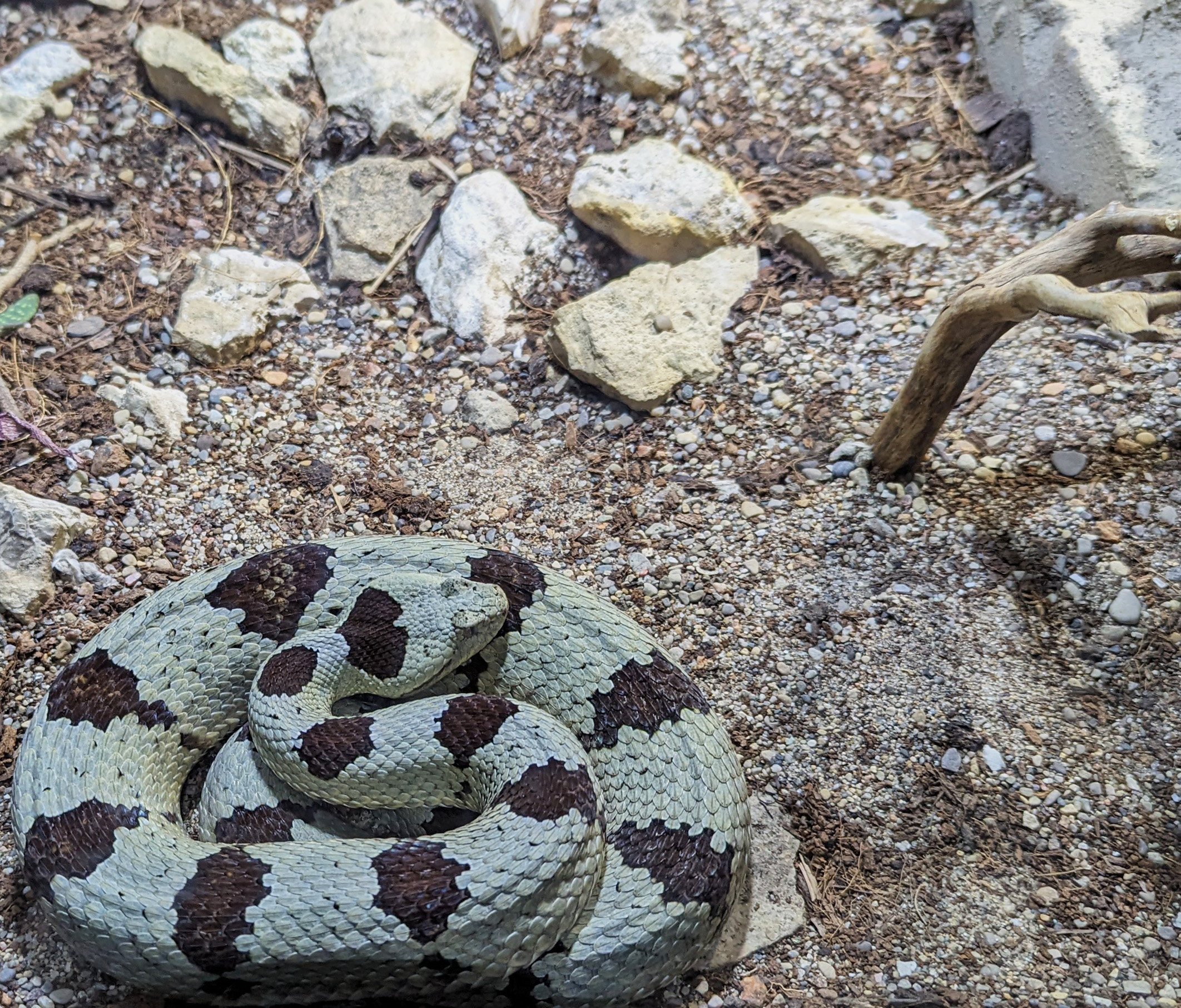
Crotalus Lepidus Klauberi
Taxonomy
- Domain: Eukaryota
- Kingdom: Animalia
- Phylum: Chordata
- Class: Reptilia
- Order: Squamata
- Suborder: Serpentes
- Family: Viperidae
- Subfamily: Crotalinae
- Genus: Crotalus
- Species: Crotalus lepidus
- Subspecies: Crotalus lepidus klauberi (Gloyd, 1936)
Common Names by Region
- United States (southwest): Banded rock rattlesnake, rock rattlesnake, green rattlesnake, green rock rattlesnake, blue rattlesnake
- Texas / El Paso region: Rock rattler; the pale Franklin Mountains animals are known locally by their silver appearance
- Mexico (native range): Víbora de las rocas, cascabel de las rocas — regional variants referencing rock habitat
- Herpetoculture: “Klauberi,” used as a standalone name to distinguish it from the mottled rock rattlesnake (C. l. lepidus) in collections
- Etymology: Crotalus from the Greek krotalon, a rattle. Lepidus is Latin for neat or elegant. The subspecies epithet honors Laurence M. Klauber, whose two-volume rattlesnake monograph remains the foundation of the field.
Description
Quick ID
- Size: Small for a rattlesnake. Adults rarely exceed 61 cm (24 in) total length; the species maximum is roughly 84 cm. An adult is a snake you could coil in two cupped hands.
- Pattern: Clean, well-defined dark crossbands on a pale ground, with the interspaces essentially unmarked. This is the working field character separating klauberi from the mottled rock rattlesnake, whose interspaces carry heavy grey speckling.
- Ground color: Highly variable and matched to local rock. Limestone populations run pale grey to silver; higher-elevation animals run darker; some localities produce green, blue-grey, pink, or nearly purple ground color. The animal in this photo shows a pale grey-green ground against chocolate-brown bands.
- Sexual dichromatism: Males frequently carry an olive or green cast; females tend grey. Useful as a hint, unreliable alone — locality affects color more than sex does.
- Head: Broad, triangular, distinctly wider than the neck. Loreal pit between eye and nostril on each side — the heat-sensing organ that defines the pitvipers. Vertical pupil.
- Rattle: Present but proportionally small, and easily hidden inside a resting coil, as here.
- Body: Stout for its length, with strongly keeled scales giving a matte, granular surface rather than a gloss.
Look-alikes
- Mottled rock rattlesnake (C. l. lepidus): Overlapping range in west Texas and southern New Mexico. Speckled interspaces, often pinkish in the Davis Mountains. The two are close enough that scale counts, band counts, and eye-stripe characters all produce exceptions, and whether they intergrade where ranges meet is not settled.
- Twin-spotted and ridge-nosed rattlesnakes (C. pricei, C. willardi): Share the same sky-island mountains. C. pricei carries paired dorsal blotches rather than full crossbands; C. willardi has a raised ridge along the snout.
- Tamaulipan rock rattlesnake (C. morulus): Formerly ranked as a subspecies of C. lepidus, now generally treated as a full species. Northeastern Mexico only.
Range
- United States: Southeastern Arizona, southern New Mexico, and west Texas — concentrated in the isolated mountain ranges rather than the desert floor between them.
- Mexico: Chihuahua, Coahuila, Sonora, Durango, Zacatecas, Jalisco, Nuevo León, San Luis Potosí, and Tamaulipas.
- Distribution pattern: The core of the range is the Madrean Sky Island Archipelago — mountain ranges standing above surrounding desert as ecological islands. Populations are separated by lowland habitat the snake cannot cross, which makes each range a partially independent lineage. Roughly 91% of the records in the principal diet study came from the northern portion of this archipelago.
Habitat & Behavior
- Rock is the habitat, not the backdrop. Talus slopes, canyon walls, boulder fields, limestone outcrop, and rocky drainages within oak, pine-oak, and juniper woodland. The species is largely absent from open flats.
- Typically montane, generally found from the foothills up into the mid-elevation woodland belt.
- Ambush predator. Coils in a fixed position along rock seams and lizard travel routes and waits, often for extended periods, rather than actively searching.
- Tolerant of cool conditions. Rock rattlesnakes are frequently active at temperatures that keep other rattlesnakes inactive — an adaptation to montane life where the warm season is short and mornings stay cold.
- Docile by rattlesnake standards. The species is noted for a reluctance to rattle or strike, often relying on stillness and camouflage first. This is a temperament observation, not a safety rating.
- Uses rock crevices for shelter, thermoregulation, gestation, and overwintering. Individual snakes may reuse the same crevice system across seasons.
Diet
The diet is one of the better-documented aspects of the subspecies. The principal study, drawing on field and museum specimens, found:
- Lizards — 55.4%. Sceloporus spiny lizards made up 92.4% of the lizard component, with Yarrow’s spiny lizard (Sceloporus jarrovii) alone accounting for an extrapolated 82.3% of lizard records. This is close to a specialist relationship.
- Centipedes — 28.3%. Large scolopendromorph centipedes. An unusually high invertebrate fraction for a rattlesnake, and one that skews later in the season.
- Mammals — 13.8%. Small rodents and shrews.
- Birds — 1.9% and snakes — 0.6%.
- Larger snakes took the larger prey classes: the individuals eating birds were longest, followed by mammal-eaters, lizard-eaters, and centipede-eaters. Prey is generally swallowed head first. Captive animals have also accepted frogs and salamanders.
- Juveniles practice caudal luring — waving a contrastingly pale tail tip to imitate an insect and draw lizards into strike range. The behavior fades as the animal grows and shifts toward larger prey.
Reproduction
- Viviparous. Young are born live rather than laid as eggs — the standard reproductive mode among montane rattlesnakes, where cool ground temperatures make egg incubation unreliable.
- Mating generally occurs in the warm season, with birth the following year. Litters are small: roughly 2–8 young, each about 15 cm at birth and fully venomous from the first hour.
- Neonates remain with the female until their first shed, typically 9–11 days after birth, after which the group disperses. This is the limited but real parental attendance now documented across many pitvipers.
- Parturition timing tracks spring temperature. Long-term field data on C. lepidus found that each 1 °C rise in mean daily maximum temperature during the April–June gestation window corresponded to litters appearing about six days earlier. Whether that shift benefits the female or costs the embryos is an open question, and it makes this a working indicator species for warming in the sky islands.
- Slow to mature — several years to reproductive age — and long-lived. Captive individuals have reached 23–33 years.
Venom & Human Interaction
- Venom yield is small in proportion to the animal, but the venom itself is strongly hemorrhagic, producing swelling, bleeding, and local tissue necrosis. Bites are uncommon and rarely fatal; they are nonetheless a medical emergency requiring antivenom and hospital care.
- The species’ reluctance to strike, combined with its habitat, means most encounters are with a snake that has already frozen and would rather not be found.
Threats / Conservation / Notes
- New Mexico lists the rock rattlesnake as a threatened species. Protection varies by state, and anyone considering field work or collection should check current regulations rather than relying on a summary.
- Collection for the pet trade is the primary documented pressure. The subspecies is desirable for its color range and calm disposition, and the majority of animals moving through the trade are wild-caught rather than captive-bred.
- The collateral damage exceeds the take. Locating these snakes means prying and flipping rock. A flipped slab does not go back the way it sat — the crevice microclimate that took decades to establish is destroyed whether or not a snake was under it. Sites worked repeatedly by collectors degrade for every crevice-dependent species present, not just the target.
- Habitat itself is largely inaccessible and not under development pressure, but sky-island populations are inherently fragmented and cannot be recolonized from neighboring ranges if lost.
- Prescribed fire and altered fire regimes in montane woodland have been studied as a factor for this and co-occurring montane rattlesnakes.
Additional Notes
Ecology & Significance
This animal is a specialist twice over — on a habitat structure and on a prey genus. It lives in rock and eats spiny lizards, and both of those commitments are visible in its body. The small size fits crevices. The pattern matches the local stone closely enough that ground color changes from one mountain range to the next. The cold tolerance buys foraging hours in a place where the sun clears the canyon wall late.
The sky-island geography is what makes it scientifically interesting. Each mountain range holds a population that has been separated from its neighbors for a long time, with desert acting as the barrier. That is a natural experiment in isolation running across a dozen ranges simultaneously, which is why the subspecific taxonomy of Crotalus lepidus has resisted clean resolution for as long as it has — every character proposed to separate the forms produces exceptions somewhere, and the split of C. morulus out of the complex reflects continuing revision rather than a settled answer.
The temperature-parturition correlation gives the group a second use. Populations confined to mountaintops cannot move uphill indefinitely, and a species whose birth timing measurably tracks spring temperature is a legible instrument for what warming does to isolated montane systems.
Field Note
- Photographed through glass in a managed collection — arid exhibit with gravel substrate, limestone-colored rock, weathered driftwood, and planted succulents. Not a wild encounter, and the profile should be read accordingly.
- The animal is in a resting coil, not a defensive one. Body wound into a flat spiral, head laid across the top of the coils, neck relaxed rather than drawn into a strike S. The rattle is tucked inside the coil and not visible in frame.
- Pattern is textbook for the subspecies: broad chocolate crossbands with clean, unmarked interspaces. No speckling between bands, which is the character that separates this animal from the mottled rock rattlesnake.
- Ground color reads pale grey with a faint green cast — within the range that suggests a male, though locality influences color more strongly than sex and the call is not reliable from a photograph.
- Worth noting what the exhibit demonstrates by accident: even on artificial gravel of roughly the right tone, the banding breaks the animal’s outline into disconnected segments. On actual talus, that is the entire defense, and it works well enough that the snake’s first response to being seen is usually to keep doing nothing.
All Cernunnos Foundation materials are free to use for any educational purpose.
Post Views: 136