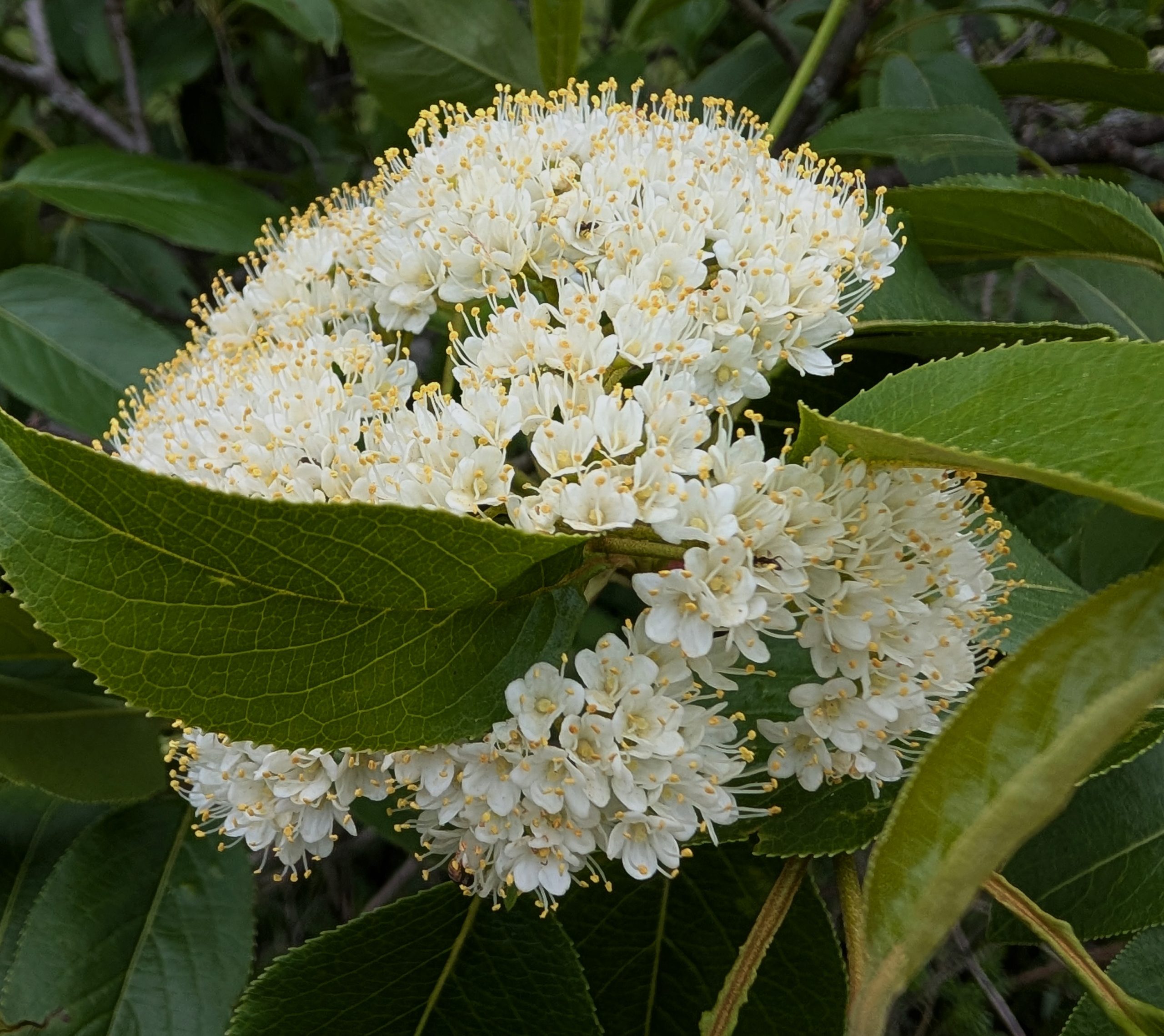
Viburnum lentago
Taxonomy
Domain: Eukaryota
Kingdom: Plantae
Subkingdom: Tracheobionta
Superdivision: Spermatophyta
Division: Magnoliophyta
Class: Magnoliopsida
Clade: Eudicots
Clade: Asterids
Order: Dipsacales
Family: Viburnaceae (formerly Adoxaceae; earlier Caprifoliaceae)
Genus: Viburnum
Species: Viburnum lentago
Common Names by Region
- United States / Canada: Nannyberry, sheepberry, wild raisin, sweet viburnum, nanny plum, blackhaw (misapplied)
- Great Lakes / Upper Midwest: Nannyberry, sheepberry
- General: Nannyberry
Description
Quick ID
- Growth form: Large multi-stemmed shrub or small tree, 10–20 feet commonly, occasionally to 30. Arching branches, often suckering into thickets. Bark on older stems breaks into small dark blocky plates.
- Flowers: Flat-topped cymes 3–5 inches across, creamy white, composed of many small five-petaled florets with long protruding stamens tipped yellow. All florets fertile — no showy sterile ring around the margin.
- The cyme is sessile — the diagnostic feature at the inflorescence. It sits directly on the twig with no stalk (peduncle) beneath it. This places the plant in the Lentago group immediately and rules out most of the genus in one look.
- Leaves — the diagnostic feature at species level: Opposite, elliptic to ovate, 2–4 inches, drawn out to a long, sharply acuminate tip. Margins finely and sharply serrate the entire length. Petioles slender, often reddish, and conspicuously winged with a wavy or crinkled margin.
- Buds: Long, narrow, gray and scurfy, curved to a point — the “cat’s ear” or “crane’s bill” shape. The single most reliable winter character in the group.
- Fruit: Drupes ripening blue-black with a pale bloom, hanging on drooping reddish stalks. Sweet and edible, one flat stone.
Blooming
- Mid-to-late spring, roughly May into early June, ahead of most other native shrubs finishing leaf-out. This photograph dates to May 20, at peak.
- Fruit colors late summer through fall and often persists into winter.
Look-alikes
The Lentago group is where the confusion lives. All three below share the sessile cyme, so that character gets you to the group but not to the species. Run the leaf.
- Blackhaw (Viburnum prunifolium): The main confusion, and the two overlap in range and habitat. Blackhaw leaves are shorter and blunt or rounded at the tip — no drawn-out point — and the petiole is plain, without a wing. Blackhaw also blooms a week or two earlier and its bark is more distinctly blocky. If the leaf tip is short and the petiole is unwinged, it’s prunifolium.
- Witherod / possumhaw (Viburnum nudum var. cassinoides): Leaf margins entire to barely and irregularly toothed, leaves thicker and often with a slight sheen. Blooms two to three weeks later and prefers wetter ground. Clean sharp serration rules it out.
- Rusty blackhaw (Viburnum rufidulum): Southern range. Petiole and leaf underside carry rusty-red hairs, and leaves are thick and glossy. Distinct once seen, but easy to overlook in a photograph.
- Arrowwood (Viburnum dentatum): Coarsely toothed leaves with prominent stalked cymes — the peduncle alone separates it.
- Alternate-leaf dogwood (Cornus alternifolia): Similar white flat-topped clusters and similar habitat, but alternate leaves with entire margins and arcuate veins. A one-second separation.
- Invasive honeysuckles (Lonicera spp.): Frequently share the same hedgerows. Opposite leaves, but paired tubular flowers rather than a cyme, and hollow pith.
Known Range
- Native: Northeastern and north-central North America — from Quebec, New Brunswick, and Manitoba south through New England, the Great Lakes, the Appalachians, and into the upper South; west to the Dakotas and Nebraska.
- Regional notes: Common through Pennsylvania and the Ohio Valley in hedgerows, woodland edges, and stream corridors. Frequent throughout the Great Lakes states. Reaches its southern limit where blackhaw and rusty blackhaw take over.
Care / Habitat
Light
- Full sun to part shade. Flowers and fruits best with at least half a day of sun; persists and flowers thinly in fairly deep shade. One of the more shade-durable natives in the genus.
Soil
- Wide tolerance. Prefers moist, well-drained, neutral to alkaline ground, and does noticeably well on limestone. Handles clay. Tolerates poor and rocky soils better than most large shrubs.
Water
- Moist to average. Drought-tolerant once established, but happiest along a stream edge or a low fencerow that holds moisture.
Typical Habitat
- Woodland edges, hedgerows, fencerows, stream and river banks, moist thickets, old field margins, and the transition zone between pasture and woods. Characteristically an edge species — it colonizes the seam between open and closed canopy, which is exactly the habitat that farm consolidation and roadside mowing have been erasing.
Propagation / Reproduction
- Seed: Doubly dormant. Requires warm stratification followed by cold — realistically 2–3 months warm at 70°F, then 2–3 months at 40°F. Germination in the second spring is normal, not a failure.
- Suckers: Spreads readily from root suckers, forming clonal thickets. This is the fastest route to a stand and the reason it’s often found as a colony.
- Layering: Low branches root where they contact soil. Simple to propagate by pinning a branch down.
- Cuttings: Softwood cuttings in early summer root reasonably with hormone treatment.
- Birds are the primary long-distance disperser.
Pests / Diseases / Threats
- Powdery mildew is the significant issue — routine on this species in humid summers, particularly in crowded or still-air plantings. Cosmetic more than damaging, but it looks rough by August.
- Viburnum leaf beetle (Pyrrhalta viburni), invasive and spreading, defoliates susceptible Viburnum. V. lentago rates as moderately resistant — better off than V. dentatum or V. opulus, but not immune.
- Occasional aphids, scale, and leaf spot. Rarely consequential.
- Deer browse young plants but generally leave established shrubs alone.
- No conservation concern at the species level. Locally diminished where hedgerows and field-edge thickets have been cleared.
Additional Notes
Ecology & Use
- Broad pollinator value. The open cymes are accessible to short-tongued insects that can’t work tubular flowers — small native bees, syrphid flies, beetles, and a range of wasps. Fertile-across-the-whole-cyme means the entire display is a food source, unlike the sterile-margin viburnums bred for show.
- Larval host for the spring azure butterfly and several sphinx and hummingbird moths.
- High-value wildlife fruit. Cedar waxwings, thrushes, grosbeaks, and grouse take the drupes; the fruit’s persistence into winter makes it a late-season resource when little else is left. Foxes and small mammals take fallen fruit.
- Edible for people. The drupes are sweet, date-like, and best after frost — the “wild raisin” name is earned. Thin flesh over a large flat stone, so the yield is low relative to the picking time, but the flavor is genuinely good.
- Thicket structure provides nesting cover and protected travel corridors for songbirds and small mammals. In a hedgerow restoration this species does structural work, not just ornamental work.
Management
- Want a specimen tree? Prune out suckers annually and select a leader. It takes to training well and makes a good small tree for a tight site.
- Want a thicket? Let the suckers run. This is the higher-value outcome for wildlife and the lower-labor one.
- Mildew management is spacing and airflow, not spray. Site it where air moves.
- Renewal pruning — take the oldest third of the stems to the ground on a rotation — keeps a stand vigorous and fruiting.
- Prune after flowering if you want fruit. Cutting in late winter removes the flower buds.
Field Note
- Photographed May 20 at a woodland edge, at full bloom.
- Look at where the flower cluster meets the twig. There is no stalk. The cyme sits flush against the branch, and that one character drops you into the Lentago group — nannyberry, blackhaw, witherod — and out of the rest of the genus in a single glance.
- From there the leaf finishes it. The blades in this frame taper to long drawn-out points and carry fine sharp teeth from base to tip, and the petioles are slender, reddish, and winged with a slightly wavy edge. Blackhaw would show short blunt leaf tips on plain unwinged stalks. Witherod would show margins nearly smooth.
- A few of the lower leaves in this image are blunter than the rest, which is normal variation and a good reminder to read the whole plant rather than one leaf.
- Come winter, skip all of it and check the buds. Long, narrow, gray, scurfy, curved to a point — nothing else in the eastern woods looks like that.
All Cernunnos Foundation materials are free to use for any educational purpose.
Post Views: 151