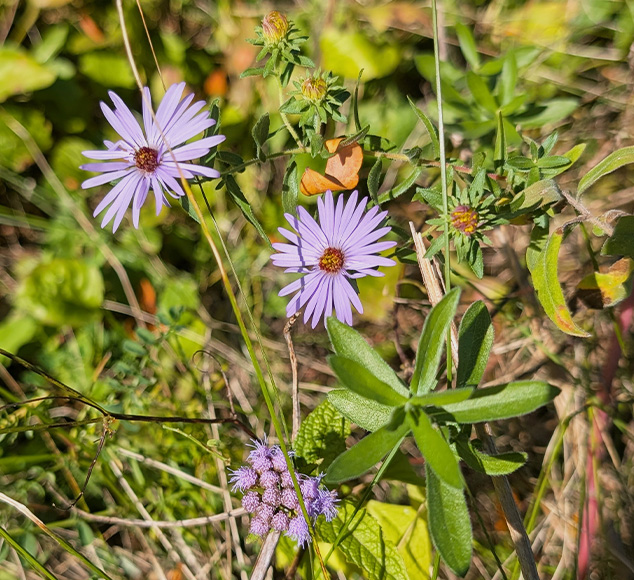
Symphyotrichum oblongifolium
Taxonomy
Domain: Eukaryota
Kingdom: Plantae
Subkingdom: Tracheobionta
Superdivision: Spermatophyta
Division: Magnoliophyta
Class: Magnoliopsida
Clade: Eudicots
Clade: Asterids
Order: Asterales
Family: Asteraceae
Genus: Symphyotrichum
Species: Symphyotrichum oblongifolium (formerly Aster oblongifolius)
Common Names by Region
- United States: Aromatic aster, fall aster, shale-barren aster, wild blue aster
- Great Plains / Midwest: Aromatic aster, fall aster
- General: Aromatic aster
Description
Quick ID
- Growth form: Bushy, densely branched perennial, 1–3 feet, wider than tall. Stiff, often woody at the base. Spreads by short rhizomes into low mounded clumps rather than running.
- Flowers: Heads roughly 1–1.5 inches across. Twenty to thirty-five narrow ray florets, violet to blue-purple, around a disc that opens yellow and ages to red-purple. A working plant shows both colors at once — the older heads red-centered, the newer ones gold.
- Leaves — the diagnostic feature: Small, stiff, oblong to lance-shaped, 1–3 inches, stalkless and clasping the stem at a broad base. Crowded closely along the branches, decreasing upward. Rough to the touch on both surfaces.
- Scent — the name and the tiebreaker: Crushed foliage is strongly balsamic, resinous, a little turpentine-and-mint. No other blue fall aster in the eastern range does this. Crush a leaf and the ID is finished.
- Involucre: Bracts spreading and often glandular-sticky to the touch — another useful separator, and it’s why insects sometimes stick to opening buds.
- Bloom timing: One of the latest asters, opening after most of its relatives have finished.
Blooming
- Late summer into hard frost, roughly September through November, later than nearly anything else in the genus. In this photograph the surrounding grasses have gone tan and the goldenrod is done — the classic aromatic aster window.
Look-alikes
The blue fall asters are a genuinely hard group. Leaf attachment and texture do most of the work; scent finishes it.
- Smooth blue aster (S. laeve): The closest match. Leaves also clasping, but smooth, waxy, and hairless with a bluish cast, and the stems are smooth. No scent when crushed. If the leaf feels slick rather than rough, it’s laeve.
- Late purple aster (S. patens): Clasping leaves as well, but rough-hairy throughout with a distinctly hairy stem, and again no aromatic scent. Heads carried on longer, more spreading branches.
- New England aster (S. novae-angliae): Larger plant, taller, with many more ray florets (40–100) in deeper purple, hairy clasping leaves, and glandular stems. Blooms earlier and finishes earlier.
- Sky blue aster (S. oolentangiense): Basal leaves long-stalked and heart-shaped — a clear separation at the base of the plant.
- New York aster (S. novi-belgii): Narrow leaves that only partly clasp, smooth stems, wetter habitat.
Known Range
- Native: Central and eastern United States — from the Great Plains east through the Midwest and into the Appalachians and mid-Atlantic; south to Texas and the Gulf states, north to the Great Lakes.
- Regional notes: In Pennsylvania and the Ohio Valley it favors dry, rocky, calcareous ground — shale barrens, limestone glades, dry bluffs, and roadside cuts. Common through the prairie states.
- Widely planted well outside its native range as a late-season garden perennial.
Care / Habitat
Light
- Full sun. Tolerates light shade but flops and flowers thinly. This is a plant of open ground.
Soil
- Dry, lean, well-drained — and it means it. Sandy, rocky, gravelly, and calcareous soils all work. Rich moist soil produces a floppy plant that opens in the middle. Poor ground produces a tight mound covered in flowers.
- Genuinely alkaline-tolerant. One of the better natives for limestone and disturbed calcareous fill.
Water
- Drought-tolerant once established, and among the most reliably so in the genus. Does not want irrigation.
Typical Habitat
- Dry prairies, limestone and shale glades, rocky bluffs, gravel bars, roadside cuts, railroad ballast, and thin dry soil over rock. Habitats where competition is low because most things can’t hold on. In this photograph it’s growing through dry grass on open ground with no canopy above it.
Propagation / Reproduction
- Seed: Sets readily. Benefits from 30–60 days cold moist stratification; surface-sow, as it needs light to germinate. Self-sows modestly in open ground.
- Division: Simplest route. Split clumps in spring every three to four years — this also keeps the center from thinning out.
- Cuttings: Softwood cuttings root easily in early summer.
- Rhizomes: Short and clumping, not running. This species stays where you put it, unlike several of its relatives.
Pests / Diseases / Threats
- Notably trouble-free on the dry soils it prefers.
- Powdery mildew and rust appear in humid, crowded, or over-watered conditions — almost always a siting problem rather than a disease problem.
- Aster yellows, a phytoplasma spread by leafhoppers, causes distorted green flowers. Uncommon, and the only remedy is removal.
- Rabbits browse young growth. Deer generally pass it by.
- Aster wilt in heavy wet soil, which is the same problem as everything else on this list: wrong ground.
- No conservation concern; secure across its range, though shale barren and glade habitat is itself limited and worth protecting.
Additional Notes
Ecology & Use
- A critical late-season nectar source. By the time this plant opens, the goldenrods are finishing and hard frost is weeks out. Migrating monarchs, late bumblebee queens provisioning for hibernation, and the last generation of solitary bees all depend on what’s still blooming in October. Aromatic aster is one of the few things still working.
- Specialist bees: Several Andrena species are aster specialists and time their entire flight period to this bloom window.
- Larval host for the pearl crescent butterfly and a substantial list of moth species. Symphyotrichum as a genus ranks among the highest-value native host plants in eastern North America.
- Seed feeds goldfinches, juncos, and sparrows through winter.
- Restoration value on hard ground. This is the practical argument for the species: it establishes on dry, thin, alkaline, disturbed soil where most natives fail, holds it, and delivers pollinator resource at the season when resource is scarcest. On limestone spoil, roadway cuts, and reclaimed rocky fill, it does work that showier plants cannot.
Management
- Site it dry and lean. Nearly every problem with this plant traces back to soil that was too rich or too wet.
- Pinch or shear in early summer — once by mid-June — for a tighter mound and more heads. Optional; wild plants manage without it.
- Leave the stems standing through winter. Seed for birds, hollow stems for overwintering insects, and structure in a bare season.
- Divide every three to four years if the center starts to open.
Field Note
- Photographed in fall on dry open ground, growing through tan grass alongside spent goldenrod and a Pycnanthemum-type mountain mint in seed head.
- Note the two-tone discs. The upper flower has aged to red-orange at the center while the lower one still shows gold. That color shift runs outward as the disc florets open in sequence, and a plant in full bloom carries the whole range at once.
- The tiebreaker for this species is not visual. Crush a leaf between your fingers and smell it — balsam, resin, a sharpness like turpentine. Smooth blue aster and late purple aster grow in the same dry ground with similar flowers and give you nothing.
- Bloom date is itself diagnostic. If you’re looking at a blue aster still opening after everything around it has gone to seed, the list is already short.
All Cernunnos Foundation materials are free to use for any educational purpose.
Post Views: 135