
Same template, matched to the live format.
Taxonomy
Kingdom: Animalia
Phylum: Chordata
Class: Amphibia
Order: Anura
Family: Bufonidae
Genus: Anaxyrus
Species: Anaxyrus americanus
Subspecies: Anaxyrus americanus americanus
Binomial Name: Anaxyrus americanus (Holbrook, 1836)
Synonym: Bufo americanus Holbrook, 1836
Common Names by Region
American Toad (English, general)
Eastern American Toad (English, subspecies)
Hop-toad / Hoptoad (English, colloquial, older rural usage)
Crapaud d’Amérique (French, Canada)
Adult
A stout, dry-skinned, thoroughly warty toad, 2 to 3.5 inches snout-to-vent, with females running larger — occasionally to 4.5 inches. Ground color is highly variable and shifts with temperature, humidity, and substrate: brown, brick red, olive, tan, or gray, sometimes within the same population and sometimes within the same individual over a matter of hours. Dark dorsal blotches are scattered across the back, each usually enclosing one or two enlarged warts. A pale mid-dorsal stripe runs the length of the spine in most individuals. The belly is cream to gray and typically mottled or spotted with dark, heaviest across the chest.
Prominent bony cranial crests run above and behind the eyes. Behind each eye sits the parotoid gland — a raised, kidney-bean-shaped swelling that produces the animal’s chemical defense. The iris is gold to copper, flecked and reticulated, with a horizontal pupil.
Distinguishing from Fowler’s Toad
The two overlap across much of the range and are routinely confused. Three reliable checks: American toads carry one or two large warts inside each dark dorsal spot, where Fowler’s carries three or more smaller ones; the American toad’s parotoid gland is separate from the cranial crest or joined to it only by a short spur, where Fowler’s parotoid sits in direct contact with the crest; and the American toad’s belly is spotted, where Fowler’s is generally plain with at most a single dark chest mark.
Larva (Tadpole)
Small, dark to nearly black, with a rounded body and a short tail. Tadpoles school in dense aggregations in the shallows, which is unusual among North American anurans and makes a breeding pond conspicuous. Metamorphosis takes roughly 40 to 70 days depending on water temperature.
Toadlet
Newly emerged toadlets are astonishingly small — under half an inch — and leave the water in enormous synchronized waves, often by the thousands, after a rain. Most will not survive the first season.
Eggs
Laid in long paired gelatinous strings, spiraled through submerged vegetation and along the bottom, containing anywhere from two thousand to twenty thousand eggs. The paired-string form is diagnostic; frogs in the same water lay eggs in clusters or films, never in strands like these.
Quick ID
Warty, dry-skinned, stout-bodied toad with prominent bony ridges above the eyes
One or two enlarged warts inside each dark dorsal blotch — not three or more
Kidney-shaped parotoid gland behind the eye, separate from the cranial crest or joined by a short spur
Pale stripe down the center of the back; spotted or mottled belly
Long musical trill, six to thirty seconds, heard from shallow water in spring
Walks and makes short hops rather than the long leaps of true frogs
Known Range
Eastern North America, from Labrador, Quebec, and Manitoba south through the eastern and central United States to Georgia, Mississippi, and eastern Kansas, bounded to the west by the Great Plains. The eastern subspecies covers the bulk of that territory. Common and secure across Pennsylvania and throughout the Appalachian region.
Habitat
One of the most adaptable amphibians on the continent. Deciduous forest, forest edge, meadows, floodplains, farm fields, suburban lawns, gardens, and vacant lots — anywhere with moist cover, loose soil for burrowing, insects to eat, and shallow standing water within reach for breeding. Adults spend most of the year terrestrial and often well away from water. Daytime is passed under logs, boards, stones, leaf litter, or in a shallow scraped form in loose soil. Toads are creatures of habit and will return to the same daytime retreat night after night.
Life Cycle / Reproduction
Breeding runs from roughly March through July, peaking early in the season and triggered by warming temperatures and rain. Males gather at shallow ponds, ditches, flooded fields, and pool margins and call — the long, sustained, high musical trill that is one of the defining sounds of an eastern spring night. Females select a male, amplexus follows, and the paired egg strings are laid and fertilized in the shallows. Adults leave the water shortly after; there is no parental care.
Tadpoles school, feed on algae and detritus, and transform in one to two and a half months. Toads mature at two to three years. Outside the breeding season the species is nocturnal and crepuscular, burrowing backward into loose soil using hardened spades on the hind feet. Winter is spent below the frost line in a self-dug chamber or an existing burrow. Wild individuals can reach ten years; captives have exceeded thirty.
Diet
Almost entirely invertebrate and almost entirely opportunistic: beetles, ants, crickets, moths, flies, spiders, sowbugs, earthworms, slugs, and snails. Prey is taken with a fast sticky tongue anchored at the front of the mouth. A toad retracts its eyeballs downward into the roof of the mouth to help force a swallow — the reason a feeding toad appears to blink hard with each bite. Estimates of daily intake for an adult run into the hundreds of insects, and a single toad working a garden through a summer is a meaningful pest-control presence.
Predators / Threats
Eastern hognose snakes are specialists and effectively immune to the toad’s toxin. Garter and water snakes, raccoons, skunks, opossums, crows, herons, and owls also take toads; raccoons in particular have learned to eviscerate them and eat the interior while leaving the toxic skin. Tadpoles are eaten by dragonfly larvae, diving beetles, and predatory fish, though toad tadpoles are themselves distasteful enough that many fish reject them.
Defense is chemical. The parotoid glands and dorsal warts secrete a milky bufotoxin that is intensely irritating to mucous membranes and can be seriously dangerous to dogs that mouth a toad. It is not dangerous to handle a toad, and toads do not cause warts — but hands should be washed afterward, and eyes left alone in the meantime. A threatened toad will also inflate its body, rise up on stiffened legs to appear larger, and frequently void its bladder.
Population threats are the familiar ones: road mortality during breeding migrations, loss of ephemeral pools and shallow wetlands, broad-spectrum pesticide and herbicide use, and the amphibian diseases — chytrid fungus and ranavirus — that continue to move through North American populations. The species remains common, which is exactly the reason it tends to go unmonitored.
Supporting This Species
Toads are among the easiest native animals to accommodate deliberately. Leave a board, a flat stone, a section of drainage tile, or an overturned cracked pot in a shaded, damp corner and a toad will occupy it. Keep a portion of the yard unmown and unmulched with bare soil available for burrowing. Skip the slug pellets and the broad-spectrum insecticides — you are poisoning the food supply of the animal that eats slugs for free. A shallow water feature with sloped sides, or a seasonal pool allowed to stay wet through early summer, gives them somewhere to breed. If a low ephemeral pool forms on your property in spring, resist the urge to drain it; that puddle is worth more than it looks.
For anyone running a garden or a food system, the calculation is simple. A resident toad is unpaid nightly labor.
Additional Notes
The genus was moved from Bufo to Anaxyrus in 2006 following molecular work on the Bufonidae, and older field guides and signage still carry Bufo americanus. Both names refer to the same animal.
Three subspecies are recognized: the eastern American toad (A. a. americanus) across most of the range, the dwarf American toad (A. a. charlesmithi) in the south-central states, and the Hudson Bay toad (A. a. copei) in the far north. The species hybridizes with Fowler’s toad where they overlap, producing intermediate individuals that frustrate clean identification.
The spring trill is produced by a single inflated vocal sac beneath the chin, and a chorus of males calling at slightly different pitches produces the shimmering interference effect that carries across water at night. It is one of the earliest and most reliable seasonal markers in the eastern woods.
Field Notes (CF Observation)
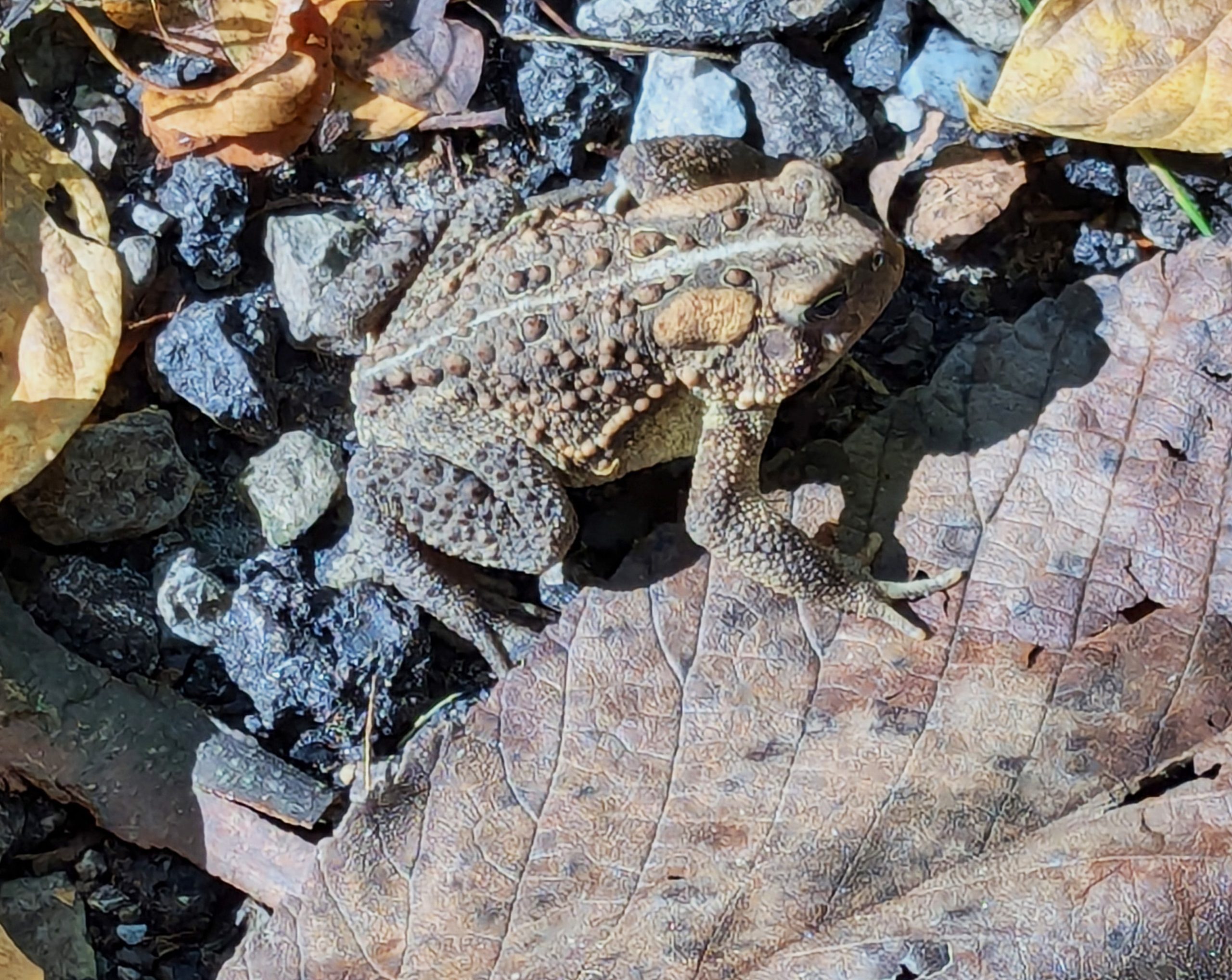
Photographed sitting motionless on wet crushed stone among fallen leaves in low autumn light. The animal was making no attempt to flee — standard toad behavior, and the reason they are so easy to photograph and so easy to step on.
The frame shows the identifying features clearly: the pale mid-dorsal stripe, the elongated kidney-shaped parotoid gland behind the eye set off from the cranial crest, and the dark dorsal blotches each carrying one or two enlarged warts rather than a cluster of small ones. That last detail is what separates this animal from Fowler’s toad, and it is legible here at full resolution.
The color match to the surrounding gravel and leaf litter is not incidental. American toads adjust ground color toward their substrate, and this individual has settled into a palette that makes it nearly invisible at a normal walking distance.
Identification confirmed by parotoid shape and placement, wart-to-blotch ratio, dorsal stripe, and cranial crest structure.