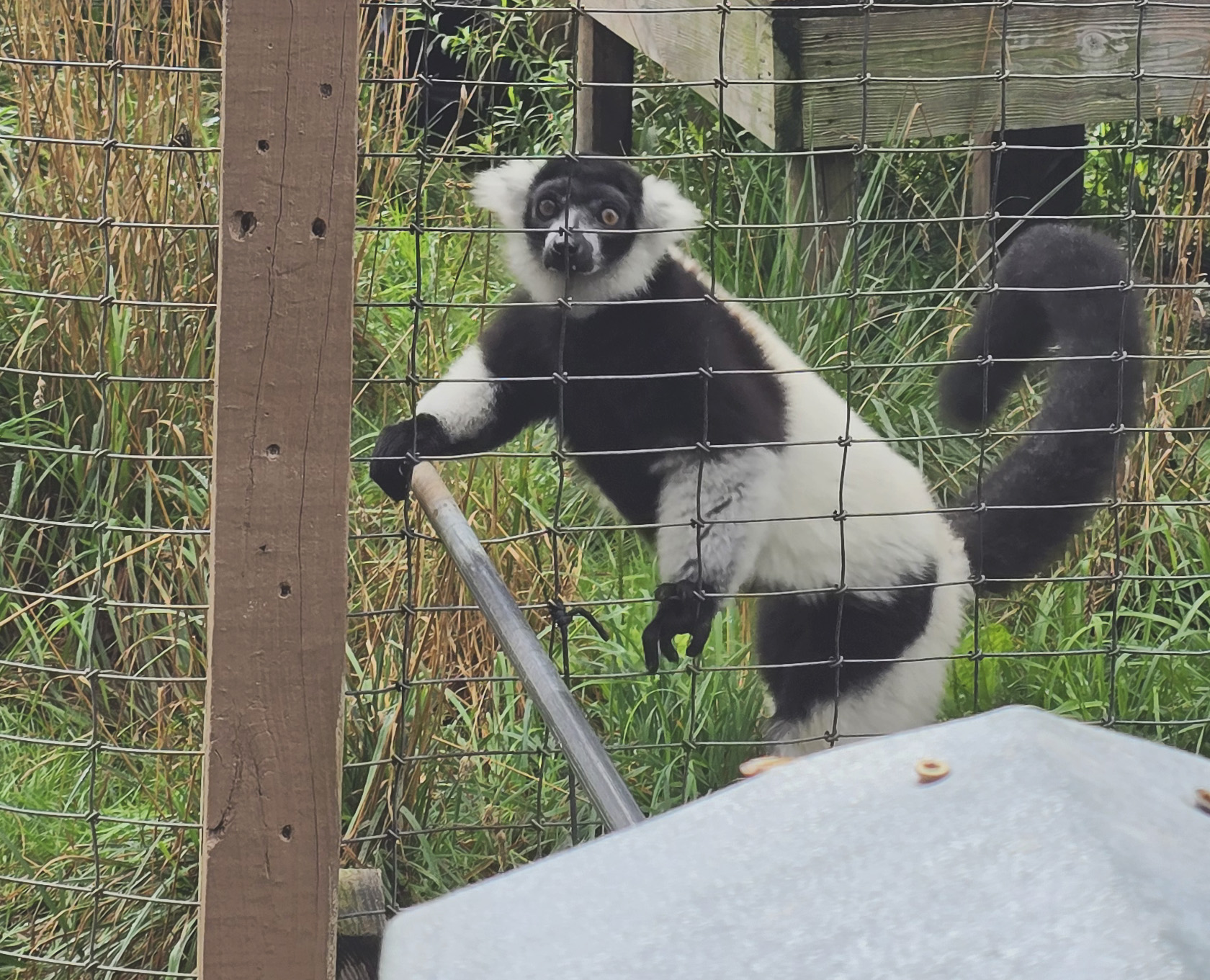
Varecia variegata
Taxonomy
- Domain: Eukaryota
- Kingdom: Animalia
- Phylum: Chordata
- Class: Mammalia
- Order: Primates
- Suborder: Strepsirrhini
- Family: Lemuridae
- Genus: Varecia
- Species: Varecia variegata (Kerr, 1792)
- Subspecies: V. v. variegata, V. v. editorum (Osman Hill, 1953), V. v. subcincta (A. Smith, 1833)
Common Names by Region
- United States / exhibit trade: Black-and-white ruffed lemur, ruffed lemur
- Madagascar (native range): Varikandana, varijatsy, varimena and related regional Malagasy names — the genus name Varecia comes directly from vary, the Malagasy word for this animal
- France / Francophone literature: Vari noir et blanc
- General: Ruffed lemur (shared with the red ruffed lemur, Varecia rubra, its only congener)
Description
Quick ID
- Pattern: Sharply bicolored and consistent across the species — black on the face, crown, forehead, hands, feet, inner limbs, belly, and the full length of the tail; white across the back, flanks, hindquarters, and hind limbs. Individual animals vary in where the boundaries fall, but the palette does not.
- Ruff: A thick white collar of fur framing the face and throat — the feature the name is built on, clearly visible on the animal at center.
- Face: Black, with a long fox-like muzzle and bright yellow-gold eyes.
- Tail: Long, black, and non-prehensile — roughly as long as the body and used purely as a counterweight.
- Size: The largest living lemurs alongside the red ruffed. Head-and-body 50–55 cm (20–22 in) with a tail adding another 61–66 cm (24–26 in); total length 100–120 cm. Weight 3.1–4.1 kg (6.8–9.0 lb).
- Sexes: Alike. No reliable visual sexual dimorphism in coat or size.
- Posture: Quadrupedal above the branch, often seen hanging by the hind feet with hands free — the suspensory feeding posture is characteristic.
Field note on the exhibit sign: the placard in this frame lists “Height 3.3 to 3.9 feet.” That figure is total length including the tail, not standing height. A ruffed lemur stands well under two feet at the shoulder. Common shorthand on interpretive signage, worth correcting for anyone drawing from it.
Range
- Endemic to Madagascar, and found nowhere else on Earth. Distribution runs along the eastern rainforest belt, from the Antainambalana River south toward the Mananara River, with the three subspecies segregating roughly north to south.
- Distribution is patchy and fragmented rather than continuous — populations sit at low density in isolated forest blocks, many of them reproductively cut off from one another. Genetic work identifies a major population split on either side of the Mangoro River.
Habitat & Behavior
- Primary lowland and mid-altitude rainforest, with a strong preference for tall, mature, contiguous canopy. Patchy or degraded forest gets used when nothing else is available, but poorly.
- Almost entirely arboreal. These animals spend their lives in the upper and middle canopy and come to the ground rarely. Movement is by climbing, leaping, and suspension.
- Diurnal, with activity peaking in morning and late afternoon — unusual among lemurs of this size and a convenience for observers.
- Social structure: fission-fusion communities that may number a dozen or more animals, splitting into small subgroups that forage independently and recombine. Females are dominant, as in most lemur societies.
- Voice: Among the loudest primates in the world. The group roar-shriek chorus carries better than a kilometer through forest and functions in territorial spacing and alarm. In captivity it goes off without warning and startles visitors reliably.
- Predators: The fossa (Cryptoprocta ferox) is the principal natural threat, along with raptors and boas taking young.
Diet
- Obligate frugivore — among the most fruit-dependent primates on the island, with fruit running 74–90% of the diet. Nectar, flowers, leaves, and seeds fill the remainder seasonally.
- This narrow dependence is the species’ central vulnerability. Fruiting trees require mature forest, so ruffed lemurs are typically the first primates to vanish when a forest is logged or fragmented.
- The traveler’s palm connection: V. variegata is the principal pollinator of Ravenala madagascariensis. The flower bracts are tough and sealed; the lemur pries them open with its long fingers and pushes its muzzle inside to reach the nectar, coating that white facial ruff in pollen and carrying it to the next tree. This makes it, by weight, the largest pollinator of any animal anywhere — a job filled elsewhere by insects, birds, and bats.
- Also a significant seed disperser for large-seeded canopy trees that few other Malagasy animals can swallow whole.
Reproduction
- Seasonal and synchronized. Breeding females within a community come into estrus together, producing a boom-bust reproductive pattern with long intervals between birth years.
- Gestation is short for a primate of this size — roughly 90 to 120 days.
- Litters of two to three are standard, with as many as six recorded. Large litters are rare among primates and effectively unheard of at this body size.
- Females build nests and leave infants there rather than carrying them, returning to nurse and moving them by mouth. Infants are altricial at birth and develop fast.
- The combination — short gestation, litters, nests, park-and-leave infant care — is a suite normally seen in small nocturnal lemurs. In an animal this large it is anomalous and remains a live question in primate life-history research.
Threats / Conservation / Notes
- Critically Endangered (IUCN). The population has fallen by 80% or more over roughly two decades, and the trend has not reversed.
- Habitat loss is the driver: slash-and-burn agriculture (tavy), commercial and illegal logging, and mining. Logging roads compound the damage by opening interior forest to hunters.
- Hunting for meat is a direct and continuing pressure across much of the range.
- Fragmentation isolates already low-density subpopulations. Ironically, the species still carries among the highest genetic diversity recorded in any primate — the raw material for recovery is present; contiguous habitat is not.
- Captive breeding is well established and coordinated internationally. A reintroduction of captive-born animals to the Betampona Reserve in the late 1990s produced mixed results and remains one of the more instructive case studies in primate release work.
Additional Notes
Ecology & Significance
- A keystone mutualist. Remove this animal and the traveler’s palm loses its pollinator and several large-seeded canopy trees lose their disperser. The loss propagates outward into the forest’s own ability to regenerate.
- Madagascar’s lemurs descend from a single ancestral colonization roughly 60 million years ago and radiated in isolation into every niche the island offered. Varecia occupies the large-bodied frugivore slot that monkeys and apes fill elsewhere — a case of convergent ecological role reached by an entirely separate lineage.
- Strepsirrhine, not simian. Wet nose, tapetum lucidum behind the retina, toothcomb in the lower jaw, and a grooming claw on the second toe. These are primates, but they sit on the far side of a split that predates monkeys entirely.
In Exhibits
- Housed in tall mesh enclosures with heavy vertical furniture — the elevated platforms, ropes, and climbing holds visible here are standard, and the height matters more than the floor area for an animal that lives in a canopy.
- Nest boxes are required, not optional; the third animal in this frame is watching from one. They serve for birthing and for the daytime rest periods.
- Ruffed lemurs are among the most commonly held lemurs in accredited collections and are managed under coordinated breeding programs — the captive population is a genuine reserve against wild extinction, not a display convenience.
- Temperate-climate housing means indoor winter quarters. Outdoor access in a Pennsylvania summer, as photographed here, is seasonal.
All Cernunnos Foundation materials are free to use for any educational purpose.
Post Views: 163