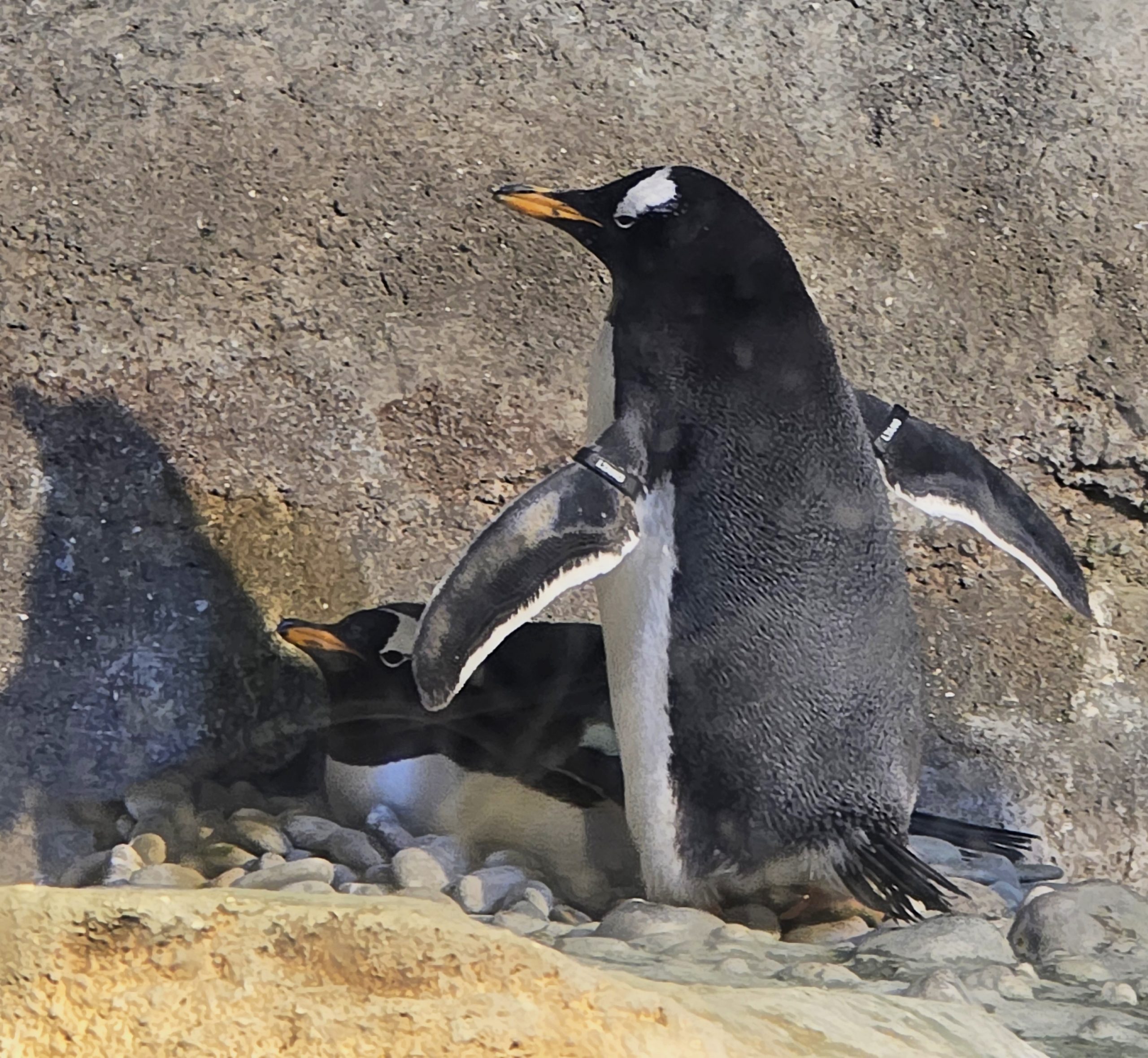
Pygoscelis papua
Taxonomy
- Domain: Eukaryota
- Kingdom: Animalia
- Phylum: Chordata
- Class: Aves
- Order: Sphenisciformes
- Family: Spheniscidae
- Genus: Pygoscelis
- Species: Pygoscelis papua (Forster, 1781)
- Subspecies: P. p. papua (northern gentoo) and P. p. ellsworthi (southern gentoo). A 2020 genomic study proposed splitting the species four ways; the question remains open.
Common Names by Region
- United States / exhibit trade: Gentoo penguin
- Falkland Islands: Johnny penguin, johnny rook’s neighbor
- Spanish / South America: Pingüino papúa, pingüino juanito
- General: Gentoo — origin genuinely uncertain. Proposed derivations include an Anglo-Indian term and a reference to turbans, from the white head band. None is well supported.
- Genus: Pygoscelis means “rump-tailed” — a reference to the long stiff tail that sweeps side to side as the bird walks.
Description
Quick ID
- Bill: Bright orange-red — the fastest field mark, and unique among the three Pygoscelis penguins.
- Head: Black, with a conspicuous white patch over each eye. In many birds the two patches connect across the crown in a band; in others they stay as separate wedges. Both are visible in this group.
- Feet: Orange, webbed, and large.
- Body: Black back and head, clean white underside, with the whitish spotting on the breast that some individuals carry.
- Tail: Long and stiff, projecting well behind the body and sweeping as the bird walks — the longest tail of any penguin and the source of the genus name.
- Size: The third-largest penguin, after the emperor and the king. Height 51–90 cm (20–35 in); weight 4.5–8.5 kg (10–19 lb), fluctuating widely across the season. Northern birds average larger than southern ones.
- Sexes: Similar; males average slightly larger.
- Chicks: Gray-backed with white fronts, and noticeably fluffier than the sleek adults.
Range
- Circumpolar in the Southern Hemisphere, breeding from roughly 42°S to 65°S — subantarctic islands and the Antarctic Peninsula.
- Principal colonies: the Falkland Islands (holding roughly 40% of the world population), South Georgia, the South Sandwich Islands, Kerguelen, Heard, Macquarie, and the South Shetlands.
- Breeds on ice-free ground, which distinguishes it sharply from its ice-dependent relatives and matters a great deal to its current fortunes.
Habitat & Behavior
- Coastal shorelines, beaches, tussock grass, and low rocky slopes near open water. Colonies range from a few dozen pairs into the thousands.
- The fastest swimming bird in the world. Burst speeds around 36 km/h (22 mph) are widely cited, though the figure comes from observation rather than controlled measurement and should be treated as an estimate rather than a number. Either way, it outswims every other penguin.
- Porpoising: leaping clear of the surface at speed to breathe without losing momentum — both an efficiency measure and an evasion tactic against leopard seals and orcas.
- Divers. Typical foraging dives run shallow and brief, but the species is capable of well over 100 m. Birds generally forage within about 20 km of the colony during the breeding season.
- Less aggressive than its congeners. Gentoos are markedly calmer at the nest than Adélies or chinstraps, though disputes over stones are constant.
- Nest fidelity is strong. Pairs return to the same site year after year.
Diet
- Crustaceans, fish, and squid, with proportions varying sharply by colony and season. Antarctic Peninsula birds lean heavily on krill; subantarctic island birds often take substantially more fish.
- This dietary flexibility is a central reason the species is faring better than its neighbors.
- Foraging is pursuit diving — running down prey underwater rather than surface feeding.
Reproduction
- Pebble nests. Both birds build a circular mound of stones, sometimes with bones and feathers worked in. Stones are valuable, and theft from neighboring nests is continual and unembarrassed. Males present stones to females during courtship.
- Two eggs typically, laid a few days apart.
- Incubation 34–37 days, shared by both parents in alternating shifts.
- Chicks form crèches at around a month, gathering in groups while both parents forage.
- Fledging at roughly 75–90 days, long by penguin standards.
- Monogamous within a season, with pairs frequently reuniting across years.
Threats / Conservation / Notes
- Least Concern (IUCN), with a global population around 430,000 breeding pairs and an overall stable-to-increasing trend — an unusual position among Antarctic seabirds.
- A climate “winner,” conditionally. Because gentoos nest on bare ground rather than ice and eat a broad diet, warming along the Antarctic Peninsula has opened habitat to them while it closed habitat for the ice-dependent Adélie and chinstrap. At least seven new gentoo colonies have appeared at the southern edge of the range in the last two decades, and populations there are climbing while their neighbors fall.
- The label deserves qualification. Commercial krill fishing during the austral winter affects all three Pygoscelis species, and regional gentoo trends are not uniform — some subantarctic colonies are declining even as peninsula colonies expand.
- Other pressures: fisheries interaction, oil pollution, disturbance at colonies, introduced predators on some islands, and avian influenza, which has moved into Southern Ocean seabird populations in recent years.
- Natural predators: leopard seals and orcas at sea; skuas, sheathbills, and giant petrels taking eggs and chicks ashore.
Additional Notes
Ecology & Significance
- One of three brush-tailed penguins in Pygoscelis, alongside the Adélie and the chinstrap. The three overlap across much of the Antarctic Peninsula and are diverging in fortune under the same warming — a natural experiment in which traits pay off when conditions shift.
- Generalism is the whole story here. Bare-ground nesting, a broad prey base, and a flexible foraging range are what separate this species from its specialist neighbors. The same warming that costs an ice-obligate bird its habitat hands a generalist new ground.
- The species has been studied intensively for decades, and long-term colony counts across the peninsula are among the better time-series datasets available for any Antarctic vertebrate.
In Exhibits
- Held in chilled indoor habitats with deep pools and haul-out areas, and among the most commonly exhibited penguins in accredited North American collections.
- A stone-covered floor is required husbandry, not decoration. Nesting behavior depends on it, and colonies are typically given a surplus of pebbles for exactly the reason the wild birds fight over them.
- Flipper bands identify individuals for record-keeping and breeding management, as on the birds here.
- Breeding is well established in captivity, and gentoos are frequently the species behind zoo penguin-chick announcements.
- Cool-climate exhibit design and a fish-based diet make them practical to maintain far from their range — including in a Pennsylvania March.
All Cernunnos Foundation materials are free to use for any educational purpose.
Post Views: 136