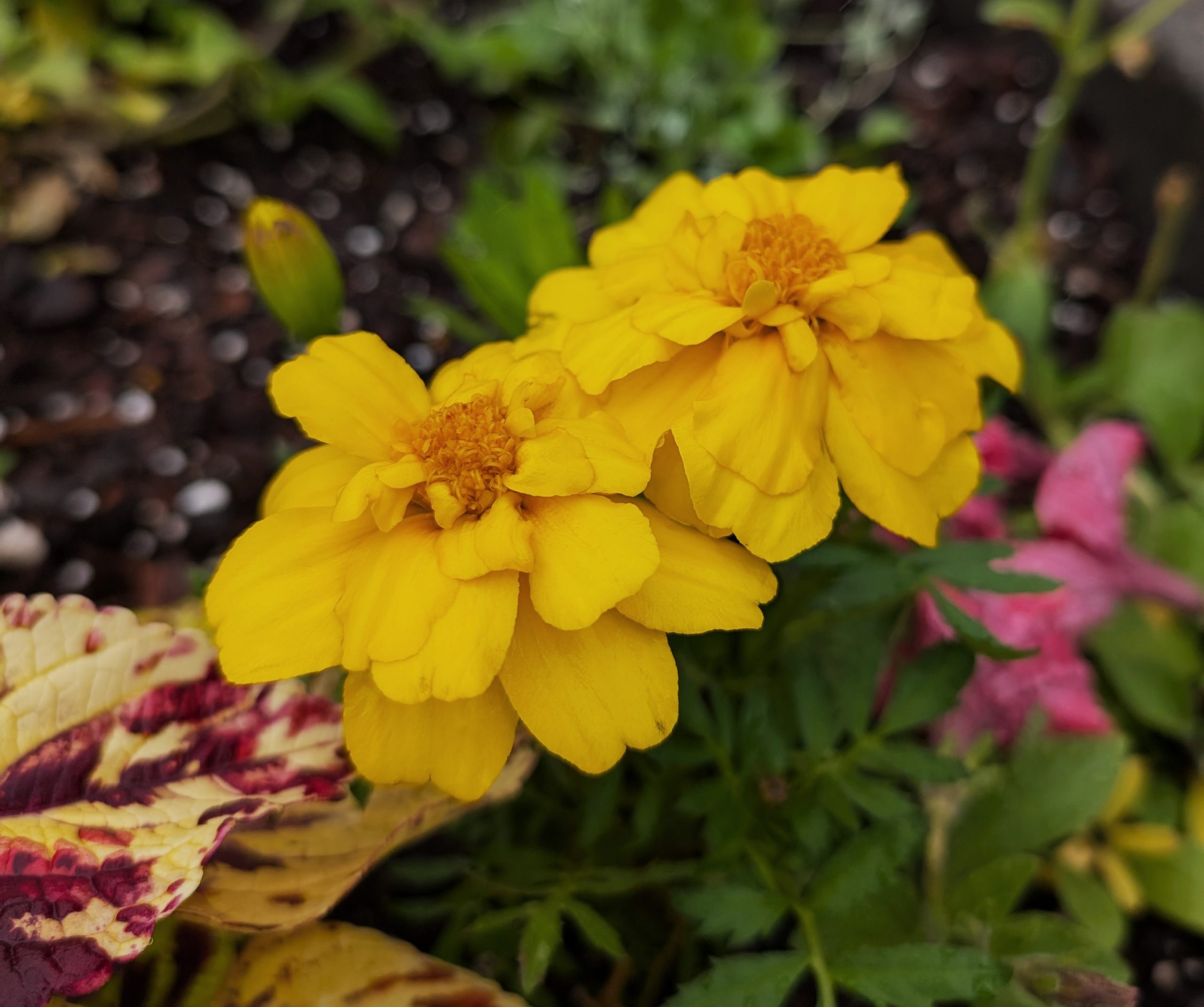
Tagetes patula
Taxonomy
Kingdom: Plantae
Clade: Tracheophytes
Clade: Angiosperms
Clade: Eudicots
Clade: Asterids
Order: Asterales
Family: Asteraceae
Genus: Tagetes
Species: Tagetes patula L.
Note: Some authorities sink T. patula into T. erecta as a synonym. The two cross freely, and the sterile crosses between them are sold as triploid marigolds.
Common Names by Region
General / English: French marigold, dwarf marigold
United States / Canada: French marigold
India: Gainda — grown at scale for garlands and loose flowers
Mexico (native range): Cempasúchil is applied across the genus, most often to T. erecta
Etymology: Tagetes honors Tages, the Etruscan demigod said to have risen out of freshly plowed ground — an apt patron for a plant that shows up in disturbed soil. Patula is Latin for spreading, describing both the low branching habit and the plant’s tendency to seed itself around.
On the name: it isn’t French. Tagetes patula is native to Mexico and Guatemala. Sixteenth-century Portuguese and Spanish traders carried seed to Europe, where it caught on in France and picked up the label on the way. The same confusion produced “African marigold” for T. erecta, which is also Mexican. Both names record European assumptions rather than plant geography.
Description
Growth Habit
A compact, bushy, branching annual. It builds a dense low mound and covers itself in flowers from planting until frost. Fast from seed, blooming in weeks, and completely undemanding.
Frost kills it outright — but it seeds itself reliably, and volunteers turn up the following spring in any bed it occupied.
Size
Height: 15–30 cm (6–12 in), occasionally to 50 cm
Spread: 15–45 cm (6–18 in)
Leaves
- Pinnately divided, with 9 to 17 narrow leaflets per leaf
- Leaflet margins sharply toothed, sometimes almost bristly
- Deep green, ferny in overall texture
- Strongly aromatic when bruised — pungent, resinous, medicinal. Opinions on it are strongly divided. The scent comes from oil glands visible as small dark dots along the leaflets.
Stems
- Green, branching from the base, sometimes reddish at the nodes
- Slightly ridged and brittle — they snap rather than bend
- Dense branching is what creates the mounded shape
Flowers
- Heads 3–6 cm (1–2 in) across, borne singly on short stalks above the foliage
- Composite structure — what reads as a flower is a head of many florets. Broad ray florets around the outside, a tight cluster of small disc florets in the center.
- Available in single, semi-double, and fully double forms. This one is a semi-double to crested type: several rows of ray florets around a raised tuft of yellow-orange disc florets.
- Color range covers yellow, gold, orange, mahogany, russet, and bicolors, frequently with dark markings at the petal base. Petal texture is velvety.
- Blooms from late spring to frost if deadheaded. In its native central Mexican highlands the natural season runs September to frost.
Quick ID
Ferny pinnate leaves with toothed leaflets, aromatic when crushed, on a low bushy plant with flower heads under 6 cm. Distinguishes from African marigold (T. erecta), which is taller with globe-shaped heads two or three times the size, and from signet marigold (T. tenuifolia), which has thread-fine foliage and small single flowers. Crush a leaf if uncertain — the smell is diagnostic for the genus.
Known Range
Native to Mexico and Guatemala. Cultivated for centuries before European contact — Tagetes species appear in the Florentine Codex and the 1552 de la Cruz-Badiano herbal, and archaeological and documentary evidence places their use back into the Classic Maya period.
Now grown worldwide as a bedding annual, with hundreds of cultivars. Naturalized populations occur across many countries in warm and temperate regions. India grows it commercially at enormous scale for garland flowers and for the pigment used in poultry feed.
Grown as an annual everywhere frost occurs; perennial only in frost-free climates.
Care / Habitat
- Light: Full sun preferred; tolerates part shade with reduced bloom.
- Soil: Average, well-drained. Tolerates poor and dry ground. Rich soil produces foliage at the expense of flowers — resist feeding it.
- Water: Moderate; drought-tolerant once established. Overhead watering on the dense double heads invites rot.
- Temperature: Warm-season annual. Plant after last frost; killed by the first hard one.
- Placement: Bed edging, containers, window boxes, vegetable-garden borders, cutting beds. The photographed plant sits in a standard mixed annual container alongside coleus, snapdragon, and petunia.
- Deer resistant. The scent that divides gardeners works reliably on browsers.
Propagation / Reproduction
- Seed is the only method that matters. Direct sow after frost or start indoors four to six weeks ahead. Germination in about a week; flowering follows in roughly seven to eight weeks.
- Seed is large, black, needle-shaped with a pale tuft — easy to handle and easy to collect.
- Achenes ripen and shed within about two weeks of a head opening, so collect promptly if you want the seed.
- Self-seeds freely. Volunteers are common where the ground is left undisturbed.
- Saved seed from hybrids will not come true. Most bedding marigolds are F1 hybrids; seedlings scatter across colors and forms. Open-pollinated strains do reproduce reliably.
- Pollination is by beetles in the wild, along with tachinid flies and other generalists.
Pests / Diseases / Threats
- Spider mites — the main problem, especially in hot, dry, still conditions
- Aphids and thrips on new growth
- Slugs and snails on young plants
- Botrytis in the double flower heads during wet spells; deadhead to manage
- Root rot in poorly drained soil
- Otherwise durable and near-untroubled
The Nematode Question
Field note
Tagetes roots release thiophenes, principally alpha-terthienyl, which is toxic to plant-parasitic nematodes — root-knot nematodes above all. The chemistry is real and well documented, and it accounts for the marigold’s fixture status in vegetable-garden folklore.
The practical caveats matter:
- The effect is strongest as a cover crop, with a dense stand grown across a whole bed for a full season and then turned in — not from a handful of plants tucked between tomatoes.
- Efficacy varies by species, cultivar, and nematode species. Some T. patula cultivars perform well; others do very little.
- Suppression is local to the root zone and does not persist indefinitely after the plants come out.
Marigold interplanting is worth doing. Treating it as a substitute for nematode management on infested ground is not.
The same thiophenes give the foliage its smell, which is the source of the broader claim that marigolds repel insects generally. Evidence for that is thinner and inconsistent.
Additional Notes
- Pollinators: Single-flowered forms are much better for insects than the fully double ones. Doubling converts disc florets — where the nectar and pollen are — into ray florets, so the more ornate a marigold is, the less it feeds anything. Choose singles or semi-doubles when pollinator value matters.
- Day of the Dead: Cempasúchil, chiefly T. erecta, is the flower of Día de Muertos. Petals are scattered to mark a path and the scent is held to guide returning spirits. The tradition long predates the Spanish and is documented in the earliest colonial-era sources on Mexica religious life.
- Pigment: Marigold petals are a commercial source of lutein and related carotenoids, used to color poultry feed for egg-yolk and skin tone and increasingly sold as a human dietary supplement. India and China dominate production.
- Edibility: Petals of some Tagetes species are used as a culinary garnish and coloring — the “poor man’s saffron” idea. Flavor is strong and not to everyone’s taste. T. lucida is a genuine culinary herb (Mexican tarragon). Contact with the foliage causes dermatitis in sensitive people.
- Rated low-severity toxic for ingestion. Not a serious hazard, not a salad ingredient.
- Companion planting: Beyond the nematode chemistry, marigolds are widely used as a trap crop for thrips and as a nectar source for hoverflies and parasitic wasps at the edges of vegetable beds. The trap-crop and beneficial-insect functions are on firmer ground than the general repellent claims.
Maintenance / Management
- Deadhead regularly — the single highest-return action. Removing spent heads keeps bloom going until frost.
- Do not fertilize in reasonable soil; feeding costs flowers.
- Pinch young plants once to encourage branching if a bushier form is wanted.
- Water at the base rather than overhead to keep the double heads dry.
- Pull and compost after frost, or leave a few heads to seed if volunteers are welcome.
- For nematode suppression, plant a full stand for a whole season and incorporate the residue before the next crop.
This site is open for educational use. Teachers and students are welcome to adapt, translate, and reuse this material with attribution.
Post Views: 161