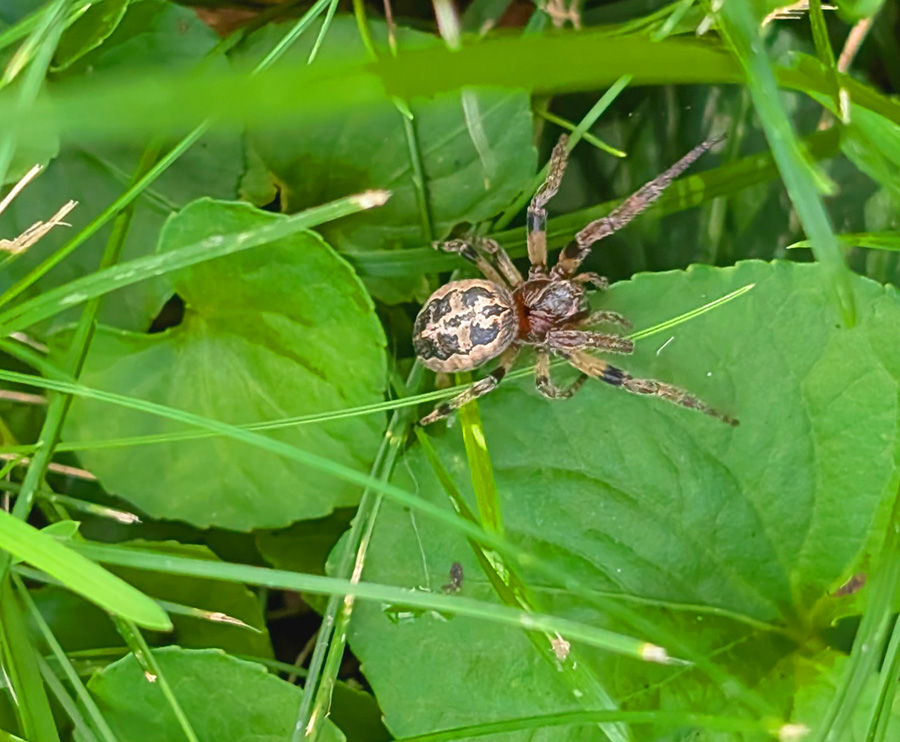
Larinioides cornutus
Taxonomy
- Domain: Eukaryota
- Kingdom: Animalia
- Phylum: Arthropoda
- Subphylum: Chelicerata
- Class: Arachnida
- Order: Araneae
- Infraorder: Araneomorphae
- Family: Araneidae
- Genus: Larinioides
- Species: Larinioides cornutus (Clerck, 1757)
The species carries an unusually long synonymy — Epeira apoclisa, Araneus cornutus, Nuctenea cornuta, and dozens more. It has been described and redescribed repeatedly across two and a half centuries of European arachnology.
Common Names by Region
- United States / Canada: Furrow orbweaver, furrow spider
- United Kingdom / Ireland: Furrow spider, foliate spider
- General: Foliate spider, furrow orb spider
- Etymology: All the common names describe the same thing — the folium, the dark leaf-shaped or furrowed marking down the top of the abdomen. Cornutus is Latin for horned.
Description
Quick ID
- Abdomen: Large, oval, bulbous, and somewhat flattened top to bottom, overhanging the front of the carapace.
- The folium: A bold dark marking running the length of the abdomen — darkest along its outer edges and fading toward the center, with pale transverse bars toward the rear. The sides of the abdomen below the folium are unmarked. This is the whole identification.
- Ground color: Highly variable — cream, tan, gray, olive, orange-brown, red, or nearly black. Do not key on color.
- Carapace: Pale brown, covered in white hairs, usually with a lighter arrow-shaped mark pointing forward toward the head.
- Legs: Short, stout, spiny, and faintly banded — not the long slender legs of a running hunter.
- Eyes: Eight, in a horizontal row of six with an additional pair set above the center.
- Size: Female body length 6–14 mm, male 5–9 mm. Leg span 18–35 mm. Females noticeably larger.
Separating it from a wolf spider: these get confused constantly, and the confusion is worth naming. Wolf spiders (Lycosidae) are ground hunters with long slender legs, a longitudinally banded abdomen, and no web. Orbweavers sit at a web hub with legs I and II held forward together and III and IV angled back, carry a rounded high-domed abdomen with a blocky folium, and have short thick spiny legs. If there is silk strung through the grass around the animal, it is not a wolf spider.
Range
Holarctic — one of the most widely distributed spiders in the northern hemisphere.
- North America: northern Mexico through the United States and Canada into southern and eastern Alaska
- Europe: essentially ubiquitous
- Asia: western Asia through Russia, into eastern China, Japan, and the Korean and Kamchatka peninsulas
- Africa: northeastern Algeria and Egypt
- Single scattered records from Australia, Greenland, and Iceland
Habitat & Behavior
- Moist ground and the edges of water. Lake and pond margins, streamsides, marsh edges, damp rough grassland, and meadows. Also common on bridges, barns, posts, fences, and houses — any structure near water with something to anchor silk to.
- Webs are built between grass stems and in low shrubbery, and on man-made structures.
- Nocturnal. The spider spends the day in a silken retreat — a curled leaf or a tube open at the bottom, camouflaged with bits of plant and prey debris — connected to the web by a signal line. It comes out to the hub at dusk.
- The web is rebuilt in the evening. Orb webs degrade fast, and daily reconstruction is standard for the family. Many orbweavers consume the old silk and recycle the protein.
- Finding one sitting exposed at the hub in daylight, as in these photographs, is not the usual pattern — often a disturbed spider, a spider on a dull overcast day, or one that has not yet retreated.
- Does not hibernate. Instead of shutting down for winter, it runs an annual cycle of cold hardening: the supercooling point sits near −8 °C in summer and drops to about −20 °C in winter. Adults can be found year-round.
Diet
- Generalist insectivore. Flying insects taken in the web — midges, mosquitoes, crane flies, small moths, and whatever else the site produces.
- The strong association with water tracks the prey. Emerging aquatic insects are abundant, predictable, and concentrated at the margin, which is the reason for the habitat preference.
- Prey is bitten, wrapped, and either eaten at the hub or carried to the retreat.
Reproduction
- Mating occurs in autumn and again in spring. The male lives on or near the female’s web during this period.
- The female builds a silk cocoon for copulation, sits inside it, and releases pheromones. Males locate her by chemoreception.
- Males frequently do not survive mating. Sexual cannibalism is common in the family.
- The female produces three to five yellow egg sacs through the summer.
- Spiderlings disperse by ballooning — releasing silk into moving air and being carried off.
Threats / Conservation / Notes
- No conservation concern. Among the most abundant and widely distributed spiders in the northern hemisphere, and comfortable in human-modified habitat.
- Harmless to people. Shy, non-aggressive, and quick to drop or retreat. Capable of biting if trapped against skin, but the venom is not medically significant — a bite reads as a pinprick with minor local redness. There is no reason to kill one.
- Predators include birds, wasps (particularly spider-hunting wasps), and other spiders.
Additional Notes
Ecology & Significance
- Nightly mosquito and midge control at the water’s edge, in volume, for free. The ecological service is real and unglamorous.
- A genome reference species. L. cornutus has been sequenced to chromosome level — roughly 2.3 gigabases across 13 chromosomal pseudomolecules including the X₁ and X₂ sex chromosomes — as part of ongoing work on spider silk genetics and arachnid genome architecture.
- Silk as a research subject. Orbweaver capture threads carry viscous adhesive droplets, and the delivery mechanism of that glue has been studied in this species specifically. Orb-weaver silk remains one of the more actively pursued biomaterials targets.
- Spiders hear. The old claim that spiders are deaf is wrong. L. cornutus and its relatives detect airborne sound through filiform hairs and specialized setae on the legs, sensitive enough to register air movement from a distance.
- The dry-habitat problem. A closely similar form, L. folium, occupies dry habitat and may be a distinct species. The two are difficult to separate, and the boundary between them is unsettled.
Field Notes
- Look for the web, not the spider. During the day the orb often appears empty. The occupant is in a retreat at the edge, on a signal line, waiting.
- Night with a headlamp is the productive way to find them. They come to the hub after dark, and the web catches the beam.
- Color is not a useful field character in this species. Work from the folium outline and the leg build.
- The pale arrow on the carapace pointing toward the head is a reliable secondary mark when the abdomen pattern is ambiguous.
All Cernunnos Foundation materials are free to use for any educational purpose.
Post Views: 138