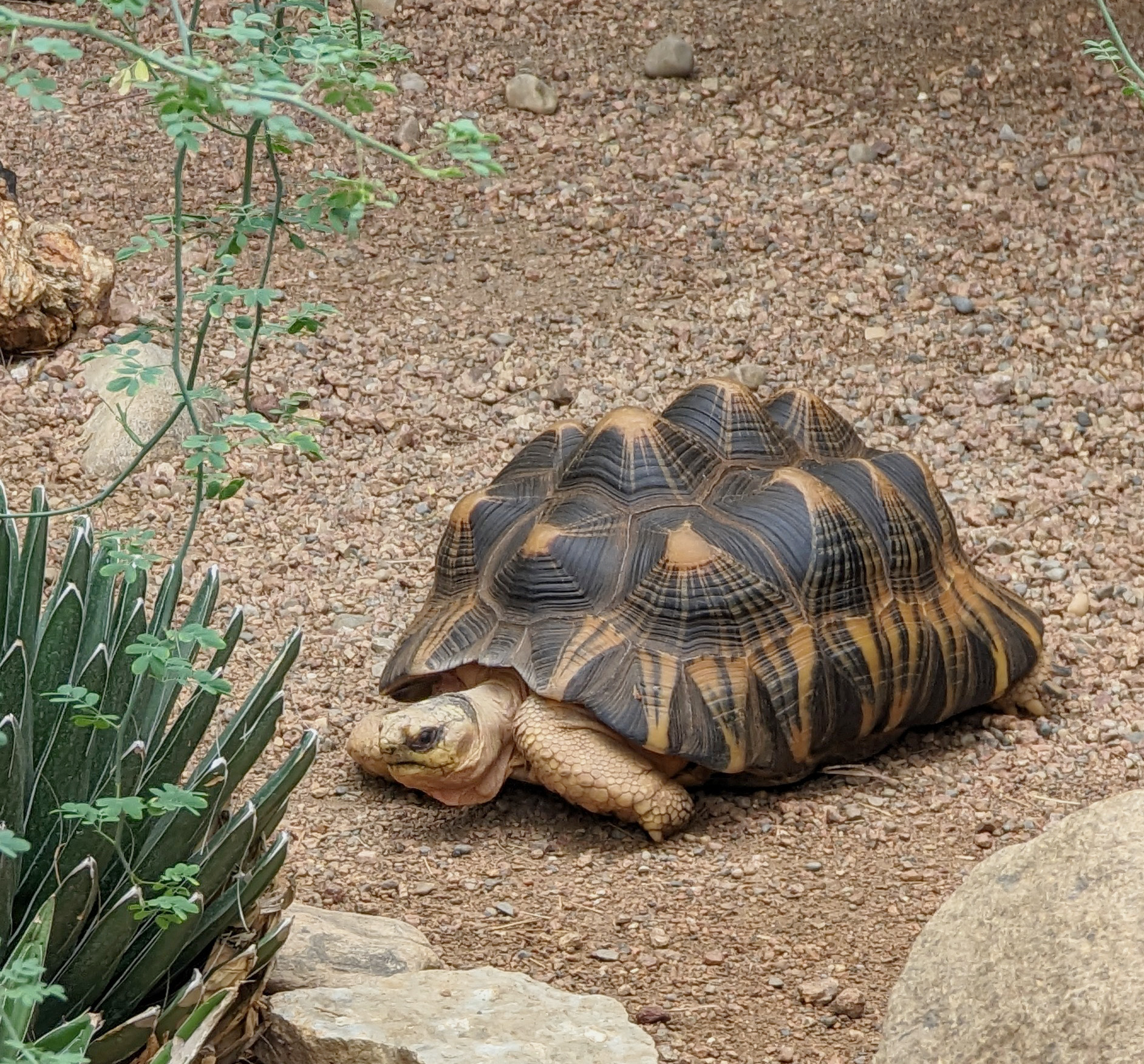
Astrochelys radiata
Taxonomy
- Domain: Eukaryota
- Kingdom: Animalia
- Phylum: Chordata
- Class: Reptilia
- Order: Testudines
- Suborder: Cryptodira
- Family: Testudinidae
- Genus: Astrochelys
- Species: Astrochelys radiata (Shaw, 1802)
The genus holds two species, both Malagasy and both critically endangered: this one and the ploughshare tortoise or angonoka, A. yniphora.
Common Names by Region
- United States / exhibit trade: Radiated tortoise
- Madagascar (Malagasy): Sokake
- General: Star tortoise (informally, though that name properly belongs to the Indian and Burmese Geochelone species)
- Etymology: Astrochelys combines the Greek astron, star, with chelys, tortoise. Radiata is Latin for rayed. Both halves of the name describe the same thing — the yellow lines radiating outward from the center of each shell plate.
Description
Quick ID
- Carapace: High-domed and elongate-oval, dark brown to black, with sharply defined yellow rays running outward from a central point on each scute. The pattern is geometric and clean-edged, and it is the whole identification.
- Pattern quality: Most vivid in juveniles and subadults; the rays broaden and can dull somewhat with age. No two animals are marked identically.
- Plastron: Pale cream to yellow with darker markings along the seams.
- Head: Yellow, with a distinctive dark patch on the crown. The rest of the skin is yellow to pale tan.
- Limbs: Stout, heavily scaled, and built for walking over dry thorny ground. Elephantine rather than clawed for digging.
- Size: Carapace length 28–40 cm in males, 24–36 cm in females, with the maximum reported around 41 cm. Weight commonly to 16 kg, with exceptional individuals well beyond — a confiscated female held in Antananarivo reached 24 kg.
- Sexes: Males average slightly larger, with a longer tail and a concave plastron.
Range
- Endemic to southern and southwestern Madagascar, where it is confined to the spiny forest of the Androy and Anosy regions.
- Introduced populations exist on Réunion, Mauritius, and the Seychelles, established from animals kept as pets.
- The species has disappeared from roughly 40% of its original range. Contraction is ongoing and follows the road network — accessible forest empties first.
Habitat & Behavior
- Spiny forest and dry thorn scrub — one of the strangest plant communities on Earth, dominated by octopus trees (Didiereaceae), Madagascar ocotillo, and tree euphorbias, most of it endemic and most of it armed. The forest is difficult for a person to cross without injury.
- Diurnal, most active in morning and late afternoon, sheltering under vegetation through the heat of the day.
- Terrestrial and slow-moving. No climbing, no swimming, minimal digging.
- Cold-intolerant. Night temperatures below roughly 15 °C (60 °F) are a problem, which constrains where the species can be kept outdoors.
- Historically enormously abundant — in some reserves the animals were reportedly thick enough on the ground that visitors had to watch their footing. The estimated historic population runs to around 12 million.
Diet
- Herbivorous grazer, with grazing making up roughly 80–90% of intake. Grasses and low herbaceous plants form the base.
- Fruits and succulents supplement it. Opuntia cactus fruit is a documented favorite, and animals will cross open ground and roads to reach it.
- Seed dispersal is the ecological payoff. Fruit passes through and is deposited elsewhere in the forest, which makes the tortoise a working part of spiny-forest regeneration rather than just a resident of it.
Reproduction
- Courtship involves the male following, bobbing the head, and sometimes ramming the female’s shell.
- Clutches of three to twelve eggs, buried in a nest chamber dug by the female. Several clutches may be laid in a season.
- Incubation is long — commonly five to eight months, varying with temperature.
- Hatchlings emerge at around 3–4 cm with the ray pattern already fully formed and at its most vivid.
- Sexual maturity takes 15 to 20 years. This is the number that matters for conservation: a poached adult represents two decades of growth that cannot be replaced quickly, and a population stripped of adults does not bounce back on any human timescale.
Threats / Conservation / Notes
- Critically Endangered (IUCN), listed on CITES Appendix I. Commercial trade in wild-caught animals is illegal.
- The scale of the poaching is difficult to overstate. A single 2018 seizure recovered more than 10,000 tortoises from one house. Over 24,000 confiscated animals have been held in rehabilitation facilities in Madagascar, managed primarily by the Turtle Survival Alliance.
- Two demands drive it: the illegal pet trade, where the shell pattern is the selling point, and bushmeat.
- Habitat loss compounds it — spiny forest is cleared for agriculture and cut for charcoal production.
- The taboo collapse. For generations the species was protected by fady, local taboo prohibiting the harming or eating of tortoises, enforced through ancestral obligation rather than law. That protection held better than any statute. It has eroded under migration into the region and severe poverty, and the collapse of the taboo tracks closely with the collapse of the population. It’s a hard case study in what happens when informal protection fails and formal enforcement isn’t there to replace it.
- Rewilding is underway. Conservation groups working with local communities are returning confiscated tortoises to spiny forest at scale — a program aiming at roughly 20,000 animals. Community partnership is the load-bearing element; releases into unwatched forest simply restock the poachers.
- Captive breeding is coordinated through the AZA Species Survival Plan, with a North American studbook population in the hundreds.
Additional Notes
Ecology & Significance
- Extreme longevity. Well past a century routinely. Tu’i Malila, a radiated tortoise reportedly given to the Tongan royal family by Captain Cook, died in 1965 at an estimated 188 years — the oldest reliably documented individual of the species and one of the oldest recorded vertebrates of any kind.
- The shell is living tissue. Scutes are keratin over bone, and the bone carries blood vessels and nerves. A tortoise feels contact on its shell. This is worth stating plainly because the assumption that the shell is inert armor underlies a lot of casual mishandling.
- The species is a cultural emblem of southern Madagascar, and its decline is legible locally as loss of something that belonged to the region rather than as an abstract conservation statistic.
- Madagascar’s tortoises, like its lemurs, are the product of long isolation. Four endemic tortoise species; all four are threatened.
In Exhibits
- Housed in warm, dry enclosures with basking sites, low humidity, and deep substrate. The gravel-and-rock desert planting shown here is standard.
- Diet in captivity is grass-based hay and leafy greens, with fruit strictly limited. High-protein or high-fruit feeding produces pyramiding — abnormal upward growth of the scutes — and this is the most common husbandry failure in the species.
- Indoor winter housing is required in any temperate climate given the cold intolerance.
- Widely held and reasonably well bred in accredited collections, and the captive population functions as a genuine reserve.
- Exhibit animals are individually identifiable by shell pattern, which makes record-keeping straightforward and makes photographic identification of trafficked animals possible.
All Cernunnos Foundation materials are free to use for any educational purpose.
Post Views: 148