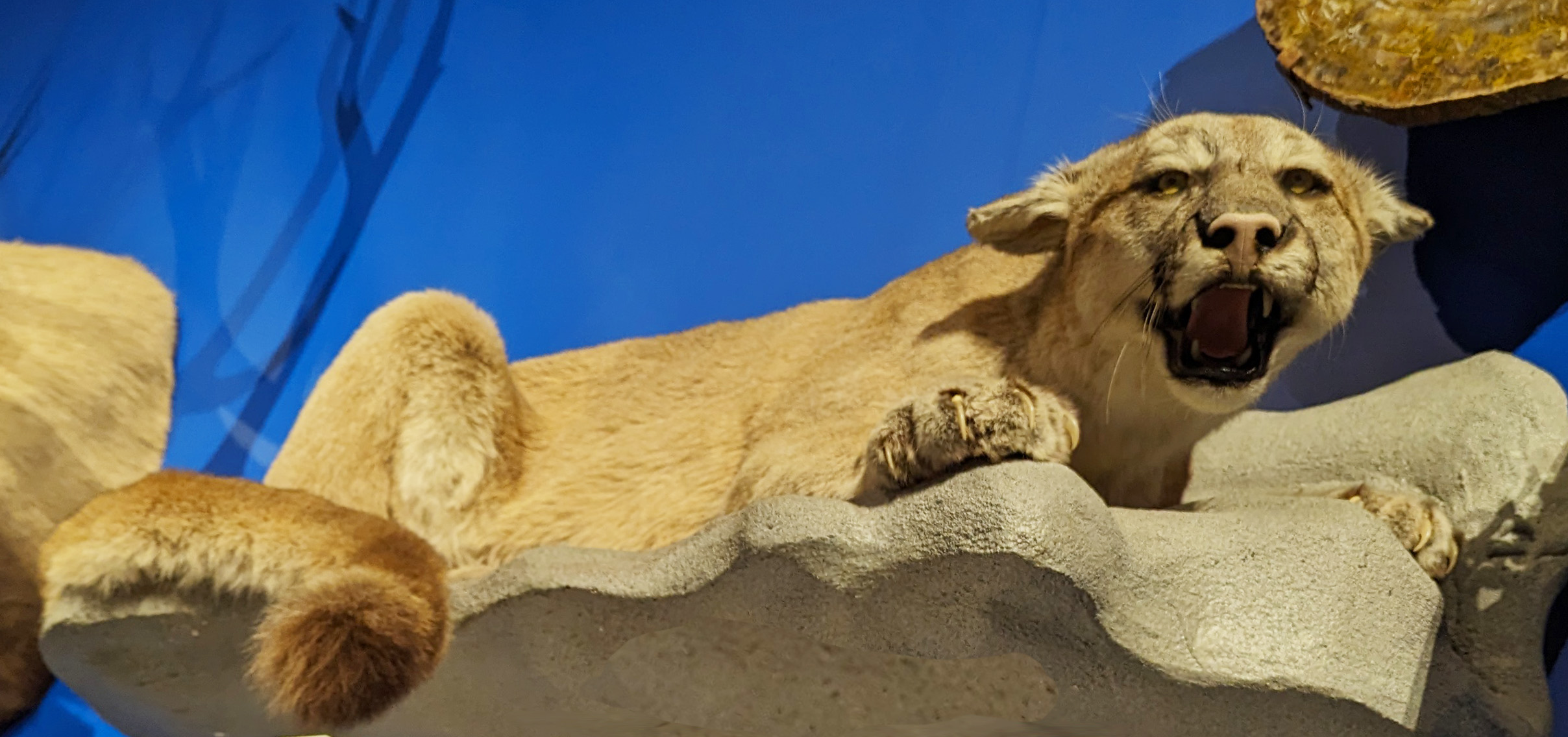
On subspecies: thirty-two were described in 1946 on the basis of coat and size differences. Genetic work beginning in the 1990s collapsed that to six, only one of which — P. c. couguar — occupies all of North America. Every mountain lion from British Columbia to Florida belongs to the same subspecies.
Common Names by Region
The species holds more English common names than any other animal in North America — a consequence of being encountered independently by many different groups of people across two continents.
Western United States: Mountain lion, cougar
Eastern United States / New England: Catamount, panther, painter
Etymology:Puma comes from Quechua. Concolor is Latin for “of one color,” describing the uniform adult coat. “Cougar” traces through French and Portuguese from a Tupi word. “Catamount” is a contraction of “cat of the mountain.”
Description
Quick ID
Coat: Uniform and unpatterned in adults — tawny, buff, gray-brown, or reddish, paler on the underside. The lack of markings is diagnostic; no spots, no rosettes, no stripes.
Face: Pale muzzle with black markings around the nose and along the sides of the muzzle, and black backs to the ears.
Tail: Long, thick, cylindrical, roughly a third of total length, with a dark tip. The tail alone rules out bobcat and lynx.
Build: Deep chest, powerful hindquarters, hind legs longer than the front — a build for leaping and short pursuit rather than distance running.
Size: Second-largest cat in the Americas after the jaguar. Head and body 1.0–1.8 m, tail 0.6–0.9 m. Males 53–100 kg, females 29–64 kg. Northern and southern populations run larger than tropical ones.
Kittens: Heavily spotted with blue eyes, losing the pattern over the first year. A spotted cat the size of a housecat with a long tail is a puma kitten, not a bobcat.
Skeletal Notes
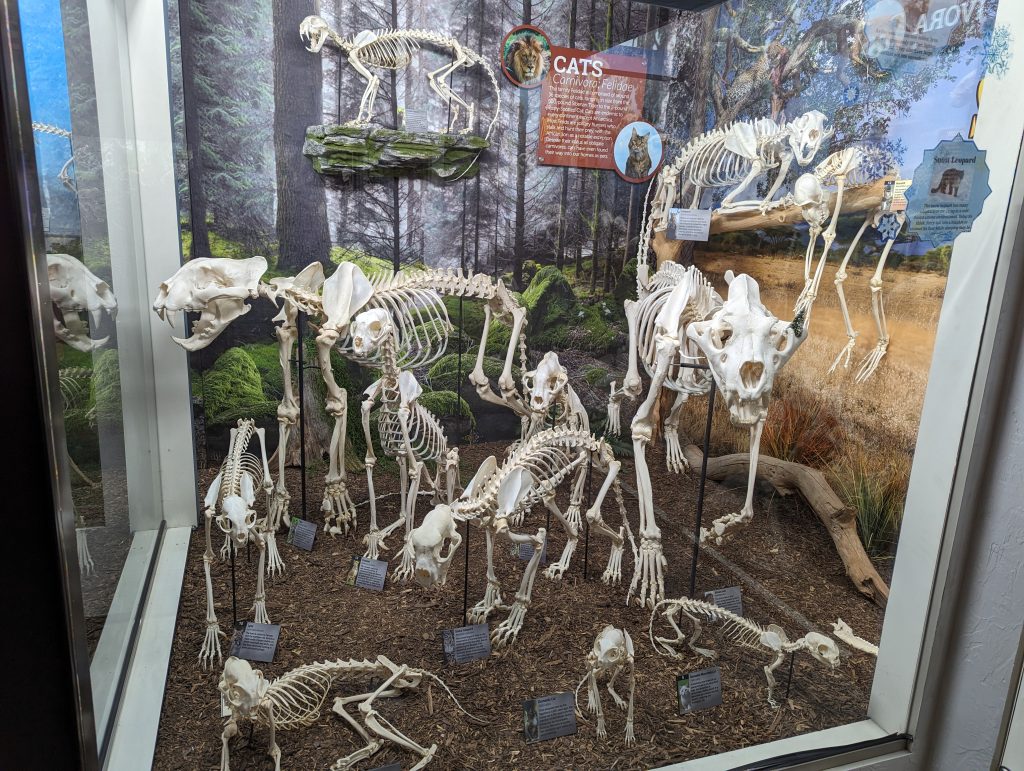
The comparative case photographed here places Puma concolor alongside lion, leopard, snow leopard, cheetah, lynx, clouded leopard, and domestic cat. A few things read directly off the bone:
Fully retractable claws with the terminal toe bone rotating back into a sheath — shared with all felids except the cheetah, whose claws stay semi-extended and whose skeleton in this case is visibly different in the foot.
Short, deep skull with a reduced snout — the felid signature, delivering high bite force over a short lever arm.
Reduced dentition. Cats have fewer teeth than most carnivores, and what remains is specialized: long canines for the killing bite, and carnassial shear for slicing meat. There are no grinding molars because obligate carnivores have nothing to grind.
Puma cannot roar. The hyoid apparatus is fully ossified, as in the small cats, rather than incorporating the elastic ligament that lets Panthera roar. The tradeoff is that pumas purr, and lions cannot. This is a bone difference visible in a skeleton case, and it is why the species sits in Felinae with the domestic cat rather than with the big cats it matches in size.
Range
The most widely distributed large mammal in the Western Hemisphere — from the Yukon to the southern Andes, across every habitat type on two continents.
In the United States, the picture is split. Established breeding populations occupy the west, from the Rockies to the Pacific and south through Texas. East of the Mississippi, the Florida panther is the only breeding population, and it numbers in the low hundreds in south Florida.
The eastern void is not natural. European settlers extirpated the cat across the entire east through bounty hunting, livestock protection, and removal of prey, and the job was complete by the early twentieth century.
Habitat & Behavior
Habitat generalist to a degree matched by few large mammals: montane forest, desert, chaparral, swamp, grassland, tropical forest, and the outskirts of major cities.
Solitary and territorial. Males hold large ranges overlapping several female ranges and avoid one another. Densities are low even in good habitat.
Crepuscular to nocturnal, most active at dawn and dusk.
Ambush hunter. Stalks to close range, then rushes and takes the animal down with a bite to the base of the skull or the throat. It does not pursue over distance.
Extraordinary athletic capability — vertical leaps of 5.5 m and horizontal bounds well past 12 m are documented.
Caches kills. A deer feeds a puma for days; the carcass is dragged to cover and buried under leaf litter and returned to.
Vocalization: purrs, hisses, growls, chirps, and the scream that gives it the “mountain screamer” name. No roar.
Diet
Obligate carnivore. Cats have lost the metabolic machinery to derive nutrition from plants — this is the physiological fact behind the reduced dentition and short gut.
Deer are the staple across most of the North American range — white-tailed and mule deer. Elk, moose calves, bighorn, and feral hogs where available.
Smaller prey fills gaps: rodents, hares, raccoons, birds, and in South America everything down to insects.
Ecologically load-bearing. In systems where pumas have been removed, deer populations rise, browse pressure increases, and forest regeneration fails. The eastern deer problem and the eastern absence of this animal are the same story told from different ends.
Reproduction
No fixed breeding season across most of the range; births peak in summer in temperate zones.
Gestation roughly 90 days.
Litters of one to six, typically two or three, born spotted and blind in a rock den or dense thicket.
The female raises them alone. Males contribute nothing and will kill unrelated kittens.
Independence at one and a half to two years. Dispersing young males travel enormous distances looking for unoccupied territory — this is the mechanism behind every eastern sighting.
Lifespan 8–13 years in the wild, into the twenties in captivity.
Threats / Conservation / Notes
Least Concern globally (IUCN) given the enormous range, but the status is uneven and regional populations are in trouble.
Habitat fragmentation is the central threat. Pumas need large territories and connected corridors; roads and development cut both.
Vehicle strikes, hunting, depredation removals, and rodenticide poisoning are the direct causes of mortality in populations near people.
Inbreeding in isolated populations. The Florida panther nearly failed on this — the population dropped low enough that genetic defects appeared, and a 1995 introduction of Texas females restored viability. It is one of the clearest demonstrations available of genetic rescue working.
The eastern cougar delisting. In 2018 the U.S. Fish and Wildlife Service removed the eastern puma from the endangered species list on the grounds that it was extinct, with no confirmed sighting since the 1930s. The framing drew objection from cougar biologists, on a specific and worthwhile point: the 1946 subspecies designation doesn’t survive modern genetics. The eastern cougar was never a distinct subspecies. The accurate statement is that the North American mountain lion is locally extinct in the northeast — the same animal is alive and well in Idaho. What was lost was a population, not a lineage, and that distinction determines whether recolonization is possible.
It is happening, slowly. A young male killed by a vehicle in Connecticut in 2011 was genetically traced to the Black Hills of South Dakota, roughly 1,500 miles away. Midwestern populations have been sending dispersers east since the 1990s. Whether they establish is another question: dispersers are overwhelmingly young males, females move far shorter distances, and almost no cat documented in the midwest in twenty-five years has been older than three. Without females, there is no population — only a long series of individual animals dying alone in unfamiliar country.
Additional Notes
Ecology & Significance
A cat that purrs. Size puts Puma concolor among the big cats; anatomy puts it with the small ones. It is more closely related to the domestic cat than to the leopard, and the jaguarundi is its nearest living relative. The cheetah’s ancestry also traces to this lineage.
Apex predator function across an enormous range of ecosystems, and one of the most complete natural experiments available in what happens when an apex predator is removed — the east has been running that experiment for a century.
Cultural weight across both continents, from Andean Quechua traditions to Appalachian panther folklore. The multiplicity of English names is itself a record of how many separate communities encountered this animal and named it independently.
Pennsylvania Note
Pennsylvania had mountain lions. The last confirmed animal was killed in the late nineteenth century, and reported sightings have continued unbroken ever since — nearly all of them bobcats, large dogs, or house cats seen at distance. The Game Commission’s position is that no breeding population exists in the state.
That is almost certainly correct, and it is also worth saying that a single dispersing male crossing Pennsylvania is not implausible. One reached Connecticut. Photographic and genetic evidence is what separates a record from a story, which is why trail cameras matter more than eyewitness accounts on this particular animal.
On the Museums
Both photographs come from the Norman and Oklahoma City area, and both institutions are worth the trip.
The Sam Noble Oklahoma Museum of Natural History on the University of Oklahoma campus in Norman holds the mount shown here.
The Museum of Osteology in Oklahoma City is something else — an entire museum of comparative skeletal anatomy, with the Felidae case shown here as one small part of it. For anyone drawing animals, studying comparative anatomy, or simply wanting to see how the same set of bones gets rearranged into thirty-six different cats, it is one of the best rooms in the country. Artists in particular should go. There is no substitute for standing in front of the actual articulation.
All Cernunnos Foundation materials are free to use for any educational purpose.