
Kingdom: Plantae
Clade: Tracheophytes
Clade: Angiosperms
Clade: Eudicots
Clade: Asterids
Order: Ericales
Family: Ericaceae
Subfamily: Ericoideae
Genus: Kalmia
Species: Kalmia latifolia L.
Seven or eight species in the genus, including sheep laurel (K. angustifolia) and bog laurel (K. polifolia). The family also holds Rhododendron, Erica, blueberries, huckleberries, and Indian pipe.
Pennsylvania / general: Mountain laurel
Appalachians: Calico bush, ivy bush, ivybush
Historical / craft use: Spoonwood
Southern Appalachia: Laurel, clamoun
Also recorded: Lambkill, sheep laurel — though those names properly belong to K. angustifolia and the confusion has caused real problems in the livestock literature
Etymology: Kalmia honors Peter Kalm, the Swedish botanist and student of Linnaeus who traveled Pennsylvania and the surrounding colonies in the 1740s collecting for the Crown. Latifolia is Latin for broad-leaved.
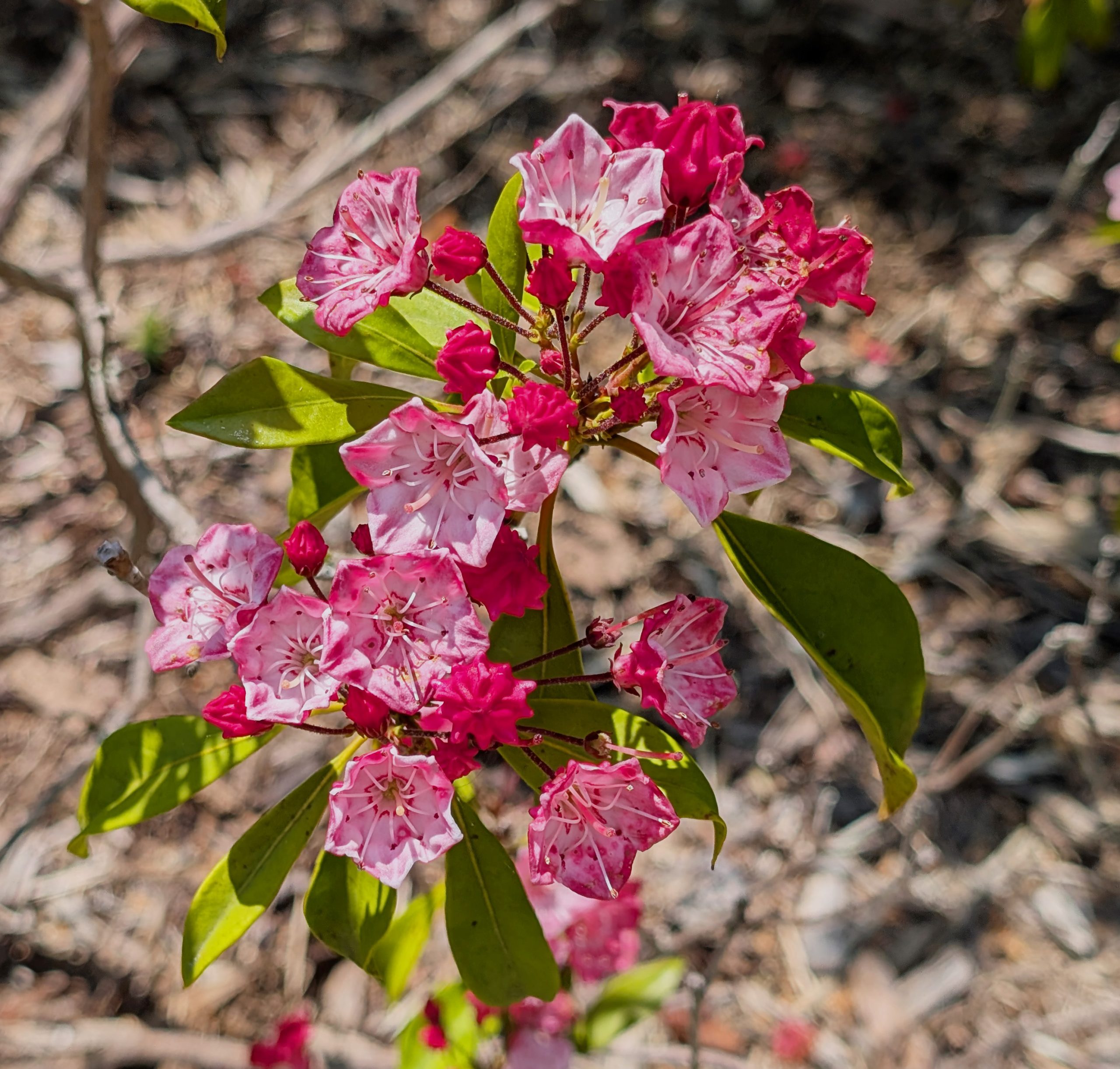
Calico bush comes from the spotted flower interior, which early colonists thought resembled printed calico fabric. Spoonwood is literal — the wood is hard and close-grained, and both Native peoples and settlers carved utensils from it.
An evergreen shrub, sometimes reaching small-tree size. Young plants are dense and rounded; old ones become gnarled, open, and picturesquely twisted, with sinuous multiple trunks. In the southern Appalachians it forms nearly impenetrable thickets — the “laurel hells” that shaped where trails could and could not go.
Growth is slow. A large old specimen represents decades.
It also carries basal burls and resprouts vigorously after fire, spreading faster where burns have been more severe.
Height: 2–5 m (7–15 ft) typically; up to 9 m (30 ft) in the southern part of the range
Spread: Roughly equal to height, wider in thickets
Evergreen leathery alternate leaves plus clustered cup-shaped flowers with ribbed buds and spotted interiors. Separates from rhododendron, which has larger leaves and larger bell-shaped flowers, and from sheep laurel, which is smaller with flowers borne below the leaves rather than at the tips.
Field note
This is the reason to stop and look at a mountain laurel rather than walk past it.
As the flower opens, the filaments bend backward and lodge each anther in a pocket in the corolla wall. The growing flower is winding itself up — the filaments hold real tension, like a cocked spring. Ten of them, arranged in a ring.
When a bee lands and pushes into the cup, it releases the catch. The filaments snap forward and fling pollen onto the underside of the insect — measured at distances up to 15 cm, which is enormous relative to a flower this size. The Harvard Gazette called it one of the fastest-moving plants on Earth, and high-speed camera work has been used to track the kinematics.
Lyman J. Briggs spent his retirement on this problem in the 1950s, after directing the National Bureau of Standards. He suspected liquid under negative pressure inside the filament was generating the force. His manuscript was unfinished when he died, and a 2014 reanalysis found his mechanism wasn’t the whole answer. The full biophysics of how the flower stores and releases that energy remains unresolved.
A 2018 study confirmed the ecological payoff: bees are the primary trigger, and insect visitation substantially improves fertilization success.
To see it: find a cluster with unsprung flowers — the anthers still visibly seated in their pockets — and touch the center gently with a grass stem. The flower will fire. It works once per flower.
Native to the eastern United States, from southern Maine south to northern Florida and west to Indiana and Louisiana. It is a plant of rocky slopes, ridges, acidic woodland, and mountain forest — often on ground too thin and sour for much else.
State flower of Pennsylvania and Connecticut. Pennsylvania adopted it on May 5, 1933, when Governor Gifford Pinchot signed the bill. Two competing bills were in play; the pink azalea was the other candidate. The Pennsylvania Federation of Women’s Clubs campaigned for the laurel, and the story that Pinchot’s wife favored it has followed the decision ever since.
Local note: the Laurel Highlands of southwestern Pennsylvania are named for this shrub. So are Laurel County, Kentucky, and Laurel, Mississippi. Anyone living in Cambria or Somerset County lives inside a place named after a plant, and the June bloom on the ridges is the reason.
Hardy roughly USDA zones 4–9.
Field note
All parts of this plant are poisonous — leaves, flowers, nectar, twigs, pollen. The active compounds are grayanotoxins, shared with rhododendron and azalea across the heath family.
The mechanism: grayanotoxins bind sodium channels in nerve and muscle cells and hold them open. Symptoms are salivation, vomiting, slowed heart rate, dropping blood pressure, weakness, and in serious cases cardiac collapse.
Livestock losses are real and historically significant. Sheep, goats, cattle, and horses are all susceptible, and browsing animals turned out onto laurel ground in early spring, before other forage is up, are the classic case.
Mad honey. Bees working Kalmia and Rhododendron produce honey carrying grayanotoxins. Xenophon recorded Greek soldiers incapacitated by it in 401 BC, and the phenomenon is still documented in Turkey and Nepal where the honey is deliberately harvested. Honey from areas with heavy laurel bloom warrants caution.
Toxic to dogs, cats, and horses (ASPCA). Do not burn the wood in an enclosed space, and do not use the twigs as skewers — that specific mistake has caused poisonings.
This site is open for educational use. Teachers and students are welcome to adapt, translate, and reuse this material with attribution.