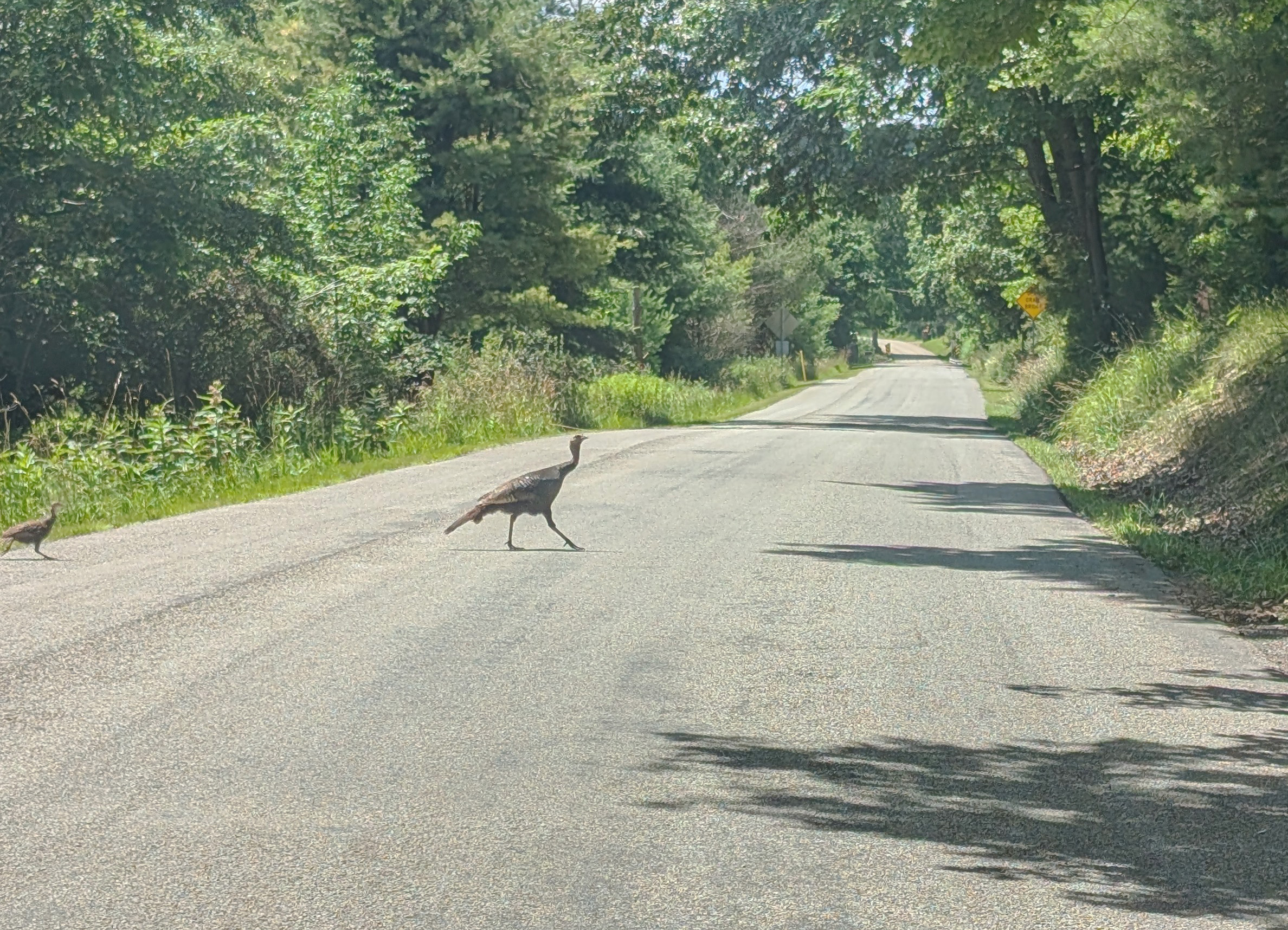
Meleagris gallopavo
Taxonomy
- Domain: Eukaryota
- Kingdom: Animalia
- Phylum: Chordata
- Class: Aves
- Order: Galliformes
- Family: Phasianidae
- Genus: Meleagris
- Species: Meleagris gallopavo Linnaeus, 1758
- Subspecies in Pennsylvania: M. g. silvestris (Vieillot, 1817), the eastern wild turkey
Five or six subspecies are recognized: eastern, Osceola (Florida), Rio Grande, Merriam’s, Gould’s, and the south Mexican. Only one other species exists in the genus — the ocellated turkey of the Yucatán.
Common Names by Region
- United States / general: Wild turkey, eastern wild turkey, ass kickin chicken
- Hunting usage: Gobbler or tom (adult male), jake (juvenile male), hen (female), poult (chick)
- Etymology: Meleagris is Ancient Greek for guineafowl. Gallopavo is Medieval Latin, roughly “chicken-peacock.” Silvestris means “of the forest.”
Why it’s called a turkey: the name is a shipping error. Guineafowl reached England through Ottoman Turkish traders and were called turkey-fowl. When Spanish ships brought the domesticated Mexican bird to Europe, English speakers filed it under the same heading. A North American bird carries the name of a country it has never seen because of a mistake about a different bird from Africa.
Description
Quick ID
- Size: Large and unmistakable. Gobblers stand 2½ to 3 feet tall, run 3 to 4 feet long, and weigh up to 25 lb with an average near 16. Hens are about a third shorter and half the weight, at 9 to 10 pounds.
- Plumage: Dark brown-black overall with strong iridescence — bronze, copper, green, and violet depending on the light. Each body feather is tipped with a fine dark edge, producing the scaled look.
- Head: Bare and unfeathered. Gobblers show blue and red bare skin that flushes and changes color with excitement; hens are duller and grayer, with more fine feathering on the head.
- Beard: A stiff tuft of modified feathers hanging from the breast — present on nearly all gobblers and on 10 to 20% of hens.
- Spurs: Sharp bony projections on the legs of males, growing longer with age and used in fights.
- Tail: Broad and fan-shaped, spread in display.
- Eastern subspecies specifics: chestnut-brown tail tips and the longest beards of any subspecies.
Wild versus domestic: the wild bird is slimmer, with a smaller head, longer neck, longer and rangier legs, and less fleshy head ornamentation than the domestic turkey. The domestic bird descends from the Mexican subspecies, not from the eastern one, and it cannot fly.
Reading this photograph: a hen crossing with poults behind. In early July poults are still small enough to travel single file at ground level. They can already fly short distances — flight feathers come in fast — but the family is walking.
Range
Native only to North America. Historically across most of the eastern and central United States, into southern Canada and down into Mexico.
Present-day range is larger than the historical one in some directions, following restoration and the bird’s own adaptability. Established in 49 states, including places well outside its original distribution.
In Pennsylvania, statewide.
Habitat & Behavior
- Mature hardwood and mixed forest with openings — the ideal is a mosaic of woods, clearings, field edges, and agricultural land. Some of the highest recorded densities occur in woodlots interspersed with farm ground.
- Roosts in trees at night. Turkeys spend the day on the ground and fly up at dusk. Poults begin roosting above ground as soon as their wing feathers emerge from the shafts, at around two weeks.
- They fly, and fly well for short distances — bursts to 55 mph have been recorded. The “turkeys can’t fly” idea comes from the domestic bird.
- Fast on foot, running to about 25 mph.
- Flocks are seasonal and sex-segregated for much of the year: hens with broods, and separate bachelor groups of gobblers.
- Sharp eyesight, including color vision and a very wide field of view, and this is the main reason they are difficult to approach. Hearing is likewise acute. The sense of smell is poor.
- Gobbling carries a mile or more and peaks in spring. Turkeys also cluck, yelp, purr, putt, and cutt — the vocal repertoire is large and structured.
Diet
- Omnivorous and opportunistic. Acorns and other hard mast are the foundation of the fall and winter diet in Pennsylvania, and acorn crop failure is a real driver of turkey population swings.
- Also seeds, grains, fruits, buds, greens, grasses, and ferns.
- Poults are heavily insectivorous in their first weeks — they need the protein, and insect availability in early summer is one of the limits on brood survival.
- Foraging is by scratching through leaf litter. The characteristic overturned patches of forest floor are turkey sign.
Reproduction
- Gobblers display in spring — tail fanned, wings dragged, body puffed, head flushed red and blue, gobbling to attract hens. Males are polygynous and contribute nothing after mating.
- Ground nests, a simple scrape in leaf litter against a log or in dense cover.
- Clutches of 10 to 14 eggs, laid roughly one per day.
- Incubation about 28 days. The hen sits alone and is enormously vulnerable during it.
- Poults are precocial — down-covered, mobile, and following the hen within a day. They have no wing feathers at hatch and cannot fly, but manage short flights within 10 days to two weeks.
- Renesting after a failed nest is common. Renesting after a successful hatch is nearly unheard of — only three documented occurrences exist in the literature, and none of those broods survived.
- Brood mortality in the first two weeks is the single largest factor in annual population change.
Threats / Conservation / Notes
The Restoration
This is the conservation story worth knowing, and Pennsylvania is central to it.
By the early 1930s the continental wild turkey population had fallen to roughly 30,000 birds — extirpated across most of the historic range, hanging on only in the most rugged and remote country. Logging removed the forest, and market and subsistence hunting removed the birds. The trajectory closely resembled the passenger pigeon’s.
Up to 10% of every wild turkey left in the United States survived in the rugged terrain of south-central Pennsylvania. The refuge was the mountains.
What followed:
- 1914, 1915, 1926 — Pennsylvania closed turkey hunting entirely in those years
- 1929 — the Game Commission established the world’s first wild turkey propagation farm
- 1930s — land acquisition targeted specifically at turkey habitat
- 1954 — the first statewide turkey season in decades
- Late 1950s — the Game Commission began trap-and-transfer, moving wild birds into unoccupied range. This turned out to be the technique that worked, and it was adopted continent-wide.
- 1968 — a minimum fall population of 60,000 birds in Pennsylvania
Today the continental population is around 7 million. From 30,000. It is routinely described as the greatest wildlife restoration success of the twentieth century, and the description is earned.
The critical lesson: pen-raised birds released into the wild largely failed. Wild birds trapped and moved succeeded. Half a century of restoration work across dozens of states rests on that distinction.
Current Concerns
The story is not finished, and the trend has turned.
- Population indices have declined across much of the range over the past two decades, particularly in the southeast, and the causes are not fully resolved.
- Candidates under investigation: declining poult recruitment, habitat maturation and loss of early-successional cover, changes in predator communities, disease, and harvest timing relative to nesting.
- Pennsylvania launched a four-year hen survival study in 2022, run by the Game Commission with Penn State and Penn’s Wildlife Futures program. Maryland and Ohio joined in 2023, New Jersey and West Virginia in 2024. It is one of the larger coordinated multi-state wildlife studies currently running, and the results will shape season structure across the region.
- Rodenticide poisoning is a documented mortality source — 5.1% of radio-tagged Pennsylvania hens in one study died from ingesting rodenticides in fruit orchards.
- West Nile virus affects turkeys, though Pennsylvania birds are showing antibodies, suggesting some population-level resistance is developing.
- Road salt poisoning has been recorded in New York birds.
Predators of eggs and poults include raccoons, skunks, opossums, foxes, coyotes, snakes, and raptors. Adults are taken by coyotes, bobcats, and great horned owls.
Reporting
The Pennsylvania Game Commission runs a Summer Wild Turkey Sighting Survey, and observations from the public feed directly into reproduction and population trend monitoring. A hen with a countable brood on a township road in July is exactly the observation they want. Sighting locations are kept confidential.
Additional Notes
The Franklin Story
Benjamin Franklin did not propose the wild turkey as the national bird. That belief comes from a private letter to his daughter Sarah in 1784, written in criticism of the Society of the Cincinnati’s eagle emblem, which Franklin thought looked like a turkey anyway. He called the bald eagle a bird of bad moral character that lived by theft, and said the turkey was in comparison more respectable and a true original native of America, though vain and silly. It was a joke in a letter, written a year after the seal was already adopted. Worth correcting when it comes up, and worth noting that Franklin’s actual assessment of the turkey was mixed at best.
Ecology & Significance
- Seed and mast dispersal through foraging, and heavy leaf-litter disturbance that affects forest floor invertebrate and seedling communities.
- A domestication that went the wrong direction geographically. Turkeys were domesticated in Mexico, carried to Europe by Spanish ships, and brought back to North America by English colonists who did not initially recognize them as the same animal as the birds already in the woods around them.
- Cultural fixture far out of proportion to most game birds — Thanksgiving, the vocabulary of American idiom, and a permanent place in the iconography of the eastern woods.
Field Notes
- Look for scratched leaf litter in fall woods, and for the three-toed tracks in mud and snow.
- Listen in spring. Gobbling carries and is unmistakable.
- Look up at dusk. Roosting birds silhouette in bare branches, and a roost tree is used repeatedly.
- They are watching you. The eyesight is the reason turkey hunting is difficult, and the reason a bird crossing a road in front of a vehicle is behaving unusually — it has decided the car is not a threat, or has miscalculated.
All Cernunnos Foundation materials are free to use for any educational purpose.
Post Views: 101