
Kingdom: Plantae
Clade: Tracheophytes
Clade: Angiosperms
Clade: Eudicots
Clade: Asterids
Order: Ericales
Family: Sarraceniaceae
Genus: Sarracenia
Species: Sarracenia purpurea L.
Subspecies: S. p. subsp. purpurea (northern) and S. p. subsp. venosa (southern)
Sarraceniaceae holds three genera of New World pitcher plants — Sarracenia, Darlingtonia (the cobra lily of California and Oregon), and Heliamphora (the sun pitchers of the tepuis of Venezuela and Guyana). The family sits in Ericales alongside the heaths, which puts pitcher plants and mountain laurel in the same order.
General / English: Purple pitcher plant, northern pitcher plant, common pitcher plant
Regional and folk: Side-saddle flower, turtle socks, frog’s britches, huntsman’s cup, Adam’s cup, whippoorwill boots
Canada: Pitcher plant — the provincial flower of Newfoundland and Labrador, adopted in 1954
Etymology: Sarracenia honors Michel Sarrazin, a French physician and naturalist working in Quebec in the late 17th and early 18th centuries, who sent specimens to Europe. Purpurea is Latin for purple.
The plant has been known to European botany for a long time — the oldest published illustration appears in Clusius’s Rariorum plantarum historia in 1601.
A perennial rosette-forming herb. Modified leaves develop into pitchers arranged in a low circular clump, with new pitchers produced through the growing season and older ones persisting into a second year.
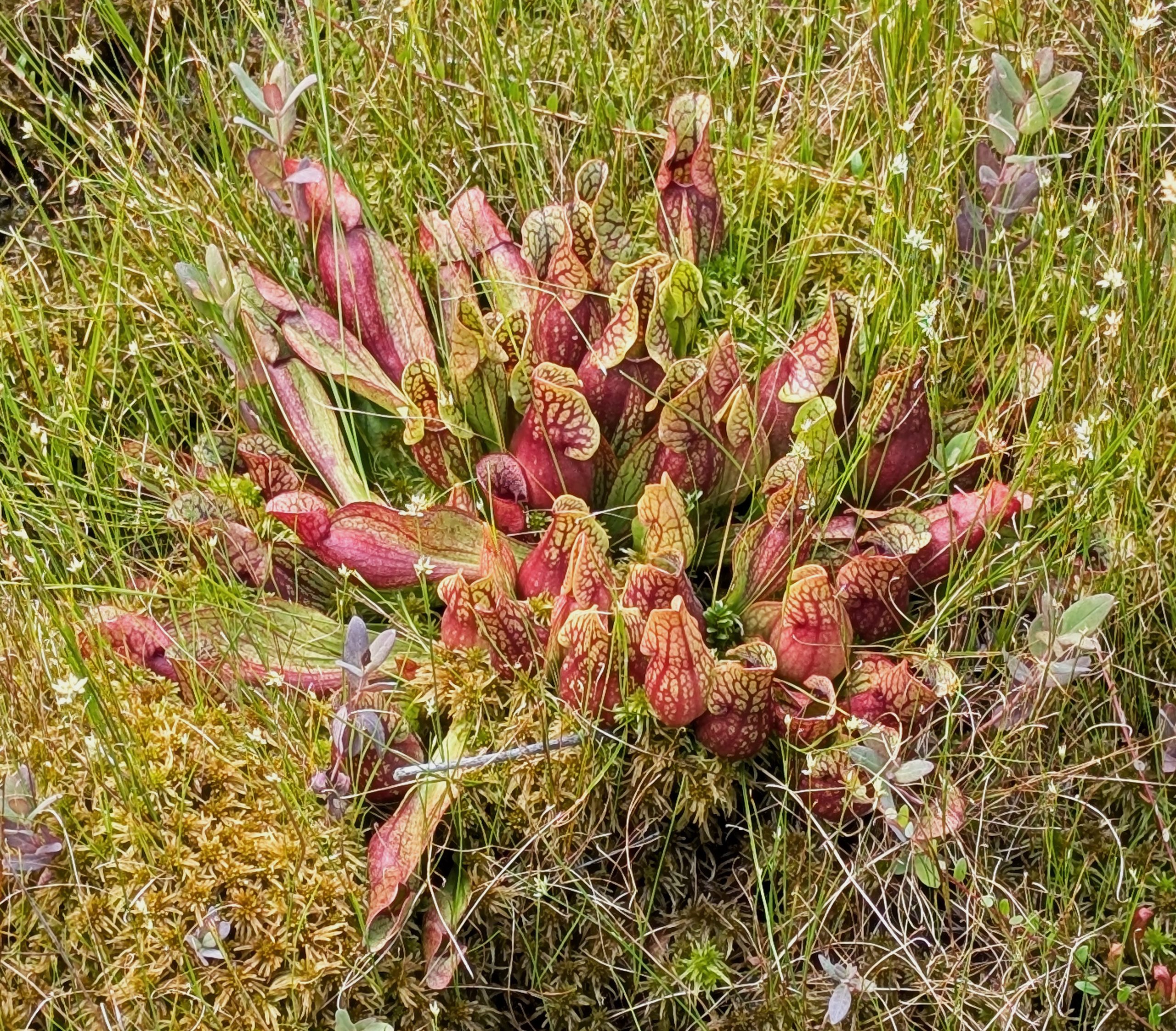
The plant grows from a short rhizome and spreads slowly by branching, forming the multi-crowned clumps visible in the featured photograph. A large clump represents many years.
Long-lived — individual plants persist for decades in stable bog conditions.
Pitcher length: 10–30 cm (4–12 in)
Clump diameter: 15–60 cm, larger in old established plants
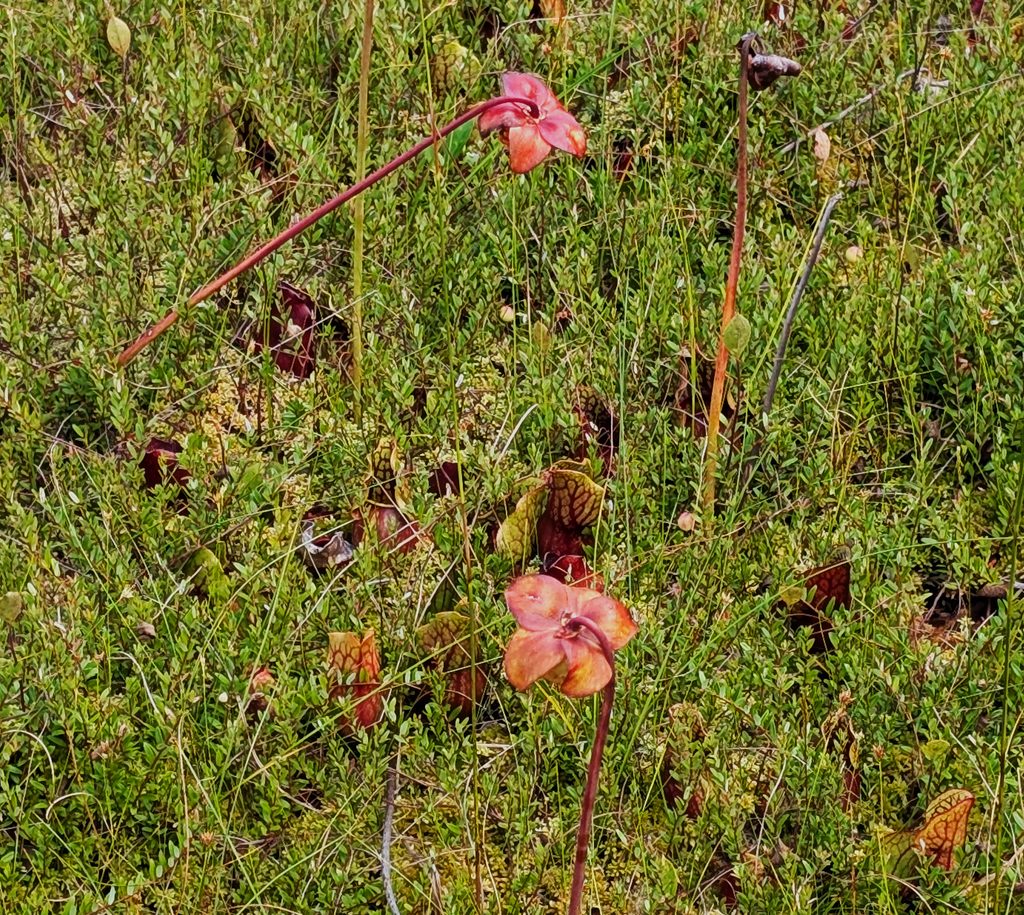
Flower stalk: 20–60 cm, held well above the pitchers
Why the flower is held so high: a carnivorous plant that traps its own pollinators has a problem. Raising the flower on a long scape well above the pitchers separates the trapping apparatus from the reproductive one. Several unrelated carnivorous lineages have arrived at the same arrangement.
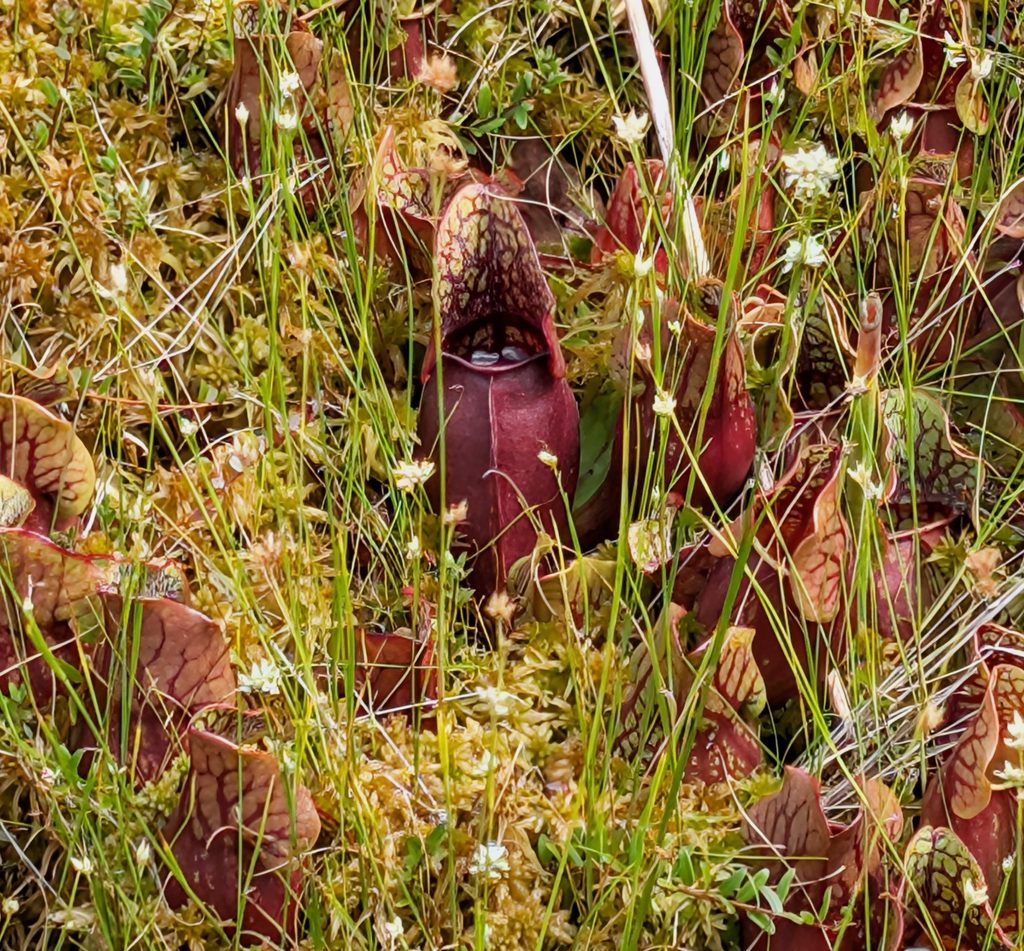
Reclining wine-red pitchers in a ground-level rosette, with an open upright hood and standing water inside, in sphagnum. No other North American pitcher plant lies down or holds rainwater in an open cup.
Field note
Most pitcher plants secrete their own fluid and cover the opening with a lid to keep rain out. S. purpurea does the opposite. It leaves the pitcher open and fills it with rainwater.
What follows from that single design decision is the most interesting thing about this plant.
The plant is a poor digester. New pitchers produce hydrolases and proteases in modest quantity. Older leaves produce very little. Compared with other carnivorous plants, S. purpurea is not well equipped to break down what it catches.
It is also a poor trapper. Studies put capture rates at under 1% of visiting insects. The great majority of what lands on a pitcher walks away.
So it subcontracts the digestion. The water in each pitcher is a self-contained aquatic ecosystem — a phytotelma — and at least 165 species of insects, protozoa, rotifers, algae, bacteria, and fungi have been recorded living in it. Two of them live nowhere else on Earth:
Together with rotifers (including Habrotrocha rosa), protists, and bacteria, these organisms shred and mineralize the captured prey, converting organically bound nitrogen into forms the plant can absorb. The midge larvae break down the bodies; the bacteria and protozoa work the fragments; the plant takes up the products.
The plant catches the food. The tenants do the cooking.
S. purpurea also maintains less acidic pitcher fluid than other carnivorous pitcher plants, which is part of why it can support such a large resident community.
Whether this is mutualism remains an open question. The inquilines consume some of the nitrogen themselves, and a 2008 modeling study framed the relationship explicitly as “mutualism or parasitism?” The mosquito’s relationship with the plant is often classified as commensalism rather than mutualism. It is one of the better-studied and less-resolved symbioses in plant ecology.
The system has become a standard research model. Because each pitcher is a discrete, replicated, self-contained community connected to others by dispersal, ecologists use S. purpurea as a working laboratory for metacommunity theory. One result from this work: pitcher plant food webs show a reverse latitudinal diversity gradient, with more species per community at higher latitudes — the opposite of the pattern found in nearly every other system on Earth.
The widest distribution of any Sarracenia, by a considerable margin.
Across most of Canada from Labrador and Newfoundland west to British Columbia and north into the Northwest Territories, and south through the eastern United States along the coastal plain into Florida and west to Texas.
It is the only pitcher plant across most of the northern part of that range. The other eight or so Sarracenia species are concentrated in the southeastern United States.
Introduced and naturalized in Europe, including Ireland and Switzerland, where it has established in peat bogs and is treated as a problem species in some sites.
In Pennsylvania, native to bogs and poor fens, and uncommon — the distribution tracks the small number of surviving glacial bog systems.
Common associates include the sundews (Drosera rotundifolia and D. intermedia), cranberry, cotton grass, bog rosemary, leatherleaf, and various bog sedges. Several of these are visible around the plants in these photographs.
As with the sundews, sphagnum is the engine. The moss acidifies its surroundings, holds water, and sequesters nutrients as peat, manufacturing the conditions under which a carnivorous strategy pays.
Among the more forgiving carnivorous plants for a bog garden or outdoor container in the north, and hardy far colder than most.
Never collect from the wild. Nursery-propagated plants are widely available. Bog populations recover from disturbance on a timescale of decades, and the plants are protected in many jurisdictions.
This site is open for educational use. Teachers and students are welcome to adapt, translate, and reuse this material with attribution.