
Version 3.0 shipped with five appendices. It has six now.
Appendix F is the species roster. Section 7.4 of the whitepaper specifies seven greenhouse configurations and names a representative handful of organisms to fill them — duckweed, azolla, wolffia, vetiver, willow, hemp, and “submerged accumulators.” Naming the full roster in the main text would have buried the argument under a plant list. So it went here instead: forty-odd species across six pollutant classes, with what each one removes, how much biomass it produces doing it, where the contaminant ends up in the plant, and which configuration it serves.
Species are organized by pollutant class, and within each class from broad-spectrum to element-specific. That ordering carries an inverse relationship that runs through the whole document. As specificity rises, tonnage collapses and concentration factor rises. Tier 1 species do volume work on everything. Tier 3 species produce almost no tonnage and remove the fraction a permit turns on. Noccaea caerulescens concentrates zinc to thirty thousand milligrams per kilogram and yields one to five tonnes a hectare. Salix concentrates a fraction of that and yields twenty. Both belong in the facility. They do not belong in the same cell.
Four screens decide what gets a row: concentration factor, tonnage, accumulation site, and downstream disposition. They are stated at the front of the document specifically so anyone can extend the roster without asking us. New species, same four screens.
The tonnage screen is the one that does the work. Most of the classical hyperaccumulator literature fails it. A plant that concentrates a metal beautifully and produces two tonnes a hectare is a laboratory result, not infrastructure, and this project is not in the business of publishing laboratory results as though they were engineering.
Three things fell out of building it.
Harvest mode is not a growing system question. Shoot accumulators get cut and the container stays in the channel. Root and rhizome accumulators leave whole — root mass and substrate together — and a replanted container takes the position. All three growing systems in Section 7.3 accommodate both, because the container is the unit that moves. This matters more than it sounds. Typha, Phragmites, and bulrush bank most of their uptake below the cut line. Cutting the tops off those species produces the appearance of removal without the substance of it.
Enclosure answers the biological containment question. It does not answer the legal one. Several of the strongest performers in the matrix — water hyacinth, water lettuce, hydrilla, Salvinia molesta, Chinese brake fern — are prohibited or regulated across much of the deployment geography. They are listed because they perform. Listing is not clearance. Section 7.5 requires legal status confirmed before stocking and no stocking while uncertainty persists, and that gate is per-jurisdiction and hard.
The nickel rows carry a precedent and stop there. Berkheya coddii and Alyssum murale are the basis of a working commercial phytomining industry, which cadmium and lead have no equivalent of. That precedent is in the document. Whether recovery is economic at the concentrations an RRP cell actually produces is listed in Section 15 as unresolved, and Appendix F does not assert otherwise. Section 12.2 holds: concentration converts unrecoverable dispersal into a defined stream with options. That is the claim that survives hostile review, and it is the only one being made.
The appendix also surfaced three gaps in Version 3.0, written up as open questions rather than buried. Giant miscanthus carries the highest terrestrial tonnage in the roster and routes cleanly to carbonization, but it is not a bast fiber crop, not a coppice species, and not aquatic — it sits outside all seven configurations. Classical rhizofiltration works on direct root-to-water contact and is blunted by a packed compost pot, so sunflower and its relatives need an open basket that Section 7.3 does not currently specify. And vetiver appears in three of the six classes at twenty to forty tonnes a hectare, carrying nitrogen, divalent cations, and toxic organic load simultaneously, which nothing else in the roster does. If that holds under pilot conditions, it is a configuration-defining species and Section 7.4.5 currently lists it as one of five equivalents.
Every figure in the document is a literature proxy, flagged. No RRP facility has operated. The ranges are given as ranges because the underlying studies disagree, and the disagreement is retained rather than averaged away.
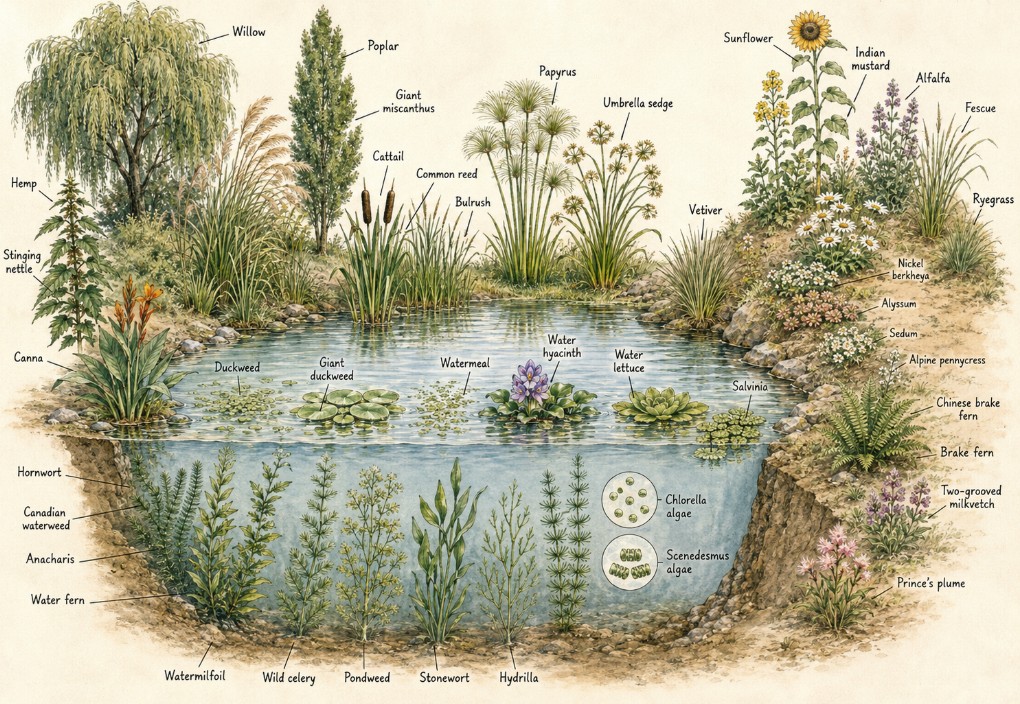
The illustration above is the whole roster in one frame — canopy to sediment, willow and poplar on the bank down through the emergent margin, the floating layer, the submerged column, and the terrestrial hyperaccumulators on the dry slope. Everything in it is in the matrix.
On Japan: still reading. Nothing applicable or new to report yet. That follow-up stands.
Documents
RRP0003-apF — Bioaccumulator Species Matrix (new)
RRP0003 — Consolidated Technical Whitepaper, Version 3.0
RRP0003-apA — Site Selection Matrix
RRP0003-apB — National Watershed Priority Map
RRP0003-apC — Initial Recommended Sites
RRP0003-apD — Master Glossary
RRP0003-apE — Field Documentation Kit
Related: River Refugium Project, Version 3.0 — Released
Open access, no paywall, reproduction and adaptation permitted.