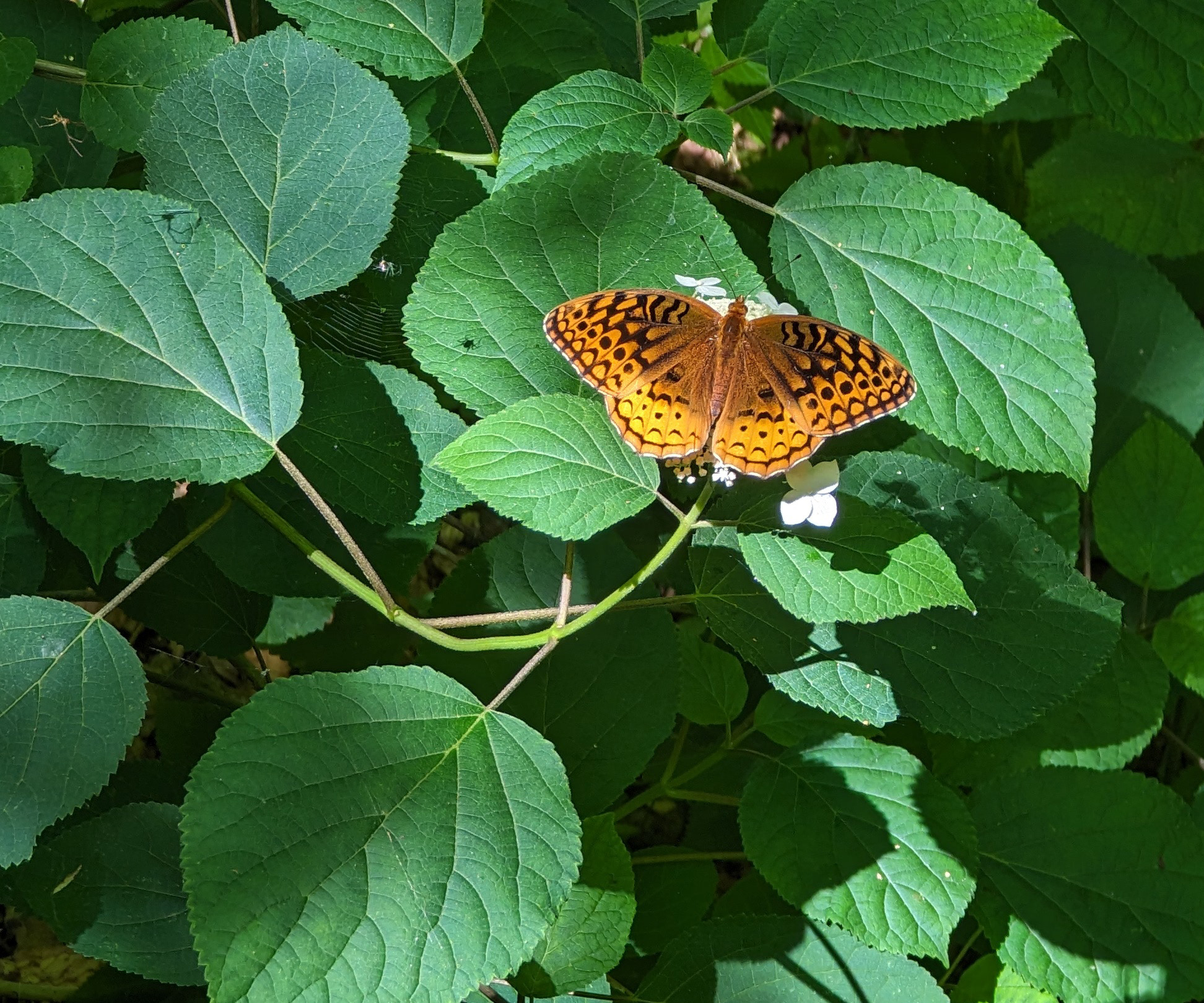
A genus in transition. The New World greater fritillaries have long been placed in Speyeria, but their close relationship to European relatives has led many authorities to move them into Argynnis. Both names are in current use, and Argynnis cybele appears increasingly in recent literature. Roughly 16 species and over 100 subspecies or geographic variants sit in the group.
Described by Johan Christian Fabricius in 1775, from a type specimen collected in New York City.
Common Names by Region
United States / Canada: Great spangled fritillary
Informal: Great spangled, silverspot
Etymology:Speyeria honors Adolph Speyer, a 19th-century German lepidopterist. Cybele is the Anatolian mother goddess, sometimes glossed as “mountain mother.”
“Spangled” refers to the metallic silver spots on the underside of the hindwing — the feature that gives the greater fritillaries their alternate name of silverspots, and which is invisible when the butterfly sits with its wings open as in this photograph.
Description
Quick ID
Size: Wingspan 54–76 mm (2⅛–3 in). A large butterfly, and the largest of the eastern fritillaries.
Upperside: Orange to orange-brown, marked with black chevrons, dashes, and rows of round black spots, darkening toward the wing bases.
Sexes: Females are duskier and darker toward the body, with heavier black markings; males are brighter and cleaner orange. The specimen here reads as a male.
Underside hindwing: Large metallic silver spots on a warm ground, with a broad pale tan submarginal band.
Flight: Powerful, buoyant, and gliding — recognizable at distance before any marking is visible.
Separating the Three
Three large fritillaries overlap across Pennsylvania and New England, and they are superficially near-identical from above.
Great Spangled
Aphrodite
Atlantis
Size
Largest
Intermediate
Smallest
Ventral submarginal band
Broad and pale
Narrow
Narrow
Forewing border
Not black-bordered
Not black-bordered
Black-bordered
The wide pale band on the underside of the hindwing is the working field mark for S. cybele. Size helps but overlaps. Getting a photograph of the closed wings is worth more than three photographs of the open ones.
Range
Southern Canada and the central and northern United States, from the Atlantic to the Pacific.
Absent from the driest western regions and from the coastal side of the Cascades in British Columbia. Occurs from sea level to about 6,000 ft.
Common throughout Pennsylvania.
Habitat & Behavior
Moist deciduous woodland, woodland edges, moist meadows, riparian corridors, and gardens. The combination that matters is violets in shaded ground for the larvae and nectar in the open for the adults — this is an edge species.
Univoltine — a single brood per year, across the entire range.
Flight period roughly mid-June through mid-September in the east, occasionally from May.
Males patrol continuously through the day searching for females, rather than perching and waiting.
Adults are strong fliers and cover ground; they are also readily approachable while nectaring, which is why they photograph well.
Diet
Adults: nectar generalists with strong preferences. Milkweeds, thistles, joe-pye weed, ironweed, bergamot, coneflowers, dogbane, and — as here — wild hydrangea. They favor tall composites and anything with a broad landing platform.
Larvae: violets. Only violets.
Speyeria larvae feed exclusively on native Viola species — common blue violet (V. sororia), round-leaved violet (V. rotundifolia), arrow-leaved violet (V. fimbriatula), bird’s-foot violet (V. pedata), and others depending on region. There is no substitute host. Every greater fritillary in North America is tied to the violets.
The Gamble
Field note — this is the remarkable part
The life cycle of this butterfly is built on a bet that would be difficult to design deliberately.
Late summer. The female — who has spent July and August in reproductive diapause, hidden in woodland and rarely seen — becomes active again and begins laying. She deposits eggs singly and haphazardly, on the ground near violets. Often near violets that have already withered for the season, which means she is laying next to plants that are barely there.
Two to three weeks later the eggs hatch. The first-instar caterpillar eats part of its own eggshell.
Then it stops. It crawls into the leaf litter and enters diapause without ever feeding. It will spend roughly six months — October through April — as an unfed, newly hatched larva, running entirely on the reserves packed into the egg by its mother.
In spring it wakes with the first flush of violet growth in May, and only then eats its first meal — from a plant it must locate itself, in a spot its mother chose the previous August, in a season she never saw.
Then it grows fast. Six instars, rather than the five typical of most butterflies. Feeding strictly at night, hiding under litter by day. Black, bristly, spined from orange-red bases, with two short horns on a black head and a reddish eversible osmeterium beneath. Nearly two inches at full size. Pupation in late May or June, chestnut brown and chunky, suspended under a rock or bark. Adults emerge two to three weeks later, males first by a matter of weeks.
Why the timing is now a conservation problem: the entire strategy depends on the larva’s dormancy ending at the same time the violets leaf out. Warmer winters deplete the metabolic reserves the unfed larva is living on, and warm early springs can break diapause before violets are available — at which point the caterpillar has nothing to eat and dies. Work on Speyeria has found that diapause intensity and desiccation resistance vary between populations and appear heritable, which means there is raw material for adaptation. Whether adaptation can keep pace is the open question.
The genus has become a model group for studying exactly this, and several Speyeria species and subspecies are already threatened or endangered.
Threats / Conservation / Notes
S. cybele itself is secure and common across most of its range — the one member of the genus that most people will see.
Its relatives are not. The Oregon silverspot is federally threatened; several subspecies elsewhere are listed. The reasons vary but always come back to loss of quality larval habitat.
Deer overbrowse is a direct and underappreciated threat. White-tailed deer at current eastern densities eat violets, and violets are the only thing the larvae can eat. A forest understory browsed clean of Viola is a forest that cannot produce fritillaries, regardless of how much nectar is in the meadow next to it.
Habitat fragmentation separates the woodland larval habitat from the open nectar habitat this species needs to move between.
Mowing and herbicide on roadsides and field margins removes both violets and nectar.
Climate-driven diapause mismatch, as above.
Additional Notes
Ecology & Significance
A two-habitat animal. The larvae need shaded moist woodland with violets; the adults need open sunny ground with nectar. Conserving one without the other accomplishes nothing. This makes the species a useful indicator of whether a landscape still has functioning edges rather than isolated blocks.
Reproductive diapause in the female is unusual and easy to misread in the field. A drop in sightings during July and August does not mean the population crashed — the females are in the woods, waiting.
The silver spots are structural rather than pigmented, produced by the microstructure of the scales.
Six instars instead of five is a small anomaly, and probably a consequence of compressing an entire larval development into the short window between violet leaf-out and midsummer.
For the Garden
If you want these butterflies, the requirement is not a butterfly bush.
Plant native violets and let them spread. Viola sororia is common, tough, and self-sows freely.
Leave the leaf litter. The overwintering larva is in it. Fall cleanup removes next year’s butterflies.
Tolerate violets in the lawn. They are the entire limiting factor, and they are the plant most people are actively trying to kill.
Field Notes
Look from late June through August, in the sun, on tall flowers at woodland edges.
Photograph the closed wings if you can. The broad pale band underneath is the identification; the open wings are only a strong guess.
Check the base of the wings for duskiness to sex the animal.
Watch the behavior. A large orange fritillary patrolling steadily and low over a meadow through the middle of the day is a male; one appearing suddenly in late August after weeks of absence is likely a female coming out of diapause to lay.
All Cernunnos Foundation materials are free to use for any educational purpose.