
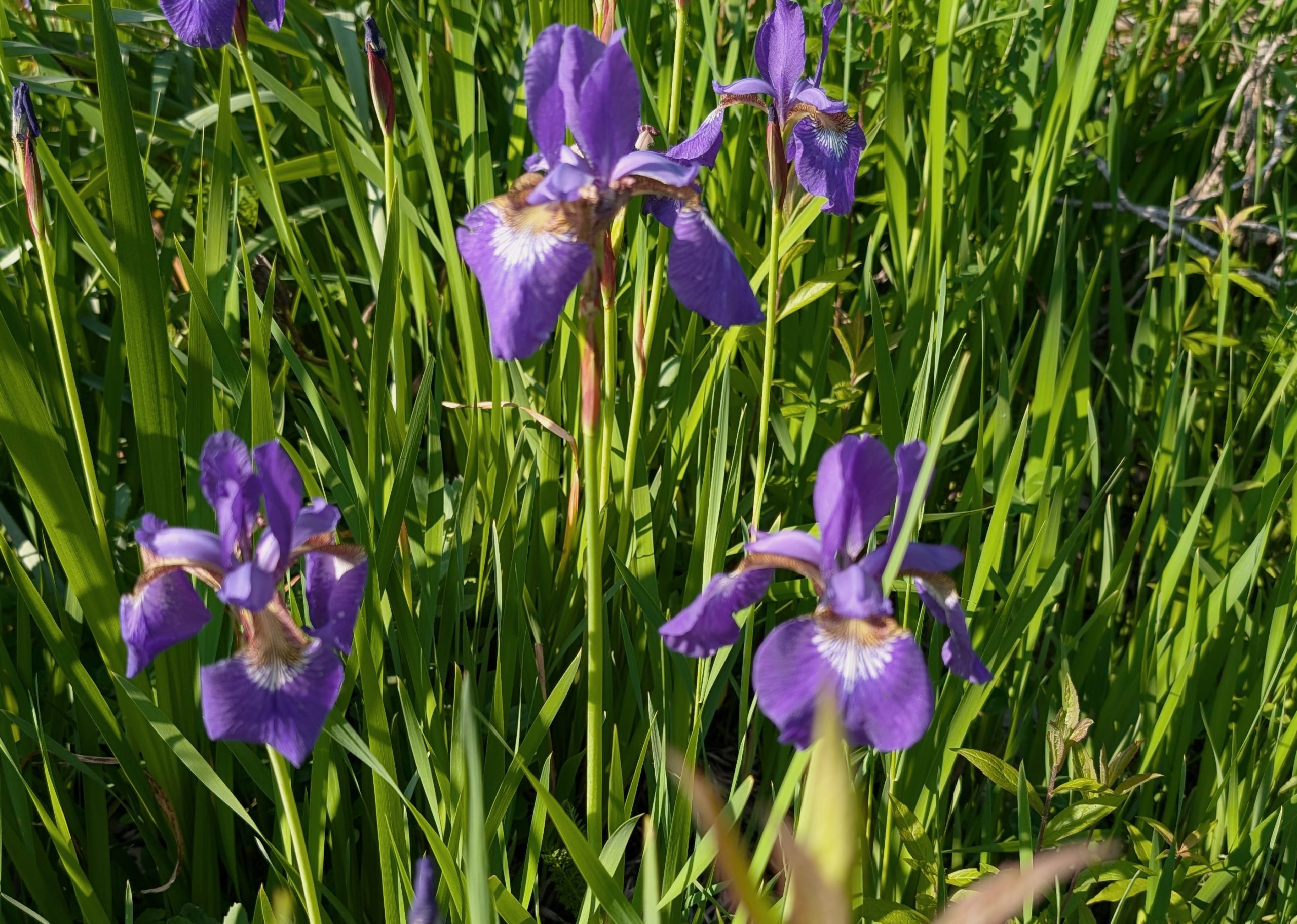
The accepted scientific name was published by Carl Linnaeus in 1753. Iris versicolor is a rhizomatous perennial native to central and eastern Canada and the north-central and eastern United States.
The French name iris versicolore refers to the flower’s varied gradations of violet-blue, white and yellow. The species has been Québec’s official floral emblem since 1999.
A colony-forming native wetland iris with:
The combination of strongly veined falls, narrow upright standards, blue-green foliage and growth in saturated ground is characteristic of northern blue flag.
Northern blue flag is a long-lived herbaceous perennial growing from thick, shallow, branching rhizomes. These rhizomes expand gradually outward, producing dense clumps or broad colonies where moisture remains reliable.
Mature flowering plants generally reach about 2–4 feet in height. The foliage remains upright or gently arching, giving colonies a grasslike appearance when the plants are not flowering.
Each flower follows the distinctive iris structure:
Flowers are normally deep violet-blue to purple, although paler blue and rare white forms occur. Individual blooms may approach 3–4 inches across, with several flowers developing on each stalk. Flowering generally occurs from May through July, depending on latitude and local conditions.
Leaves are:
The foliage may resemble cattail, sweet flag or other emergent wetland vegetation from a distance, but iris leaves form more obvious flattened fans at their bases.
The plant spreads through thick horizontal rhizomes anchored by fibrous roots. These structures store energy, survive winter dormancy and generate new shoots around the original crown.
Although sometimes casually described as growing from bulbs, Iris versicolor is properly a rhizomatous geophyte.
After successful pollination, the flower develops into an oblong, three-celled capsule. Each chamber contains two rows of flattened, rounded seeds.
The capsules mature later in the season, dry and eventually split open, allowing seeds to fall or wash into nearby saturated soil and shallow water.
The closest native lookalike. Its flowers can be nearly indistinguishable without examining several structural details and considering geographic range. Southern blue flag is generally associated with warmer portions of eastern North America.
Where ranges approach one another, photographs alone may not always support a completely secure separation.
An introduced Eurasian wetland iris with bright yellow flowers. It can form aggressive colonies and replace native blue flag iris in wetlands.
Yellow flag should not be planted near natural waterways in North America.
A common garden iris with narrower, more grasslike foliage and generally more slender flowers. Escaped plants may persist near old gardens, but they are not native North American blue flags.
Tall bearded irises usually grow in comparatively dry garden soil. Their falls carry a conspicuous fuzzy beard, which Iris versicolor lacks.
Northern blue flag is native across central and eastern Canada and the northeastern and north-central United States.
Its documented native distribution includes:
It has also been introduced outside its native range, including parts of Europe and the western Himalaya.
Northern blue flag occurs in places where the soil remains wet for much or all of the growing season:
It functions as a marginal or emergent wetland plant, rooted in saturated soil while holding most of its foliage above the water.
This is not an ordinary dry-border garden iris. Its long-term success depends on reliable moisture.
It performs particularly well in:
Established colonies generally require little or no fertilizer when growing in naturally fertile wetland soil.
Division is the fastest and most dependable propagation method.
Seed propagation is slower but preserves more genetic diversity.
In the wild, seeds are transported short distances by water and establish near the soil-water boundary.
The iris flower is built around large bee pollination.
The broad falls act as landing platforms. Their contrasting veins and yellow signals guide visiting bees beneath the arching style arms. As a bee pushes into the flower, its back contacts the stigma and anther, transferring pollen between blooms.
Flowers may also attract:
Dense rhizomes and roots help bind wet soil, slow erosion and protect exposed pond or stream margins. The foliage also adds vertical structure and cover to shallow wetland habitat.
Northern blue flag is not edible.
The rhizomes contain the highest concentration of irritating compounds, but the roots, seeds and sap should all be treated cautiously.
Possible effects of ingestion include:
Sap from cut rhizomes, roots or seeds may also irritate sensitive skin. Gloves are appropriate when dividing large clumps, especially when the rhizomes must be cut. The plant may also present a risk to dogs, cats and horses if consumed.
Historical medicinal use does not make the plant safe for home preparation.
Established colonies are generally resilient, but cultivated plants may experience:
Poor water quality, contaminated runoff and unnatural changes in water level can damage wild colonies.
The introduced yellow flag iris, Iris pseudacorus, presents a direct ecological threat in some wetlands because it grows aggressively, spreads by both seed and rhizome and can replace native blue flag vegetation. Development, drainage, water diversion and other alterations of wetland hydrology can also eliminate local populations even where the species remains widespread regionally.
For rain gardens, ponds and wetland restoration:
Once established in suitable wet ground, northern blue flag usually requires little intervention.
Northern blue flag is a classic example of allopolyploid evolution. It possesses 108 chromosomes, and genomic research supports an ancient origin involving ancestors related to southern blue flag, Iris virginica, and beachhead or Arctic iris, Iris setosa.
The hybrid lineage combined entire chromosome complements and became a stable, fertile species rather than remaining a temporary hybrid.
The genus name Iris refers to the rainbow, an appropriate name for a group famous for varied flower colors.
The species name versicolor means variously colored or changing in color, describing the mixture of violet, blue, white, green and yellow visible across each flower.
Québec adopted Iris versicolor as its official floral emblem in 1999. Unlike the previously used white garden lily, northern blue flag is native and grows across a substantial portion of the province.
The photograph captures the plant in its characteristic form: not an isolated garden specimen, but a native wetland iris rising as a colony through dense spring vegetation.
Northern blue flag occupies the exact boundary between land and water. Its rhizomes hold the bank while its leaves rise above floods, and its flowers convert a wet, difficult patch of ground into one of the most visually intense moments of the early wetland season.
It is also a practical restoration plant. Where development has left saturated soil, drainage channels or unstable pond margins, Iris versicolor can provide native color, root structure and pollinator value without importing the ecological problems associated with invasive yellow flag iris.
Protecting blue flag means protecting the water regime beneath it. A colony may survive mowing, ice, flooding and winter cold, but it cannot survive indefinitely after its wetland has been drained.