Helianthus divaricatus
Taxonomy
Domain: Eukaryota
Kingdom: Plantae
Subkingdom: Tracheobionta
Superdivision: Spermatophyta
Division: Magnoliophyta
Class: Magnoliopsida
Clade: Eudicots
Clade: Asterids
Order: Asterales
Family: Asteraceae
Genus: Helianthus
Species: Helianthus divaricatus
Common Names by Region
- United States / Canada: Woodland sunflower, rough sunflower, spreading sunflower, divaricate sunflower
- General: Woodland sunflower
Description
Quick ID
- Growth form: Upright native perennial, roughly 2–6 feet tall, on smooth, often reddish, unbranched stems below the flower cluster. Spreads by rhizomes into loose colonies.
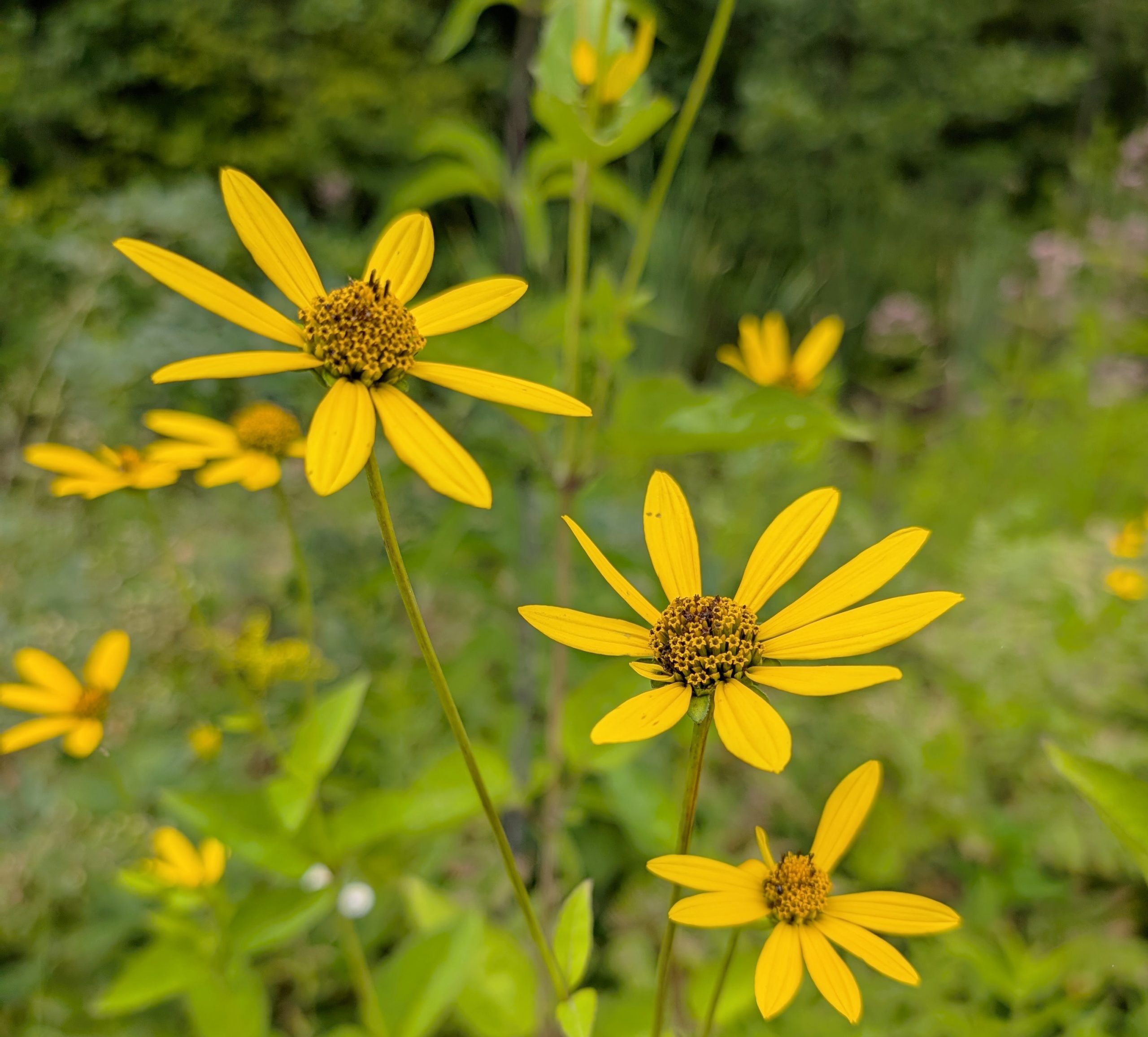
- Flowers: Yellow composite heads about 2–3 inches across, borne singly or in a loose open spray at the top. Roughly 8–15 narrow ray florets around a flattish yellow-brown disc. Note the disc is yellowish, not dark — no black cone.
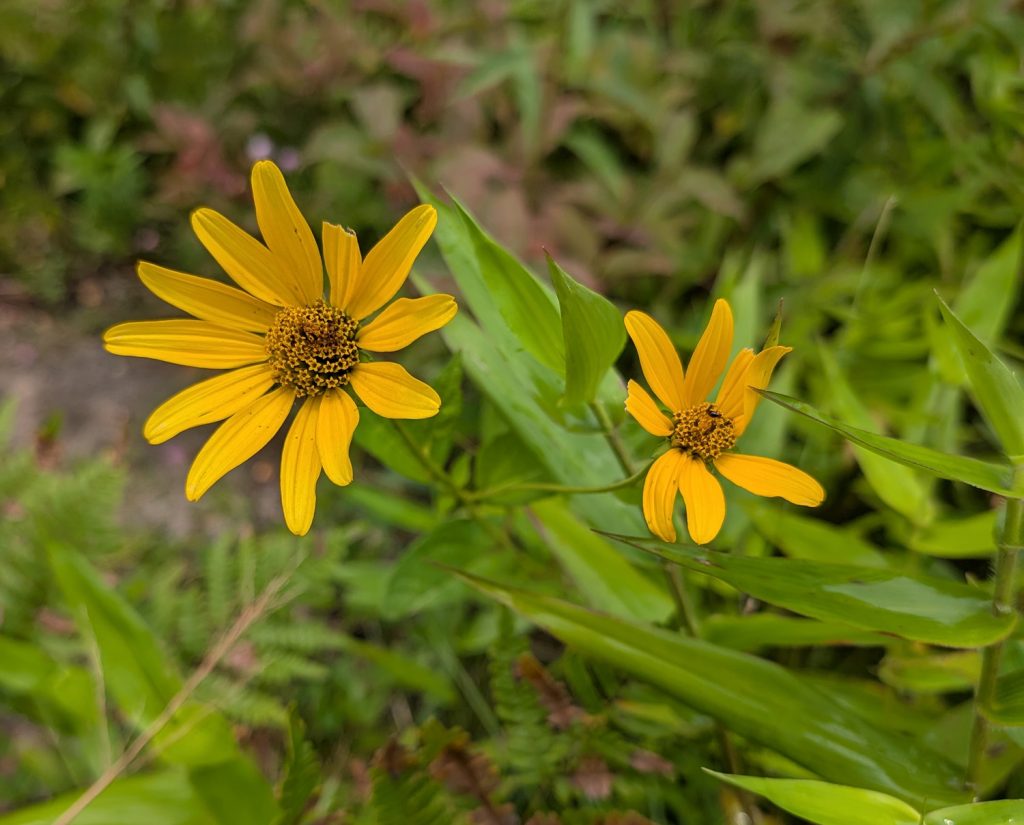
- Leaves — the diagnostic feature: Opposite, stalkless (sessile), lance-shaped, broad and rounded at the base, tapering to a point, and held nearly horizontal, spreading away from the stem. The species name divaricatus means “spreading,” and the leaf posture is the name.
- Leaf texture: Thick and rough (sandpapery) above, with margins nearly entire to only faintly toothed.
- Stem: Smooth and often glaucous below the inflorescence — a useful secondary check.
Blooming
- Midsummer into early fall, roughly July through September. This photo dates to July 31, right in the window.
Look-alikes
- Thin-leaved sunflower (Helianthus decapetalus): The main confusion. Its leaves sit on distinct winged stalks (petioles) and are thinner, broader, and sharply toothed. If you can see a leaf stalk, it isn’t divaricatus.
- Oxeye sunflower (Heliopsis helianthoides): Same habitat and season, but the leaves are triangular-ovate with coarse teeth and obvious petioles, and its ray florets persist on the seed head rather than dropping.
- Black-eyed Susan (Rudbeckia spp.): Dark brown-black domed center and alternate leaves — a quick separation.
- Coreopsis: Ray tips notched or lobed at the ends; woodland sunflower rays are smooth-tipped.
Known Range
- Native: Eastern and central North America — from Ontario and Quebec south to Florida and the Gulf, west to the Great Plains. Common through the Midwest and Appalachians.
- In Indiana and the Ohio Valley: A frequent and characteristic native of dry woodland edges, oak openings, and roadside woods. Also common through Pennsylvania in the same habitat.
Care / Habitat
Light
- Part shade to full sun. One of the few sunflowers that flowers well in dappled shade, which is what makes it valuable in a woodland planting.
Soil
- Dry to medium, well-drained ground. Tolerates poor, sandy, rocky, and clay soils. Thrives in the lean, dry conditions where showier natives fail.
Water
- Drought-tolerant once established. Deep rhizomes carry it through dry spells.
Typical Habitat
- Dry open woods, woodland borders, oak savanna, thickets, clearings, and roadside woods — usually where sun reaches the edge of tree cover. The fern-and-brush understory in this photograph is typical.
Propagation / Reproduction
- Rhizomes (primary spread): Runs underground and forms spreading clonal colonies — the reason it’s usually found as a patch, not a single plant.
- Seed: Sets readily; benefits from cold stratification. Self-sows in open ground.
- Division of established clumps works in spring or fall.
- To contain it: give it room, or expect it to colonize. It’s an enthusiastic spreader in good conditions.
Pests / Diseases / Threats
- Tough, native, and largely trouble-free.
- Occasional powdery mildew on foliage late in the season, especially in humid, crowded stands.
- Browsed by deer and rabbits, sometimes heavily.
- No conservation concern — common and widespread across its range.
Additional Notes
Ecology & Use
- A significant native pollinator plant. Bees of many kinds work the heads, including specialist sunflower bees, and it supports a range of butterflies. It’s a larval host for several moth species and for the silvery checkerspot butterfly.
- Seeds feed birds — goldfinches, chickadees, and others work the heads through fall, and small mammals take them from the ground.
- Genuinely useful in restoration and native planting: it holds dry, shaded, difficult ground where little else establishes, and it flowers there. In a woodland-edge or oak-savanna restoration it functions as both groundcover and nectar source.
- The genus is the same one that gives us the cultivated sunflower and the Jerusalem artichoke — this is the wild, shade-tolerant, rhizomatous branch of that family tree.
Management
- Want it? Give it dry shade and leave it alone; it asks for nothing.
- Want it held? Site it where the rhizomes can run against a path or mowed edge, or divide and pull back the colony margin each spring.
Field Note
- Photographed in Indiana at a dry woodland edge, growing in a loose colony alongside ferns and brush — textbook habitat for the species.
- See the second photograph included with this post for the identifying feature. The woodland sunflowers are a genuinely confusing group, and the flower alone won’t settle it. The separation runs through the leaves: in the second image the mid-stem leaves sit directly against the stem with no leaf stalk, broad and rounded at the base, spreading nearly horizontally in opposite pairs. That stalkless, spreading attachment is Helianthus divaricatus. Had those leaves been carried on short winged stalks with thinner, sharply toothed blades, the plant would be the thin-leaved sunflower, H. decapetalus, instead. When you find one of these in the field, skip the bloom and go straight to where the leaf meets the stem.
All Cernunnos Foundation materials are free to use for any educational purpose.
Views: 269