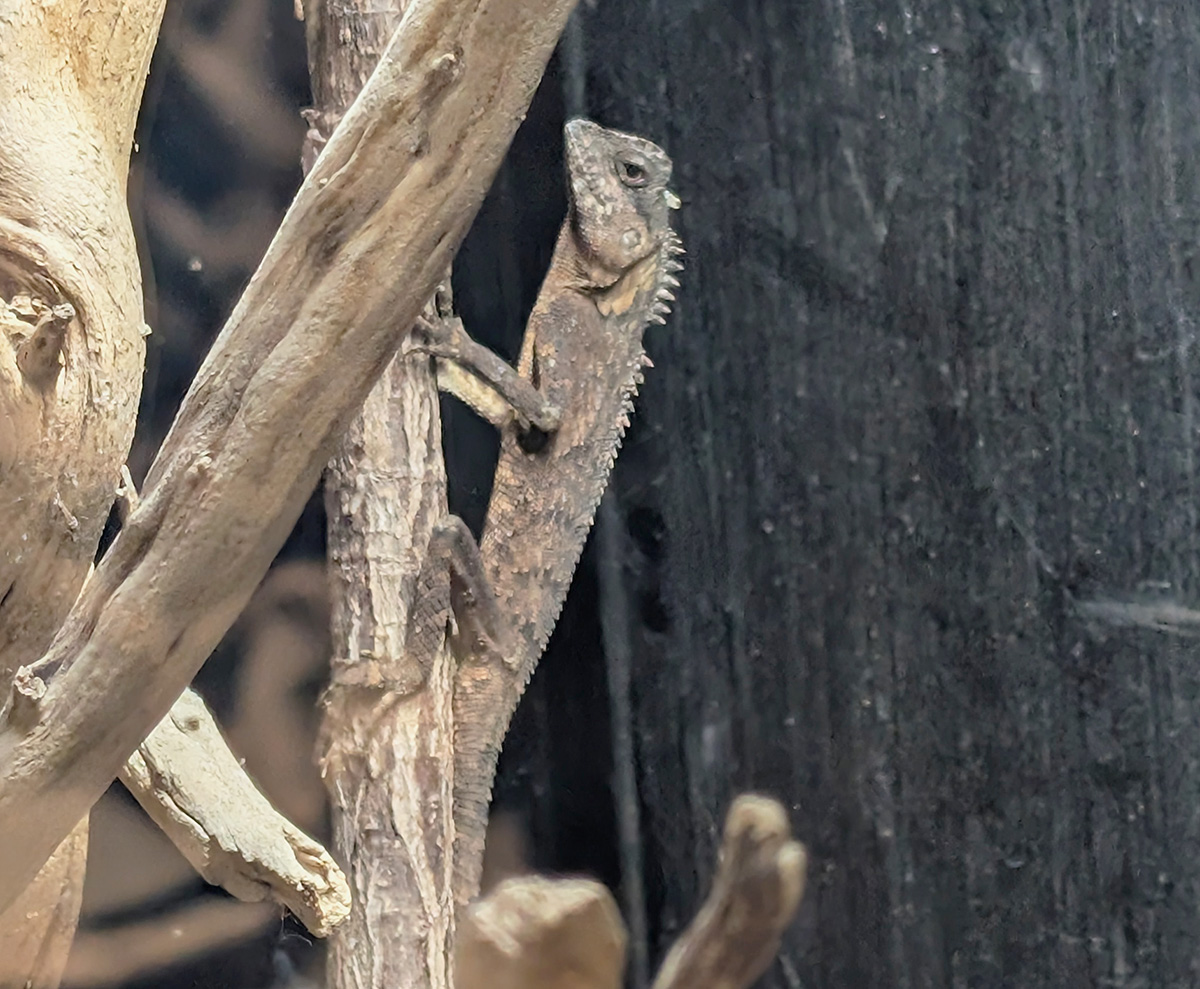
Acanthosaura capra
Taxonomy
- Domain: Eukaryota
- Kingdom: Animalia
- Phylum: Chordata
- Class: Reptilia
- Order: Squamata
- Suborder: Iguania
- Family: Agamidae
- Subfamily: Draconinae
- Genus: Acanthosaura
- Species: Acanthosaura capra
Common Names by Region
- United States / exhibit & hobby trade: Mountain horned dragon, Vietnamese mountain horned dragon, Annam horned lizard, pricklenape
- Vietnam / Cambodia / Laos (native range): Regional names referencing the horned, spiny head
- General: Mountain horned agama
Description
Quick ID
- Crest: A row of tall, sharply serrated spines running from the nape down the back — the “pricklenape” profile, clearly visible in this photo as a saw-edged ridge behind the head.
- Head: Angular and casqued, with long postorbital horns standing behind each eye and a cluster of occipital spines at the rear of the skull. These are the species-defining features in A. capra.
- Color: Cryptic brown, gray, and olive, often with darker banding and a pale throat patch. Capable of shifting tone with temperature, light, and mood.
- Body: Laterally compressed, built for gripping vertical stems; long limbs with strong claws and a long, whip-like tail.
- Size: A medium agamid, roughly 10–14 inches total length, much of that tail. Males carry higher crests and longer horns than females.
Range
- Native to Southeast Asia — the Annamite range and adjacent uplands of Vietnam, Laos, and Cambodia.
Habitat & Behavior
- A lizard of cool, humid montane and submontane forest, favoring shaded understory near streams and moist ravines at elevation. Not a hot-desert agamid — the “mountain” in the name is the whole point.
- Arboreal and semi-arboreal, spending its time clinging to trunks, saplings, and branches, usually head-up in a vertical rest posture — the position captured here.
- A sit-and-wait ambusher. Slow, deliberate, and reliant on stillness rather than speed; it holds position for long stretches and lets prey come to it. Its cryptic coloring against bark does most of the defensive work.
- Largely diurnal but low-energy, basking modestly and preferring shaded, humid microclimates over open sun.
Diet
- Insectivorous. Crickets, roaches, moths, worms, and other invertebrates taken by ambush; larger individuals will occasionally take small vertebrates.
- Drinks from droplets on leaves and branches rather than standing water — a rainforest habit that carries over into captivity, where misting matters more than a water bowl.
Reproduction
- Oviparous. Females descend to the forest floor to dig a nest in moist soil or leaf litter and deposit a clutch of eggs, typically around a dozen.
- Incubation runs a couple of months, temperature-dependent; hatchlings emerge fully formed and independent, already carrying miniature crests.
- Males display with head-bobbing, crest and gular expansion, and lateral posturing to hold territory and court females.
Threats / Conservation / Notes
- Faces pressure from deforestation and montane habitat loss across a range already fragmented by logging and agricultural conversion.
- Collection for the international pet trade is an ongoing concern, with wild-caught imports historically common. Wild-caught animals often arrive stressed and parasitized; captive-bred stock is preferable on both welfare and conservation grounds.
- Regional protections vary; the genus as a whole is under increasing scrutiny as Southeast Asian herpetofauna are reassessed.
Look-alikes
- The genus is genuinely confusing, and trade animals are routinely mislabeled. Separating A. capra from its congeners comes down to horn and spine detail: Acanthosaura crucigera (masked horned lizard) and Acanthosaura lepidogaster (scale-bellied tree lizard) both carry markedly shorter postorbital horns, and Acanthosaura nataliae and Acanthosaura armata differ in occipital spine arrangement and crest height. Any “mountain horned dragon” in a collection should be checked against the head spines rather than trusted to its label.
Additional Notes
Ecology & Significance
- A textbook ambush predator of the forest understory — its entire body plan, from the laterally flattened profile to the bark-toned crypsis, is built for holding perfectly still against a vertical stem until something edible walks past.
- The spiny crest and horns serve a double role: defense against predators that would swallow it whole, and display in male-to-male territorial contests, where crest height and horn length advertise fitness without a fight.
- The Annamite uplands it inhabits are one of the world’s more remarkable centers of endemism, and the mountain horned dragons are part of a herpetofauna still being described — several Acanthosaura species have been named only in recent decades.
In Exhibits
- Kept in tall, planted, high-humidity vertical enclosures with branch networks, moderate temperatures, and heavy misting — the driftwood climbing structure pictured here is typical. They want cool and damp, not hot and dry, which is the most common husbandry mistake made with them.
- Calm and slow-moving by nature, which makes them popular display animals, though their preference for stillness and shade means visitors often walk past without spotting one.
Field Note
- Photographed in a planted vertical exhibit, resting head-up against driftwood in the shaded posture typical of the species. The serrated nuchal and dorsal crest runs clearly from behind the head down the back, and two distinct postorbital horns stand behind the eyes — each roughly as tall as the eye though narrower — the feature that separates A. capra from the short-spined members of the genus. Worth knowing in the field: the flower of this ID is the head, not the body. Mountain horned dragons are routinely mislabeled in collections and in the trade, and the horns and occipital spines are the only reliable way through.
All Cernunnos Foundation materials are free to use for any educational purpose.
Views: 215