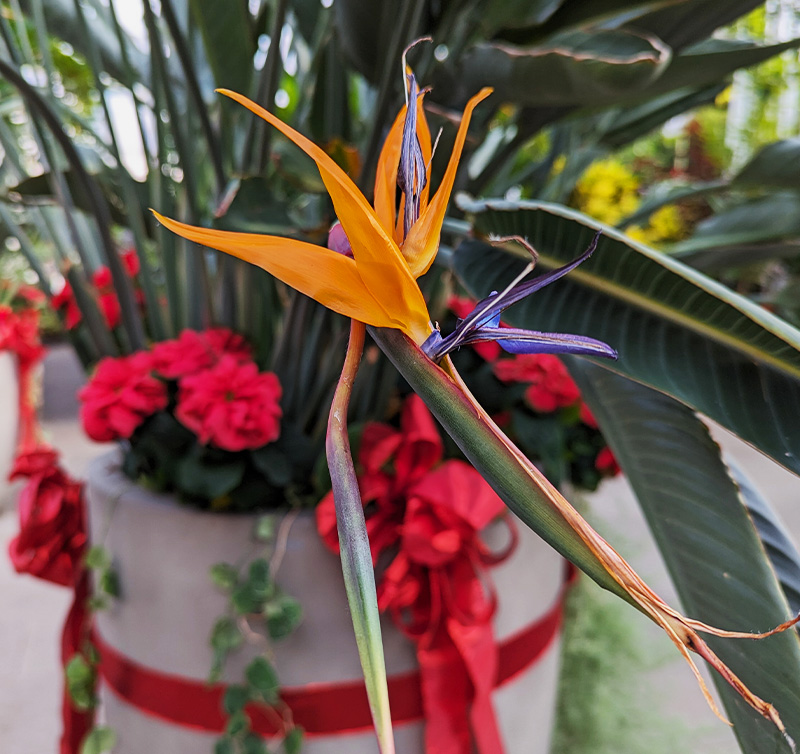
Strelitzia reginae
Taxonomy
Domain: Eukaryota
Kingdom: Plantae
Subkingdom: Tracheobionta
Superdivision: Spermatophyta
Division: Magnoliophyta
Class: Liliopsida (monocots)
Clade: Commelinids
Order: Zingiberales
Family: Strelitziaceae
Genus: Strelitzia
Species: Strelitzia reginae
Common Names by Region
- United States / Canada: Bird of paradise, crane flower, bird-of-paradise flower
- United Kingdom: Bird of paradise, crane flower
- South Africa (native range): Crane flower, isigude (Zulu); a national emblem, featured on the country’s 50-cent coin
- General: Strelitzia
Description
Quick ID
- Growth form: Clumping, trunkless evergreen perennial, 3–5 feet tall, growing in a fan-like clump of leaves from a stout underground rhizome.
- Flower — unmistakable: A horizontal, boat-shaped green-and-pink spathe (bract) sits crosswise atop the stalk like a bird’s perch. From it rise a fan of vivid orange sepals and an arrow of fused blue-purple petals — together mimicking the head and plumage of an exotic bird in profile. Blooms emerge in succession from the single spathe over weeks.
- Leaves: Large, leathery, blue-green, paddle- or banana-shaped on long stalks, held upright in a fan — a strelitzia relative of the banana in overall build.
- Size of bloom: The flower head runs 6+ inches, held on a stalk well above the foliage.
Blooming
- Mainly fall through spring, with peak bloom in winter — which is why it anchors so many holiday and winter conservatory displays, as here. A mature clump can flower much of the year in ideal conditions.
Look-alikes
- Giant white bird of paradise (Strelitzia nicolai): Far larger — tree-like to 20+ feet — with white-and-blue flowers. Same genus, very different scale.
- Mexican bird of paradise (Caesalpinia / Erythrostemon spp.): A completely unrelated legume shrub that shares only the common name — yellow or red-orange flowers, ferny divided leaves. A frequent name mix-up worth flagging.
- Canna and heliconia: Share the tropical Zingiberales look but not the distinctive perched-bird flower structure.
Known Range
- Native: South Africa, in the eastern Cape, along riverbanks and forest clearings in a subtropical coastal climate.
- In cultivation: Grown worldwide as an ornamental and cut flower. Outdoors it’s limited to frost-free and near-frost-free climates (roughly USDA zones 10–12) — in the U.S., mainly California, Florida, and the Gulf. Everywhere colder, including Pennsylvania, it’s a conservatory, greenhouse, or houseplant — the context of this photograph.
Care / Habitat
Light
- Bright light to full sun. Wants strong light to bloom; a mature plant in too little light produces leaves but no flowers.
Soil
- Rich, well-drained soil with plenty of organic matter.
Water
- Regular moisture in the growing season, easing off in winter. Established plants tolerate some drought but flower best kept evenly watered.
Temperature
- Frost-tender. Damaged by freezing; needs to be grown under glass or indoors anywhere with real winter — hence its life as a greenhouse and houseplant across most of the country.
Patience note
- Notoriously slow to first bloom — a plant from seed or division may take 3–5 years to flower, and it flowers best when slightly pot-bound. This is the single most common source of frustration with it.
Propagation / Reproduction
- Division of the rhizome clump is the standard and fastest route, done on established plants.
- Seed is possible but slow — slow to germinate and years to bloom.
- Pollination in the wild is by sunbirds, which perch on the horizontal spathe (the “perch” is functional, not just ornamental) and trip the blue petals to pick up pollen on their feet — a specialized bird-pollination system. Away from its native sunbirds, hand-pollination is needed to set seed.
Pests / Diseases / Threats
- Scale insects, mealybugs, and spider mites are the common indoor/greenhouse pests.
- Root rot from overwatering or poor drainage.
- Generally tough and long-lived once established; no conservation concern as a widely cultivated plant.
Additional Notes
Ecology & Use
- A specialized bird-pollinated flower — the whole architecture, from the sturdy perch-spathe to the pollen-bearing blue petals, is engineered around sunbirds. It’s one of the clearest garden-plant examples of a flower built for a specific pollinator.
- A premier cut flower in the global florist trade, prized for its dramatic shape and long vase life.
- Named to honor Queen Charlotte (Charlotte of Mecklenburg-Strelitz), consort of King George III — reginae means “of the queen,” and Strelitzia nods to her ducal house. A South African wildflower carrying an 18th-century British royal name.
- A national symbol of South Africa and an emblem of Los Angeles, where it’s the official city flower.
Management
- Want blooms? Give it strong light, let it get slightly pot-bound, be patient through the establishment years, and keep it above freezing.
- Growing it cold-climate? Treat it as a greenhouse or bright-window houseplant; it’ll reward a warm sunny spot and steady care with winter flowers when little else is blooming.
All Cernunnos Foundation materials are free to use for any educational purpose.
Views: 254