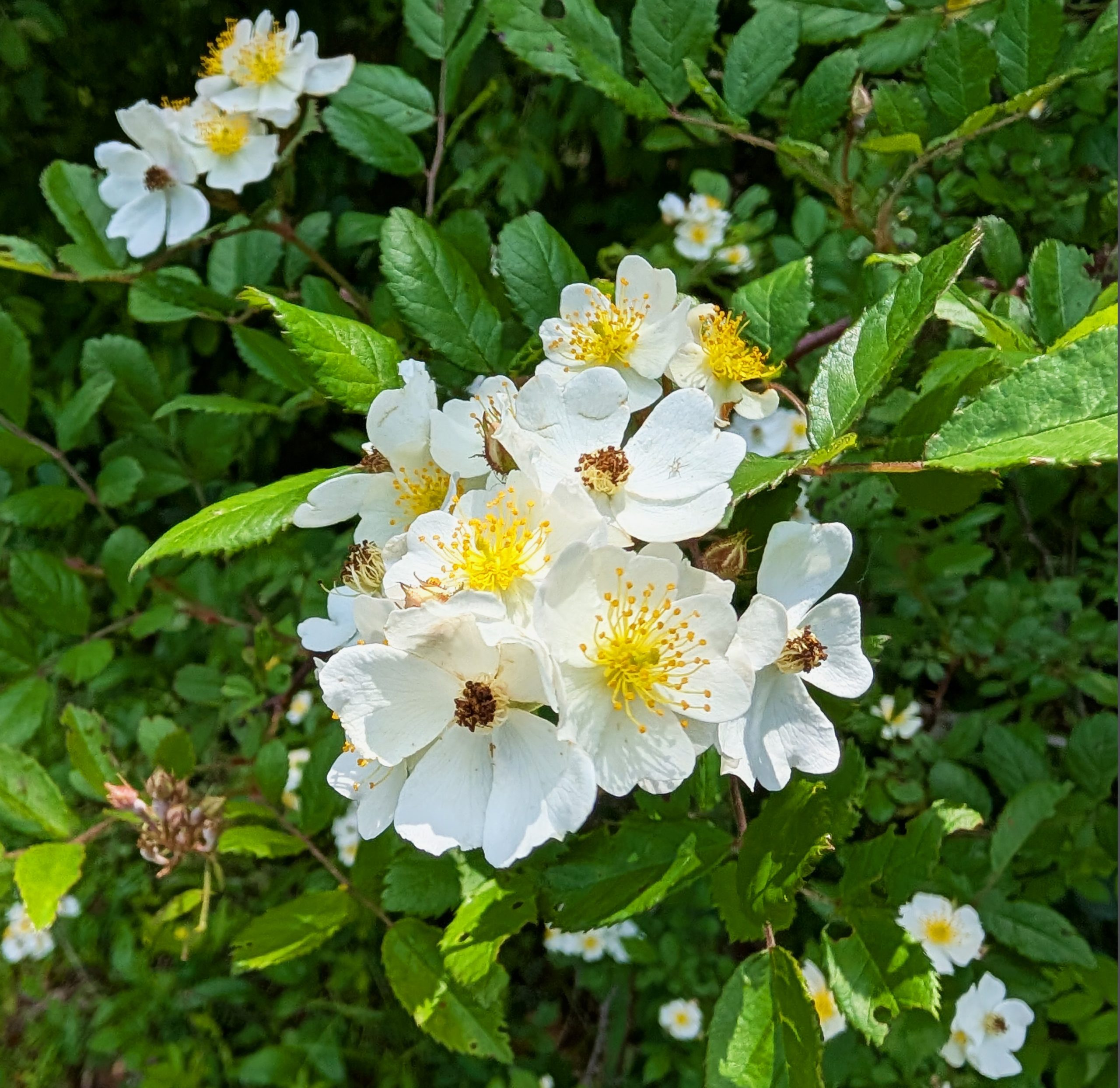
Rosa multiflora
Taxonomy
Domain: Eukaryota
Kingdom: Plantae
Subkingdom: Tracheobionta
Superdivision: Spermatophyta
Division: Magnoliophyta
Class: Magnoliopsida
Clade: Eudicots
Clade: Rosids
Order: Rosales
Family: Rosaceae
Genus: Rosa
Species: Rosa multiflora
Common Names by Region
- United States / Canada: Multiflora rose, baby rose, Japanese rose, rambler rose, multiflowered rose
- East Asia (native range): Noibara (Japan)
- General: Multiflora rose
Description
Quick ID
- Growth form: Vigorous, arching, sprawling shrub, 6–15 feet, forming dense impenetrable thickets. Canes arch over and root where the tips touch ground (tip-layering), spreading the plant outward.
- Flowers — the key tell: Small, white (occasionally pink-tinged), about 1 inch across, five petals, borne in large branched clusters (panicles) of many blooms — not singly. Fragrant. This clustered habit separates it instantly from native roses.
- Stipules — the clincher: At the base of each leaf stalk, the stipules are fringed / comb-like (pectinate) — a feathery edge unique among roses here and the single most reliable ID feature.
- Leaves: Pinnately compound, usually 7–9 toothed leaflets, bright green.
- Canes: Green to reddish, armed with stiff, curved thorns.
- Hips: Small, red, firm, in clusters — persist into winter and feed birds (which is exactly how it spreads).
Blooming
- Late spring to early summer (May–June), in a heavy, fragrant flush. This photo catches it in full bloom.
Look-alikes
- Native roses (Rosa carolina, R. virginiana, R. blanda, etc.): Bear larger pink flowers singly or in small numbers, and crucially have smooth (entire) stipules, not fringed. If it’s white, clustered, and the stipules are combed, it’s multiflora.
- Blackberry/dewberry (Rubus): Superficially similar arching thorny canes and white flowers, but Rubus flowers are larger and solitary-to-few, leaves differ, and there are no fringed rose stipules.
Known Range
- Native: Eastern Asia — Japan, Korea, and eastern China.
- Introduced / invasive: Widely naturalized and invasive across the eastern and central United States and beyond. Common throughout Pennsylvania in pastures, old fields, forest edges, roadsides, fencerows, stream banks, and any disturbed ground — including the reclaimed-industrial and river-corridor habitat around Johnstown.
Care / Habitat
Light
- Full sun to partial shade. Most aggressive in the open but persists and spreads into the forest understory.
Soil
- Indifferent — tolerates a wide range of soils and moisture, from dry banks to damp bottomland. Avoids only standing water and deepest shade.
Water
- Adaptable; drought-tolerant once established.
Typical Habitat
- Disturbed and edge habitat: pastures, old fields, roadsides, fencerows, woodland margins, savannas, and stream corridors. A thicket-former that crowds out everything beneath it.
Propagation / Reproduction
- Three ways, which is what makes it so hard to stop: prolific seed (a single established plant can produce up to a million seeds a year, viable in soil for many years), tip-layering (arching canes root where they touch ground), and sprouting from the root crown after cutting.
- Birds and mammals eat the hips and disperse the seed widely — the main engine of its spread across the landscape.
- Cutting alone resprouts vigorously; effective control requires removing or killing the root crown, repeated over years.
Pests / Diseases / Threats
- The plant is the threat. It forms dense thorny thickets that exclude native vegetation, degrade pasture, obstruct wildlife and livestock movement, and take over old fields and forest edges. Listed as a noxious or invasive weed in many states.
- Rose rosette disease (RRD): the one thing that reliably attacks it. This mite-vectored virus is often lethal to multiflora rose and is being studied as a biological control — but it also infects and kills desirable roses (including Knock Out plantings), so it cuts both ways.
- Rose seed chalcid and other insects attack the seed but don’t meaningfully slow it.
Additional Notes
Ecology & Use
- A cautionary tale in intentional introduction. Brought to the U.S. from Asia — first as ornamental rootstock, then actively promoted from the 1930s onward as a “living fence” for livestock and for erosion control and wildlife cover. Government programs distributed it widely before its invasive nature became undeniable. It did exactly what it was planted to do, and then kept going.
- Its hips do feed birds and its thickets do provide cover, which is part of why it spread so effectively — the wildlife value that recommended it is also its dispersal mechanism.
- The flowers are genuinely fragrant and attractive to pollinators in bloom, which is the cruel part: a real pollinator resource wrapped around a serious ecological problem.
- Its most useful modern role is as a teaching example — of how a plant introduced for good reasons, with real virtues, can still become one of the region’s most damaging invasives. A field guide is exactly the place to make that case honestly.
Management
- Want it gone? Accept a multi-year fight. Repeated cutting to exhaust the roots, grubbing out the root crown, or targeted treatment; mowing regimes on pasture. Single interventions fail — it resprouts and reseeds.
- Never plant it. It needs no help and gives no quarter.
All Cernunnos Foundation materials are free to use for any educational purpose.
Views: 235