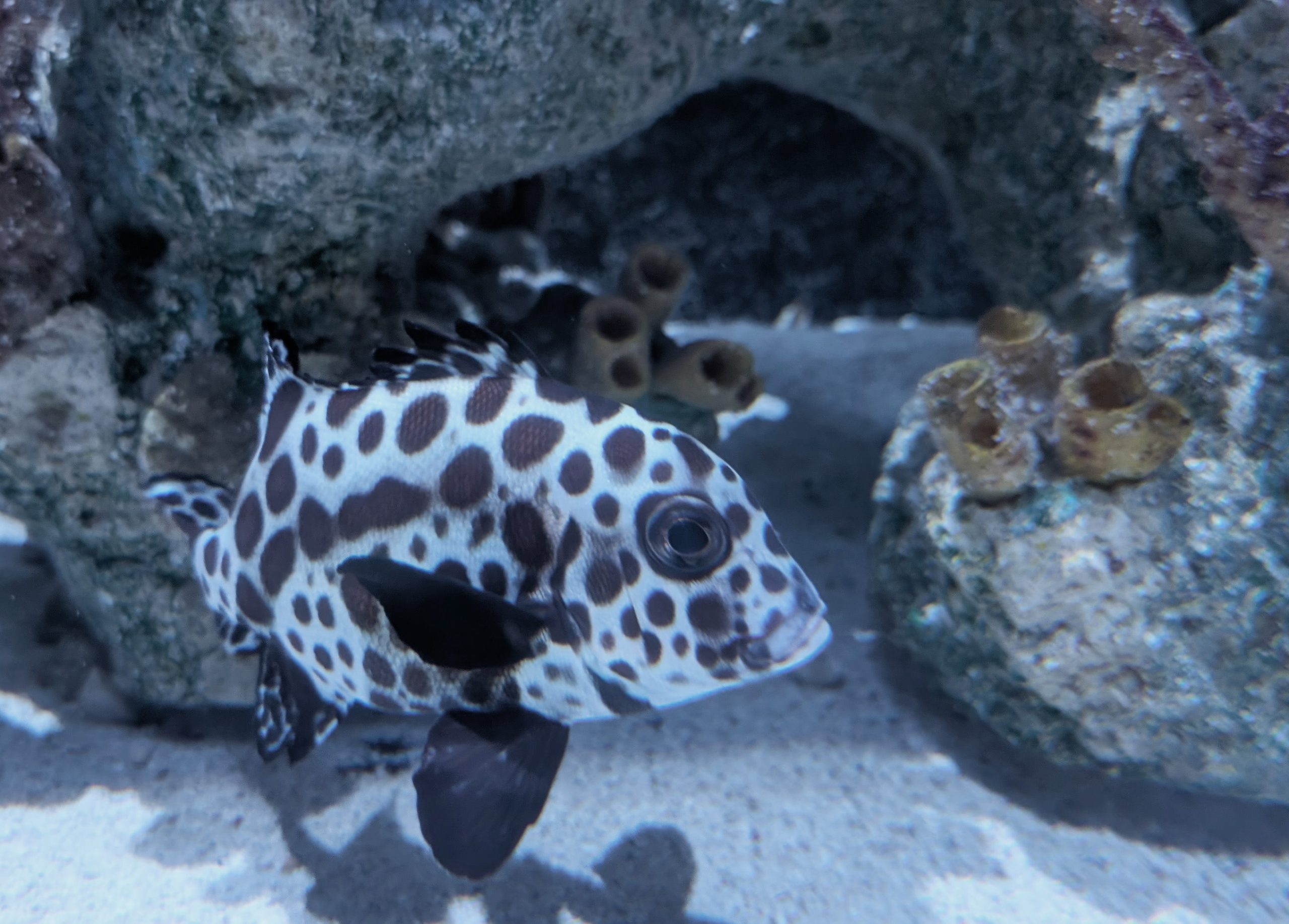
Cromileptes altivelis
Taxonomy
- Domain: Eukaryota
- Kingdom: Animalia
- Phylum: Chordata
- Class: Actinopterygii
- Order: Perciformes
- Family: Serranidae
- Subfamily: Epinephelinae
- Genus: Cromileptes
- Species: Cromileptes altivelis
Common Names by Region
- United States / exhibit & aquarium trade: Panther grouper, humpback grouper, polka-dot grouper
- Australia / Indo-Pacific: Barramundi cod, humpback cod
- General: Panther grouper
Description
Quick ID
- Pattern: The signature — a pale, whitish-gray body covered in bold, well-separated black spots, scattered across the head, body, and all the fins. The polka-dot look is unmistakable and gives the fish its “panther” and “polka-dot” names.
- Body profile: Distinctive concave, sloping head and a high, humped back — the “humpback” name. The small pointed head over a deep body is diagnostic and separates it from the blockier Epinephelus groupers.
- Fins: Rounded, spotted, carried softly; the body is deep and laterally compressed.
- Size: Reaches roughly 2 feet in the wild, though aquarium specimens are usually seen smaller. Large for a display fish, and it keeps growing.
- Juveniles vs adults: Young fish have fewer, larger spots and are especially prized in the trade; the spots become smaller and more numerous with age.
Range
- Native to the Indo-Pacific — East Africa and the Red Sea east through Southeast Asia to the western Pacific, including the Great Barrier Reef and southern Japan. A coral-reef and lagoon fish of warm tropical waters.
Habitat & Behavior
- A fish of coral reefs, lagoons, and rocky bottoms, typically in relatively shallow, structure-rich water where it can hunt and shelter among rock and coral — the reef-and-sand exhibit setting here mirrors that.
- A sit-and-wait ambush predator. Slow and deliberate in the open, it drifts near cover and relies on a sudden lunge and a cavernous mouth rather than a chase.
- Generally solitary and site-attached, holding to a patch of reef.
- Its unhurried, almost tame demeanor in an exhibit is natural — this is simply how a low-energy ambush grouper carries itself.
Diet
- Carnivorous ambush feeder. Takes small fish and crustaceans by engulfing them whole — groupers feed by opening the large mouth explosively and drawing prey in on a rush of water (suction feeding).
- In an aquarium it will eat anything small enough to fit in its mouth, which is the single most important fact for anyone housing one (see notes).
Reproduction
- Like many groupers, a broadcast spawner that releases eggs and sperm into the water column, producing pelagic larvae that drift before settling to the reef.
- Many groupers are protogynous hermaphrodites (maturing first as females, some later becoming males); the family’s reproductive biology follows this general pattern, which has direct consequences for how fishing pressure affects wild populations.
Threats / Conservation / Notes
- Under pressure in the wild from the live-reef food-fish trade and the aquarium trade, plus reef degradation. It’s a valued food fish in parts of Asia and a popular ornamental, and both markets draw on wild stock.
- Aquaculture of the species has been developed to supply both the food and ornamental trades and to relieve some wild-collection pressure.
- Reef-fish groupers of this kind are broadly vulnerable to overfishing because they grow slowly, mature late, and often aggregate to spawn — traits that make local populations easy to deplete.
Additional Notes
Ecology & Significance
- A textbook reef ambush predator, and a clear demonstration of suction feeding — the explosive mouth-opening that lets a slow fish capture fast prey. The whole body plan serves that one moment of the strike.
- The bold spotting is thought to serve as disruptive camouflage against the dappled light and broken shadow of a reef — the same pattern that reads as showy polka-dots in a bright tank helps break up the fish’s outline in the wild.
- One of the most recognizable groupers in public aquariums precisely because of that pattern and the humpbacked profile — an easy fish for a visitor to remember.
In Exhibits & the Aquarium Trade
- Extremely popular as a juvenile for its polka-dot looks and calm temperament, but a classic “cute juvenile, problem adult” aquarium fish. It grows large, needs a big tank, and — as an ambush predator — will eat any tankmate small enough to swallow. Many are bought small and outgrow or out-eat the home aquariums they were sold into, ending up rehomed to public tanks or larger systems.
- In a properly large exhibit like this one, it’s a hardy, long-lived, and charismatic display animal — best appreciated as the sizeable predator it becomes rather than the palm-sized polka-dot juvenile it starts as.
All Cernunnos Foundation materials are free to use for any educational purpose.
Post Views: 144