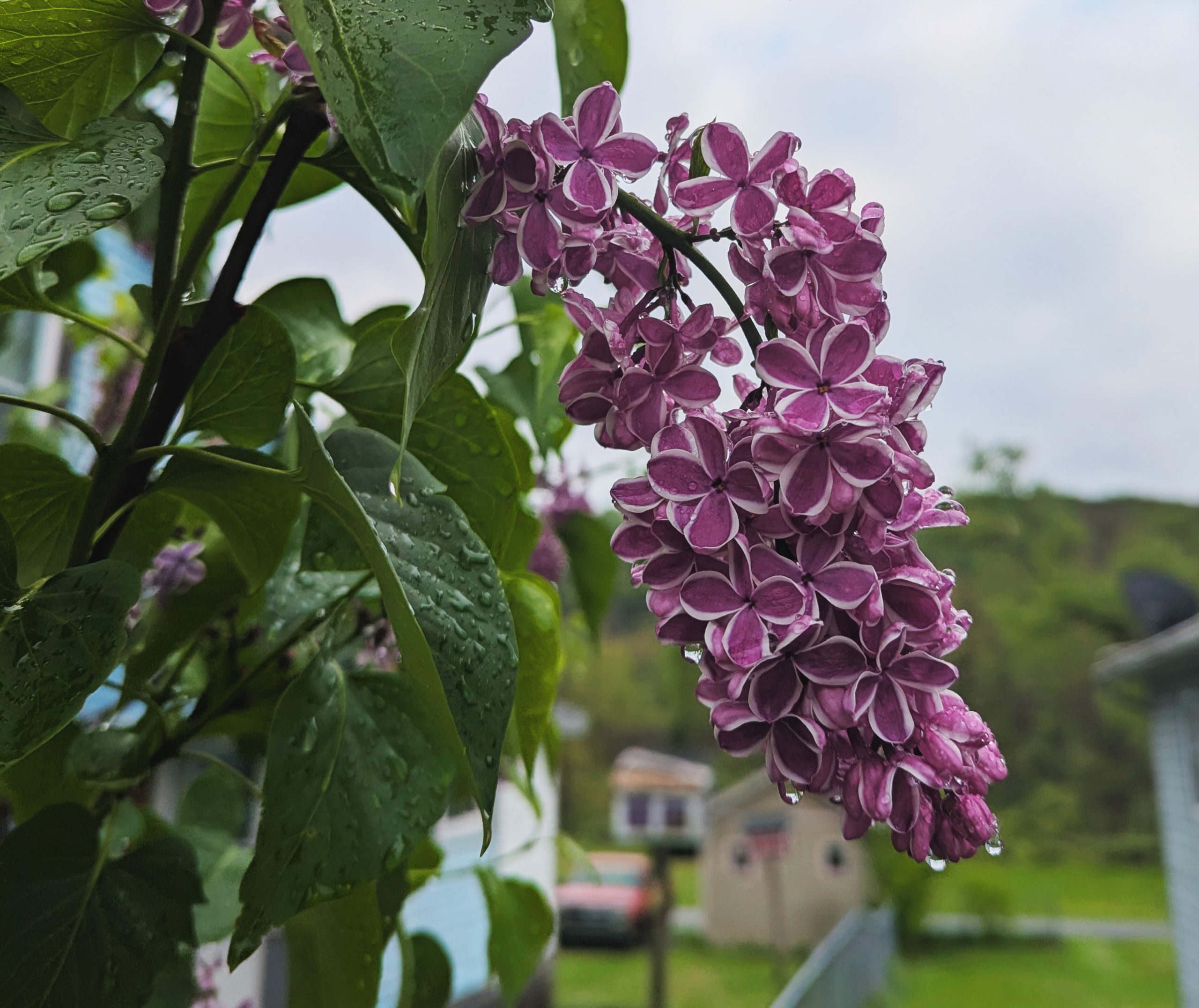
Common Lilac
Taxonomy
Kingdom: Plantae
Clade: Tracheophytes
Clade: Angiosperms
Clade: Eudicots
Clade: Asterids
Order: Lamiales
Family: Oleaceae
Genus: Syringa
Species: Syringa vulgaris L.
Common Names by Region
General / English: Common lilac, French lilac, English lilac
United States / Canada: Lilac, old-fashioned lilac
United Kingdom: Lilac
France: Lilas commun
Germany: Gemeiner Flieder
Balkans (native range): Jorgovan — the flower carries strong national and folk associations in Serbia, Bosnia, and North Macedonia
Etymology: Syringa comes from the Greek syrinx, a pipe or tube — the young stems have soft pith that hollows out easily, and the wood was historically used for pipe stems and flutes. “Lilac” traces back through French and Spanish to the Arabic līlak and ultimately Persian nīlak, meaning bluish.
On “French lilac”: the name refers to the breeding, not the origin. Victor Lemoine and his family in Nancy produced hundreds of cultivars between the 1870s and the 1950s, and their work defines most of what is sold today. The species itself is from southeastern Europe.
Description
Growth Habit
A large deciduous shrub or small multi-stemmed tree, upright and eventually leggy. It suckers freely from the base, spreading into a thicket over decades if left alone. Growth is slow to moderate; young plants take three to five years to flower.
Extremely long-lived. Lilacs outlast the houses they were planted beside — an old lilac standing alone in a field usually marks a vanished farmstead, and they persist in that state for a century or more.
Size
Height: 2.5–7 m (8–23 ft)
Spread: 2–4 m (6–13 ft), wider as suckers establish
Leaves
- Opposite, simple, entire — no teeth or lobes
- Heart-shaped to broadly ovate, 4–12 cm long, pointed at the tip
- Medium to blue-green, smooth, slightly leathery
- No fall color to speak of. Leaves go dull yellow-green or drop still green — the one real weakness of the plant.
Stems
- Gray-brown bark, becoming shredded and furrowed with age
- Young shoots stout with soft pith and prominent opposite buds
- Old stems become gnarled and hollow; the shrub renews itself from the base
Flowers
- Borne in dense conical panicles 10–20 cm long, usually paired at the ends of the previous year’s shoots
- Individual florets small, tubular, opening to four spreading lobes
- Powerfully fragrant — the defining feature, carrying well on still air
- Species color is pale purple; cultivars run white, cream, primrose yellow, pink, magenta, deep purple, and bicolor
- Bloom period is brief: roughly two weeks in mid to late spring, May in most of the northeast
Quick ID
Opposite heart-shaped untoothed leaves, conical panicles of four-lobed tubular florets, and the smell. Nothing else in a temperate garden combines those.
Note on this specimen: the florets show deep purple-magenta centers with a clean white margin around each lobe — a picotee edge. That pattern points to ‘Sensation’, introduced in the Netherlands in the 1930s and the best-known bicolor lilac. ‘Sensation’ is known for reverting: branches sometimes throw solid purple flowers, and those shoots need removing to keep the bicolor.
Known Range
Native to the Balkan Peninsula — the limestone hills of Serbia, Bosnia and Herzegovina, North Macedonia, Albania, Montenegro, Bulgaria, Romania, and Greece — where it grows on rocky slopes and open scrub.
Introduced to western Europe in the 16th century via Ottoman gardens, and to North America by the 1750s. It appears in the earliest colonial garden records and was planted at Mount Vernon and Monticello.
Widely naturalized across the northeastern United States, eastern Canada, and parts of Europe, persisting at abandoned sites and spreading along roadsides and fencerows. Not aggressive enough to be treated as invasive in most jurisdictions, though it holds ground stubbornly once established.
Hardy USDA zones 3–7. Requires winter chilling to flower — this is why lilacs fail in the South and why they thrive here.
Care / Habitat
- Light: Full sun, and this is not negotiable. Six hours minimum. Shade produces leaves and no flowers, which is the single most common reason a lilac disappoints.
- Soil: Well-drained, neutral to slightly alkaline. Tolerates and prefers limestone ground — a legacy of its Balkan origin. Acidic soil benefits from lime.
- Water: Moderate. Drought-tolerant once established. Will not accept wet feet.
- Air movement: Important. Crowded, still plantings get powdery mildew every year.
- Cold: Needed. A cold dormant period is a requirement, not a tolerance.
- Placement: Hedgerows, property lines, foundation plantings well back from the house, cutting gardens, old-house restorations.
Propagation / Reproduction
- Suckers are the easiest route. Lift a rooted sucker from the base of an own-root plant in spring or fall. This produces an exact clone.
- Softwood cuttings in late spring root with reasonable success under mist.
- Layering works well and is the traditional method.
- Seed requires cold stratification and produces variable seedlings that take four to seven years to flower. Cultivars will not come true.
- Grafted plants — common in the trade, usually onto privet or ash rootstock — will sucker from the rootstock rather than the cultivar. Those suckers must be removed, and they’re the reason some purchased lilacs slowly turn into something else. Own-root plants are worth seeking out.
- Pollination is by bees, butterflies, and hummingbirds. Fruit is a smooth brown capsule splitting into two.
Pests / Diseases / Threats
- Powdery mildew — near-universal, cosmetic, and late enough in the season to be ignorable. Air circulation reduces it.
- Lilac borer (Podosesia syringae) — a clearwing moth whose larvae tunnel in stems, causing wilting and dieback. The real pest. Remove and destroy affected canes.
- Bacterial blight (Pseudomonas syringae) — blackened shoots and leaf spotting in cool wet springs. Prune out well below the damage.
- Lilac leafminer, scale insects, and lilac witches’-broom phytoplasma occur locally.
- Deer resistant.
Additional Notes
- Fragrance chemistry: The scent comes largely from lilac aldehydes and related terpenoids, a combination not fully reproduced synthetically. Most commercial “lilac” fragrance is an approximation built from other materials — the flower has resisted extraction, and true lilac absolute is not commercially produced at scale.
- Phenology: Lilac first-bloom date is a standard indicator in phenological monitoring. The USA National Phenology Network’s cloned-lilac program uses genetically identical plants across many sites to track seasonal timing, and the accumulated record is one of the longer plant-based datasets on the advance of spring in North America.
- Two-week problem: The bloom is spectacular and short. Repeat-blooming cultivars in the Bloomerang series and the Preston hybrids (S. × prestoniae) extend the season, at some cost in fragrance.
- Cut flower: Excellent, though short-lived in the vase. Crushing or splitting the woody stem base improves uptake.
- Not toxic to people or pets. The flowers are edible in the technical sense — used as a garnish and infused — with a flavor that is strongly floral and somewhat bitter.
- Cultural weight: In the Balkans the lilac is a folk emblem tied to the Kosovo cycle. In the United States it carries a specific association with mourning through Whitman’s elegy for Lincoln. In Britain it accumulated a superstition against bringing the flowers indoors. It is the state flower of New Hampshire.
- Wildlife value is modest — good nectar during a narrow window, and dense cover for nesting birds, but the plant supports few native insects in North America.
Maintenance / Management
- Prune immediately after flowering. Lilacs set next year’s buds on this year’s growth within weeks of blooming. Pruning in fall, winter, or early spring removes the entire coming display. This is the second most common lilac mistake after siting in shade.
- Deadhead spent panicles where reachable to redirect energy.
- Renewal pruning: remove roughly a third of the oldest stems at ground level each year over three years. An overgrown lilac can also be cut hard to about 30 cm and rebuilt from suckers, at the cost of two or three seasons of bloom.
- Remove suckers annually to hold the shape — and remove all of them below the graft on grafted plants.
- Do not overfeed. High nitrogen produces leaves at the expense of flowers.
- Lime on acidic ground every few years.
- On ‘Sensation’ and other bicolors, cut out reverted solid-colored shoots as they appear.
This site is open for educational use. Teachers and students are welcome to adapt, translate, and reuse this material with attribution.
Post Views: 157