
Kingdom: Animalia
Phylum: Chordata
Class: Reptilia
Order: Squamata
Family: Chamaeleonidae
Genus: Chamaeleo
Species: Chamaeleo calyptratus
The species name calyptratus comes from the Greek for “covered” or “veiled,” a reference to the tall helmet, or casque, that crowns the head.
The Veiled Chameleon is among the largest chameleons kept in captivity. Males reach 17–24 inches (43–61 cm) total length, with females smaller at 10–14 inches (25–36 cm). The body is strongly compressed side to side, a leaf-mimicking profile that helps the animal disappear among foliage. A serrated crest runs along the spine and belly.
Coloration shifts with mood, temperature, health, and social signaling rather than serving as simple background camouflage. The color itself is produced by an active lattice of guanine nanocrystals beneath the skin, which the animal tunes by spacing the crystals closer or farther apart. Hatchlings and resting juveniles appear plain green, tan, or gray. Mature males band out in green, teal, yellow, and orange. Gravid females turn dark with blue and yellow spotting, a clear visual signal that they will not accept a male.
The defining feature is the casque, a tall bony helmet that grows larger with age and stands highest in males. Beyond display, the casque channels condensed dew down toward the mouth, a water-harvesting adaptation suited to a dry homeland.
The eyes sit in conical turrets that rotate independently, each sweeping a wide arc for near-panoramic vision. When prey is spotted, both eyes converge forward for the binocular depth perception needed to range a strike.
The dorsal and lateral surfaces typically show:
Individual appearance changes through the day as the animal warms, cools, and reacts to its surroundings.
The tail is long and fully prehensile, gripping branches as a fifth limb. Unlike many lizards, chameleons keep the tail for life and cannot drop and regrow it.
The feet are zygodactyl, with the toes fused into two opposing bundles that clamp around twigs like pincers. Males carry a small tarsal spur on the back of each hind foot, present from hatching and the standard way to sex young animals. Feeding is ballistic: the projectile tongue can launch beyond the animal’s own body length to seize prey.
The Veiled Chameleon is native to the southwestern Arabian Peninsula, principally:
It occupies a wider band of conditions than most chameleons, from humid mountain plateaus and seasonal wadis to drier coastal lowlands. That tolerance for swings in heat and humidity is a large part of why the species adapts so readily to captive life.
Escaped and released pets have founded breeding populations outside the native range, including:
In Hawaii the species is treated as a regulated invasive that preys on native insects and small animals, and possession is restricted.
In the wild the Veiled Chameleon lives in shrubs and trees, climbing through dense branch networks. In captivity it needs a tall, heavily planted, well-ventilated screen enclosure with abundant horizontal and diagonal climbing routes. Glass terraria like a typical starter tank suit small juveniles for a time, though adults fare better in screen housing that keeps air moving and prevents stagnant humidity.
These are solitary animals. Two chameleons housed together, or even within sight of one another, suffer chronic stress.
A basking spot of roughly 85–90°F (29–32°C) suits adults, cooler for juveniles, with ambient temperatures in the mid-70s to low 80s and a night drop into the 60s tolerated well. A proper UVB lamp is essential; without it the animal cannot metabolize calcium and develops metabolic bone disease. Hydration comes from moving droplets supplied by a dripper or daily misting, since chameleons often will not recognize standing water in a bowl.
The Veiled Chameleon is primarily insectivorous, taking crickets, roaches, hornworms, and similar feeders, gut-loaded and dusted with calcium and vitamins. Setting it apart from most chameleons, it also browses plant matter and flowers, so any live plants in the enclosure must be non-toxic. Pothos is a common safe choice.
Veiled Chameleons mature quickly, often by four to six months. The species is egg-laying. Females produce eggs even without a mate and will deposit infertile clutches, so a deep, moist laying bin is a husbandry requirement rather than an option; without one, females are prone to egg-binding, a frequent and often fatal complication.
Clutches are large, commonly 20–80 eggs, buried in damp substrate. Incubation runs roughly 5–9 months near 78°F (26°C). Hatchlings emerge fully independent and resemble miniature adults in pale green.
Most threats in captivity trace back to husbandry:
In the wild, habitat conversion and collection apply pressure, though the species remains abundant. It is listed as Least Concern by the IUCN and appears on CITES Appendix II, which regulates international trade.
The Veiled Chameleon is the hardiest of the commonly kept chameleons and serves as most keepers’ entry into the family. Its independently aiming eyes, projectile tongue, and tunable nanocrystal coloration make it one of the most physiologically distinctive reptiles a person is likely to meet at home.
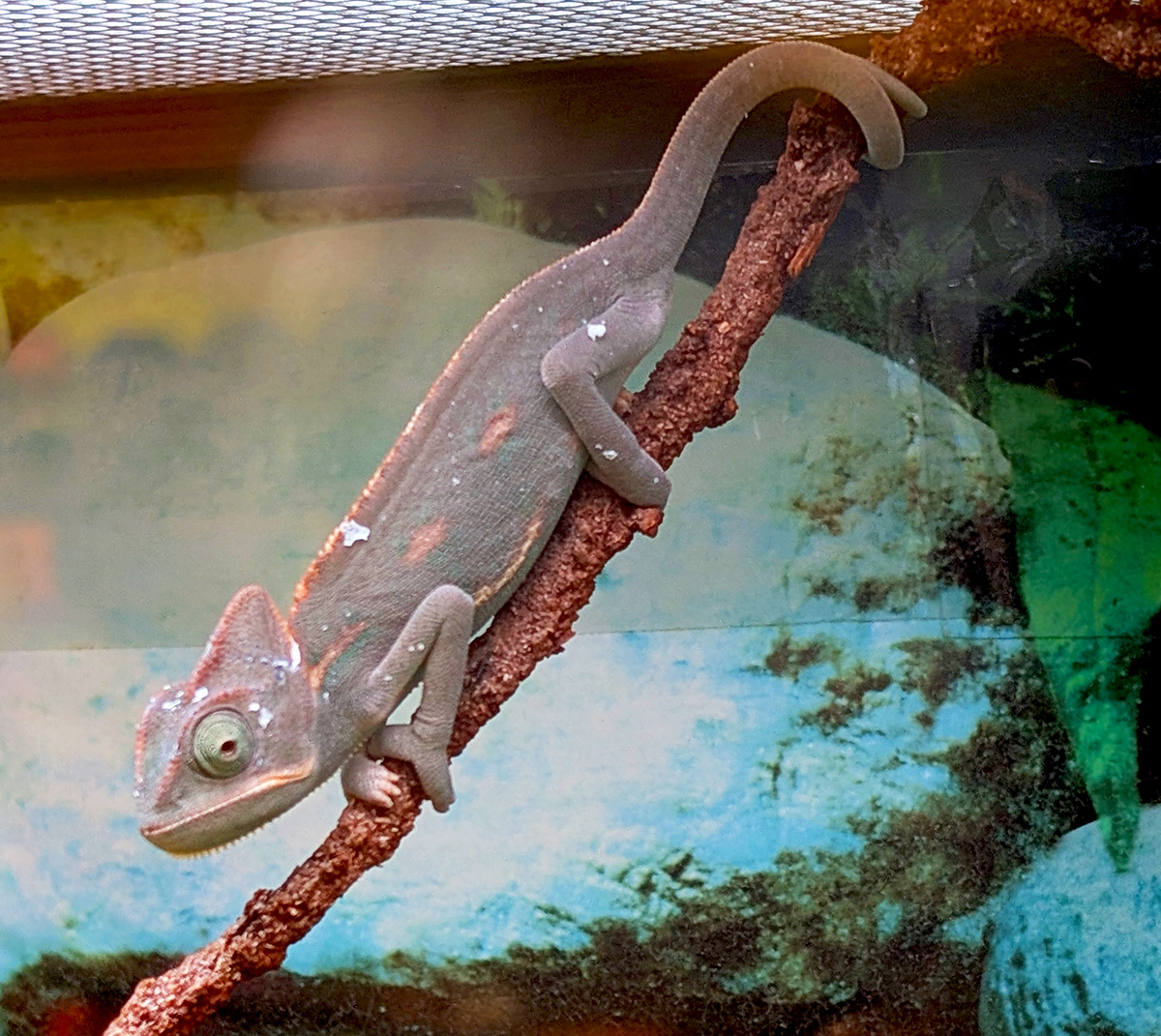
The individual photographed here is a juvenile resting in subdued gray-green coloration, with a casque already taking shape. The pale flecks on the flanks read as ordinary shed skin or feeder dust rather than anything of concern.
For keepers, steady husbandry is the whole game: hold the UVB schedule and replace bulbs on time, gut-load and dust feeders, mist or run a dripper daily, give females a laying bin well before they need it, house each animal alone, and graduate growing juveniles from glass into ventilated screen housing planted with safe greenery. Get the lighting, hydration, and solitude right, and the rest tends to follow.
Images, text, and biological descriptions published by the Cernunnos Foundation are released for educational, artistic, and reference use. Artists, educators, and naturalists are encouraged to use these materials to promote ecological literacy and appreciation of biodiversity.
Attribution is appreciated but not required. Knowledge grows best when it is shared.