Verbascum blattaria
Taxonomy
Domain: Eukaryota
Kingdom: Plantae
Subkingdom: Tracheobionta
Superdivision: Spermatophyta
Division: Magnoliophyta
Class: Magnoliopsida
Clade: Eudicots
Clade: Asterids
Order: Lamiales
Family: Scrophulariaceae
Genus: Verbascum
Species: Verbascum blattaria
Common Names by Region
- United States / Canada: Moth mullein (occasionally “moth torch” in older texts)
- United Kingdom / Ireland: Moth mullein
- Continental Europe: Local-language equivalents of “moth mullein” (e.g., German Schaben-Königskerze, referencing the cockroach association in the name)
Description
Quick ID
- Growth form: Slender, wiry, usually unbranched flowering stalk rising from a flat basal rosette. Reads as an airy roadside plant rather than a thick “candle.”
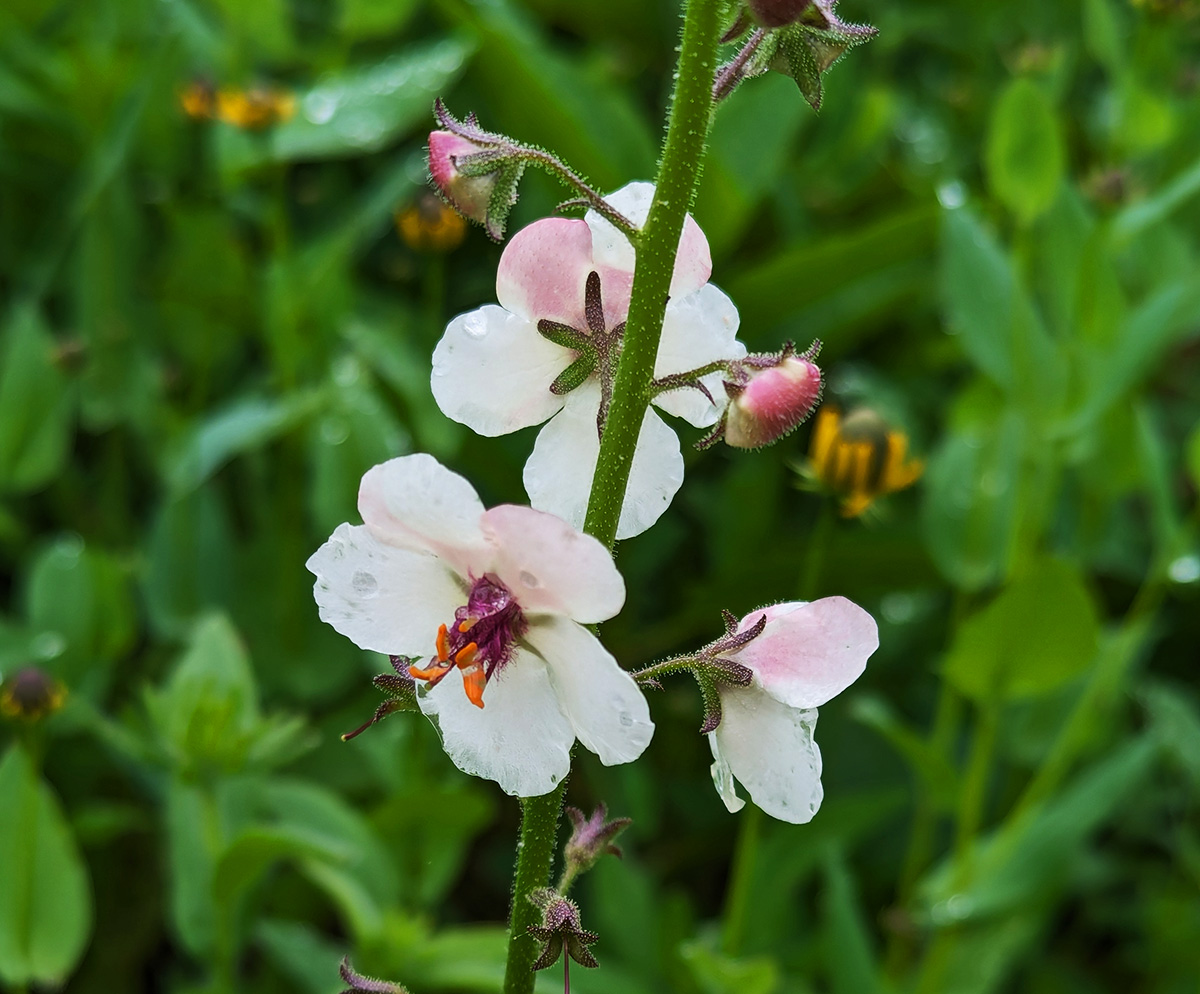
- Flowers: Five-petaled, roughly 1 inch across, borne singly at each node on long, slender pedicels. This photo is the white form with a pink flush on the buds and petal reverse; the more familiar form is bright yellow.
- Center details: Five stamens with violet, woolly (bearded) filaments and orange, kidney-shaped anthers — the “purple eye” that clinches the ID.
- Leaves: (Key check) Nearly hairless (glabrous) and toothed, basal ones oblong, upper ones clasping the stem. No felt, no wool.
- Stem / buds: Smooth low on the stalk, turning glandular-sticky up in the flower zone; pedicels and calyx are densely glandular-hairy (clearly visible on the buds here).
Blooming
- June into September, opening progressively up the stalk. This photo dates to June 2, right at the front of the window.
Look-alikes
- Wand / twiggy mullein (Verbascum virgatum): Flowers in clusters of 2–5 per node on very short pedicels, stem glandular-hairy throughout — the opposite of the solitary, long-pedicel arrangement here.
- Common mullein (Verbascum thapsus): Thick, felted gray leaves and a dense club-like spike of yellow flowers; the whole plant looks woolly.
- Nettle-leaved mullein (Verbascum chaixii): Branched candelabra habit with nettle-like leaves; already profiled in this guide as the genus companion.
Known Range
- Native: Europe, North Africa, and temperate Asia.
- Introduced / naturalized: Widely established across North America — nearly all of the lower 48 and much of Canada. In Pennsylvania it’s a common sight on roadsides, field edges, and disturbed ground, including the river-corridor and reclaimed-industrial habitat around Johnstown.
Care / Habitat
Light
- Full sun. Tolerates light shade but flowers best in the open.
Soil
- Prefers well-drained, lean ground. Thrives in gravel, sand, and poor rocky soil where little else bothers to grow.
Water
- Drought-tolerant. A biennial that asks for nothing once the rosette is established.
Typical Habitat (when naturalized)
- Disturbed and pioneer ground: roadsides, railway ballast, fields, waste places, quarry edges, and fresh fill — sun plus sharp drainage.
Propagation / Reproduction
- Biennial: a leafy rosette the first year, bolting to flower and set seed the second.
- Seed only, and it seeds prolifically. Self-sows readily on open ground.
- Famous for seed longevity: V. blattaria seeds are the stars of the Beal Seed Viability Experiment, still germinating after well over a century of burial.
- To contain it: deadhead before seed set and thin volunteer rosettes in spring.
Pests / Diseases / Threats
- Tough and largely trouble-free. Aphids may gather on new growth and flower spikes.
- Occasional leaf spot or mildew in humid, crowded conditions.
- Weedy enough to appear on watch lists in a few states; manage by cutting seed heads if you want it held in place.
Additional Notes
Ecology & Use
- A dependable pollinator plant, working bees across a long bloom season.
- The species name blattaria comes from the Latin blatta, “cockroach” — the plant was long reputed to repel (or draw) the insects, and was strewn for that purpose. It’s the reason “moth” and pest lore cling to the common names.
- Earns its place in a field-guide garden: wild-looking, self-directed, and honest about where it likes to grow.
Management
- Want it to stay? Let a few plants reseed, or collect and re-sow.
- Want it held? Deadhead before seed drop and pull first-year rosettes early.
Open Reference / Educational Use (CF Standard)
This profile is provided for open educational reference, field identification support, and art/illustration reference in the spirit of the Cernunnos Foundation field guide project. Reuse is encouraged with attribution to CF and your on-site page as the source.
Post Views: 176