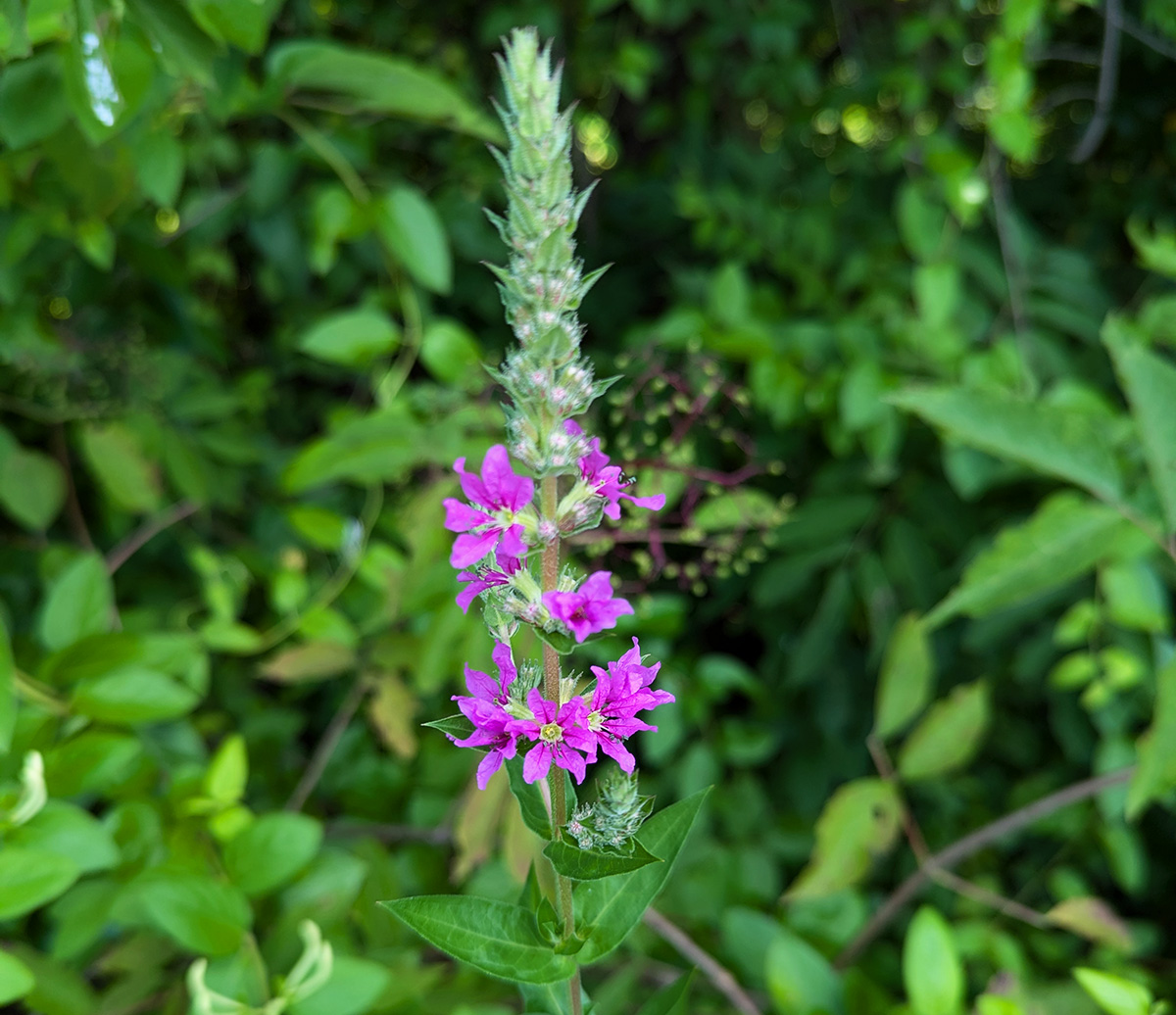
Lythrum salicaria
Taxonomy
Domain: Eukaryota
Kingdom: Plantae
Subkingdom: Tracheobionta
Superdivision: Spermatophyta
Division: Magnoliophyta
Class: Magnoliopsida
Clade: Eudicots
Clade: Rosids
Order: Myrtales
Family: Lythraceae
Genus: Lythrum
Species: Lythrum salicaria
Common Names by Region
- United States / Canada: Purple loosestrife, spiked loosestrife
- United Kingdom / Ireland: Purple loosestrife (native and welcome there)
- Continental Europe: Local-language equivalents — the plant is a benign native across its home range
Description
Quick ID
- Growth form: Tall, erect perennial, commonly 3–7 feet, throwing multiple stems from a woody root crown and forming dense clumps and stands.
- Flowers: A crowded terminal spike of magenta-pink blooms, each with 5–7 crinkled, crepe-papery petals (usually six) and a small yellow-green center.
- Stem: Downy and distinctly four-to-six-angled (squarish in cross-section), woody at the base.
- Leaves: Lance-shaped, stalkless (sessile), often clasping the stem, set opposite or in whorls of three, sometimes downy.
- Buds: Fuzzy gray-green, packed toward the spike tip — clearly visible crowning this plant.
Blooming
- July into September. This photo dates to July 6, right at the front of the window.
Look-alikes
- Winged loosestrife (Lythrum alatum): The one that matters — a native Lythrum with flowers borne singly or in pairs in the leaf axils rather than a dense spike, and a smaller, more open habit. Separate this before you pull anything.
- Blazing star (Liatris spp.): Native, spike of pink-purple, but composite (daisy-family) flower heads and grass-like leaves.
- Fireweed (Chamerion angustifolium): Pink and spiked, but four-petaled flowers and a very different leaf.
Known Range
- Native: Europe, temperate Asia, and northwest Africa, where it sits in balance with its ecosystem.
- Introduced / invasive: Established across much of North America, heaviest through the northern U.S. and Canada, and thoroughly naturalized across the Midwest, including Indiana. This observation comes from central Indiana.
Care / Habitat
(Framed for identification and management — this is a species to remove, not cultivate.)
Light
- Full sun to part shade. Flowers hardest in the open.
Soil
- Wet, mucky, nutrient-rich ground; tolerates a wide range of wetland substrates.
Water
- A wetland obligate in practice — marsh, ditch, pond and stream margin, wet meadow, shoreline.
Typical Habitat (where it invades)
- Freshwater wetlands, roadside and drainage ditches, disturbed wet ground, and lake and river edges. It colonizes exactly the habitat a wet-meadow restoration is built to protect.
Propagation / Reproduction
- Perennial, with a root crown that expands outward year over year into ever-larger clumps.
- Seed: Staggering output — a single mature plant can throw over two million seeds in a season, tiny and water- and mud-dispersed, staying viable in the seed bank for years.
- Vegetative: Resprouts readily from root and cut-stem fragments, so careless removal can seed a new stand.
- A textbook example of tristyly — three floral forms with differing style and stamen lengths that boost cross-pollination and, with it, invasive vigor. Darwin studied this very trait in this very plant.
Pests / Diseases / Threats
(Here the plant is the threat — this section covers what controls it.)
- Few North American pests hold it in check, which is central to why it dominates once established.
- Biological control is the established landscape-scale answer: leaf-feeding beetles Galerucella calmariensis and G. pusilla, the root weevil Hylobius transversovittatus, and the flower weevil Nanophyes marmoratus, released across the Midwest and Northeast with strong results in many wetlands.
Additional Notes
Ecology & Invasion
- Forms dense monocultures that crowd out cattails, sedges, bulrushes, and native wet-meadow flora, collapsing plant diversity.
- Degrades habitat for waterfowl, marsh-nesting birds, and amphibians, and offers far less wildlife value than the natives it replaces.
- Regulated as an invasive/prohibited plant in Indiana and across many U.S. states and Canadian provinces. Do not plant it; treat “sterile” nursery cultivars with skepticism, since they can still cross with wild stands.
- A clean example of context determining character: a well-behaved streamside native in Europe becomes a habitat-wrecker once it arrives here without its coevolved controls.
Management
- Small / young infestations: Hand-pull or dig, taking the whole root crown; bag and landfill the material rather than composting, and keep fragments out of the water.
- Before seed set: Cut and bag the flower spikes to stop that season’s seed rain.
- Established stands: Lean on the Galerucella biocontrol program, or use aquatic-approved herbicide (glyphosate or triclopyr formulations labeled for use near water) under the required state permits.
- Follow up: Replant cleared ground with native wetland species to hold the site — Joe-Pye weed, swamp milkweed, sedges, and blue flag iris are strong choices for the wet-meadow niche it vacates.
Field Note
- Confirm you’re looking at L. salicaria and not native winged loosestrife before any removal. The dense spike, squarish downy stem, and sessile clasping leaves here point to salicaria.
Open Reference / Educational Use (CF Standard)
This profile is provided for open educational reference, field identification support, and art/illustration reference in the spirit of the Cernunnos Foundation field guide project. Reuse is encouraged with attribution to CF and your on-site page as the source.
Post Views: 184