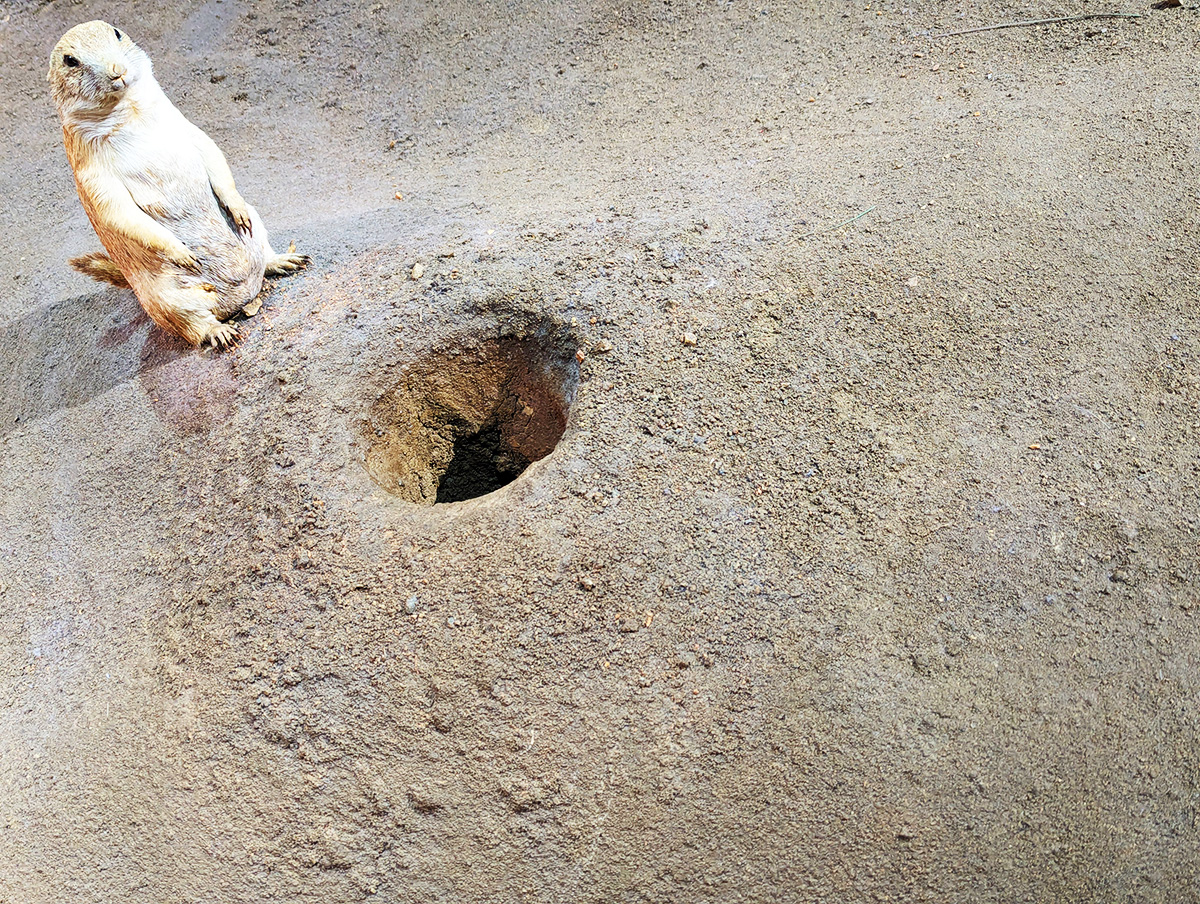
Cynomys ludovicianus
Taxonomy
Domain: Eukaryota
Kingdom: Animalia
Phylum: Chordata
Subphylum: Vertebrata
Class: Mammalia
Order: Rodentia
Suborder: Sciuromorpha
Family: Sciuridae
Subfamily: Xerinae
Tribe: Marmotini
Genus: Cynomys
Species: Cynomys ludovicianus
Common Names by Region
- United States / Canada: Black-tailed prairie dog; “prairie dog” broadly
- Historical / vernacular: “Petit chien” (little dog) in early French accounts — the source of the misleading “dog”; “barking squirrel” in older texts
- Spanish (Mexico): Perrito llanero, perrito de las praderas
Description
Quick ID
- Build: Stout, compact ground squirrel, roughly 14–17 inches including tail, ½–3 lbs, heavier in fall. Short legs, small ears, dark eyes set for a wide field of view.
- Coat: Buff-tan to pinkish-brown above, paler belly, with fine grizzling.
- Tail: Short and sparse, tipped in black — the character that names the species and separates it from the white-tailed group.
- Posture: The upright “picket pin” sentry stance shown here, forepaws tucked, is textbook — a lookout scanning above the colony.
Separating from relatives
- White-tailed prairie dog (C. leucurus) and Gunnison’s (C. gunnisoni): White or gray tail tips; higher-elevation ranges; smaller, less social towns.
- Ground squirrels (Urocitellus, Ictidomys): Slimmer, longer-tailed, and they don’t build the big communal crater-mound towns.
Known Range
- Native: The Great Plains of North America, from southern Saskatchewan to northern Mexico, and from the Rockies east into the mixed-grass prairie. A shortgrass and mixed-grass specialist.
- Historically among the most abundant mammals on the continent, in colonies that once ran to millions of animals.
Habitat & Social Structure
Habitat
- Open shortgrass and mixed-grass plains with well-drained soil for digging and low vegetation for clear sightlines.
Towns and coteries
- Lives in dense colonies called towns, subdivided into family groups called coteries — typically a male, several females, and their young, defending a shared territory.
- Towns are engineered landscapes of mounds and tunnels, historically spanning hundreds of square miles.
The burrow (foreground here)
- Burrows run deep with multiple entrances, nurseries, sleeping and latrine chambers, and a “listening” post near the surface.
- The raised crater mounds serve triple duty: flood barriers, elevated lookout perches, and passive ventilation — air flows through the tunnel because entrances of different heights create a pressure difference that pulls fresh air through. The mound in this frame is that architecture at work.
Behavior & Reproduction
- Diurnal and active year-round; black-tailed prairie dogs don’t truly hibernate, though they slow in hard weather.
- Diet: Mostly grasses and forbs, with some insects. They clip tall vegetation around the town to keep sightlines open even when they aren’t eating it.
- Communication: One of the most sophisticated vocal systems known in a rodent. Alarm calls encode the type, size, and even color of an approaching predator, and researchers treat the system as a genuine referential “language.” The contagious “jump-yip” — an animal throwing its forelegs up with a wee-oo call, rippling across the town — signals all-clear and coordinates the colony.
- Breeding: Once a year, late winter into spring. A single litter of about 3–4 pups after ~35 days, emerging above ground at five to six weeks.
Threats
- Sylvatic plague (Yersinia pestis, non-native) sweeps through towns and can kill nearly every animal in a colony — the single largest threat.
- Habitat conversion to cropland and development, plus a century of organized poisoning and shooting as an agricultural pest.
- The combined toll cut the species to a small fraction — commonly cited near 95% or more — of its historic range and numbers.
Additional Notes
Ecology — a keystone species
- Prairie dog towns are the engine of the shortgrass prairie. Their burrows shelter burrowing owls, snakes, and countless invertebrates; their grazing and digging shape plant diversity and soil health; and they’re prey for swift fox, ferruginous hawks, golden eagles, badgers, and coyotes.
- The black-footed ferret — once thought extinct, one of North America’s most endangered mammals — depends almost entirely on prairie dogs for food and on their burrows for shelter. Lose the prairie dog and you lose the ferret. That dependency makes this animal a linchpin, not a pest.
Captive care (zoo/enclosure setting)
- In managed exhibits they need deep diggable substrate, a high-fiber grass-and-hay diet, companions (they’re intensely social and fail in isolation), and enrichment that lets them dig, forage, and stand watch.
Field / Viewing Note
- Watch a town for a few minutes and the structure reveals itself: sentries up, foragers out, the jump-yip moving through like a wave. This individual is doing the sentry job right now.
Open Reference / Educational Use
This profile is provided for open educational reference, field identification support, and art/illustration reference in the spirit of the Cernunnos Foundation field guide project. Reuse is encouraged with attribution to CF and your on-site page as the source.
Post Views: 66