
Domain: Eukaryota
Kingdom: Animalia
Phylum: Chordata
Class: Actinopterygii
Order: Perciformes
Suborder: Scorpaenoidei
Family: Scorpaenidae
Subfamily: Pteroinae
Tribe: Pteroini
Genus: Neochirus
Species: Neochirus brachyptera (Cuvier, 1829)
This species was originally described as Pterois brachyptera and spent most of its modern scientific history as Dendrochirus brachypterus. A molecular and anatomical study published in 2023 separated this branch of the dwarf lionfishes into the new genus Neochirus. The California Academy of Sciences’ Catalog of Fishes, the Catalogue of Life, and the World Register of Marine Species now accept Neochirus brachyptera, although Neochirus brachypterus and the older Dendrochirus brachypterus remain common in museum, aquarium, and natural-history literature.
United States / aquarium trade: Fuzzy dwarf lionfish, dwarf fuzzy lionfish, shortfin dwarf lionfish, shortfin lionfish
Australia: Dwarf lionfish, shortfin turkeyfish, short-spined butterfly-cod, short-spined scorpionfish
General Indo-Pacific: Dwarf lionfish, shortfin turkeyfish
The “fuzzy” name comes from the small, leaflike skin appendages scattered across the head and body. “Shortfin” refers to its relatively short, rounded pectoral fins compared with those of the zebra lionfish and larger members of the lionfish group.
Body: Compact, deep-bodied, and heavily built for such a small fish, with the oversized head and broad mouth typical of an ambush predator.
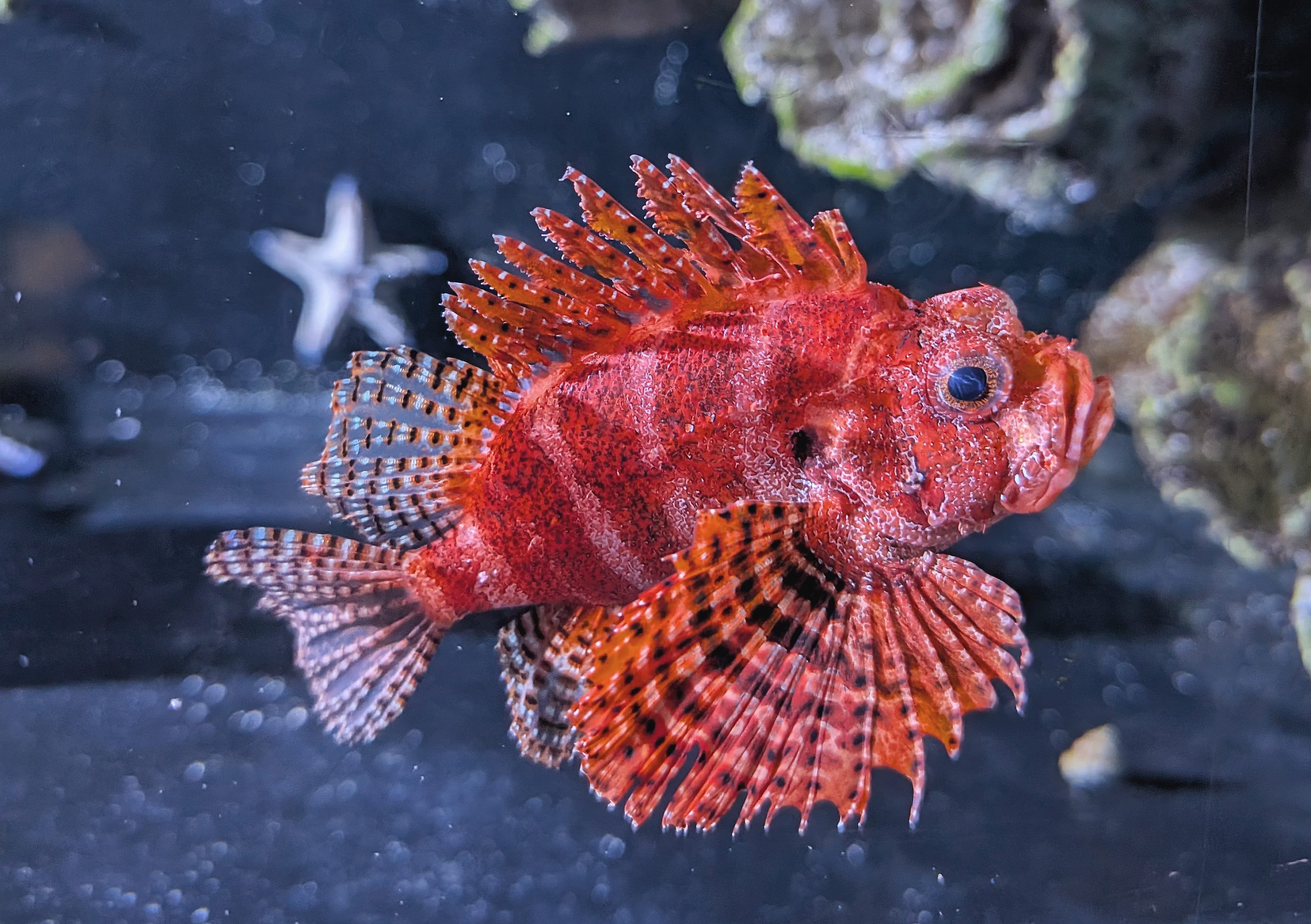
Color: Usually mottled brown, rust, or reddish brown with broad, indistinct vertical bars. Red and yellow forms also occur. The animal photographed here is an exceptionally vivid red individual, but that coloration falls within the known variation of the species.
Skin: Small fleshy flaps and leafy appendages cover parts of the head and lateral line, giving the fish its characteristic “fuzzy” texture and helping break up its outline against rock, algae, and sponges.
Pectoral fins: Short, rounded, fan-shaped, and webbed nearly to the tips. They carry distinct curved bands and rows of dark spots. These marked pectoral fins are one of the strongest field marks separating the fuzzy dwarf lionfish from the similar zebra lionfish.
Dorsal fin: Thirteen prominent dorsal spines, followed by nine or ten soft rays. The spotted membranes and dark marks on the dorsal filaments are clearly visible in this photograph.
Head: Broad and knobby, with a short tentacle above each eye, a large upturned mouth, and eyes positioned for watching prey while the fish remains nearly motionless.
Size: Usually around 6 inches long, with a published maximum of approximately 17 centimeters, or 6.7 inches. Despite the word “dwarf,” it is a substantial, thick-bodied predator.
The currently recognized species occurs across a broad section of the Indo-Pacific, from Sri Lanka eastward through Southeast Asia and the Pacific islands to Hawaii and Tonga. Its range extends north to southern Japan and south to Lord Howe Island, northern New Zealand, and the Kermadec Islands.
Older references often give it an even broader range extending into the western Indian Ocean and Red Sea. Some of those records may belong to other members of what was once treated as the Dendrochirus brachypterus species complex. Several visually similar regional forms have since been recognized as separate species, making locality information important when identifying wild animals.
The fuzzy dwarf lionfish is a marine, reef-associated species recorded from approximately 2 to 80 meters deep. It is especially associated with reef flats, sheltered lagoons, algae-covered rocks, sandy areas, caves, crevices, ledges, and sponge growth.
It is primarily nocturnal. During daylight it commonly rests in a cave, beneath an overhang, against a sponge, or almost upside down inside a dark recess. Its mottled color, skin tassels, and irregular profile make it surprisingly difficult to distinguish from the surrounding reef.
Adults are usually encountered alone, although males and females form pairs during breeding. Juveniles may gather in small groups, sometimes with roughly ten fish occupying an isolated coral or rocky outcrop.
Like other lionfishes, it is a deliberate rather than fast-moving hunter. It can remain nearly motionless for long periods, then strike with a sudden expansion of its large mouth. The broad pectoral fins help form a visual barrier around small prey and make escape more difficult.
The fuzzy dwarf lionfish is carnivorous and feeds primarily on small crustaceans, particularly crabs and shrimp. Small fishes may also be taken when available.
Its mouth can expand rapidly and swallow prey that appears surprisingly large relative to the lionfish itself. In an aquarium, ornamental shrimp, small crabs, and any fish that can fit inside its mouth should be considered potential food rather than companions.
It normally hunts after dark, using camouflage to approach or wait for prey before engulfing it in a rapid suction strike.
Males and females form distinct spawning pairs. Courtship generally occurs after dark, with the pair leaving the shelter of the reef and rising into the water column.
The female releases eggs within buoyant, gelatinous masses that are fertilized externally. The egg masses drift in open water, dispersing the developing embryos away from the reef and from many bottom-dwelling predators.
The species has spawned in managed aquariums, but successfully raising the tiny pelagic larvae remains considerably more difficult than inducing the adults to reproduce.
The fuzzy dwarf lionfish is currently assessed as Least Concern by the IUCN. It has a wide geographic range and is not presently considered globally threatened.
Individuals are collected for the marine-aquarium trade and are taken in some local subsistence fisheries. Collection may affect particular reef populations, especially uncommon color forms, but no major range-wide decline has been documented.
This species should not be confused with the much larger red lionfish and devil firefish responsible for the destructive lionfish invasion of the western Atlantic and Caribbean. The fuzzy dwarf lionfish is a different, smaller Indo-Pacific species and is not the animal usually meant when invasive Atlantic lionfish are discussed.
The thirteen dorsal spines are venomous. Additional venom-bearing spines occur in the pelvic and anal fins. The venom is defensive: the fish does not actively chase people or deliberately attack with its spines, but accidental contact can cause an intensely painful wound.
The apparent softness of the fins is misleading. The sharp spine is enclosed within tissue containing venom glands, and pressure from a puncture forces venom into the wound. Lionfishes should never be picked up by hand, cornered against aquarium glass, or handled casually with a soft net.
A person stung by any lionfish should treat it as a genuine envenomation and seek appropriate medical guidance, particularly if pain is severe or if there are signs of an allergic or systemic reaction.
The fuzzy dwarf lionfish combines camouflage and warning display in the same body. At rest, its mottled skin and ragged appendages resemble algae, sponge tissue, and broken reef growth. Once disturbed, the fish spreads its strongly patterned fins and exposes the defensive spines.
Its “fuzzy” surface is not fur and is not composed of scales standing on end. The texture comes from fleshy cirri and skin appendages, which vary considerably between individuals. Some are heavily ornamented, while others appear relatively smooth.
The dramatic pectoral fins are not armed in the same manner as the dorsal spines, but they are essential to the animal’s hunting display. When opened, they make the fish appear larger, confuse prey, and help contain small animals immediately before the strike.
The scientific name refers to the short fins: brachys means short and pteron refers to a wing or fin. The newer genus name Neochirus roughly indicates a “new hand,” acknowledging its separation from Dendrochirus, the “tree-hand” lionfishes.
This individual is an unusually clean example of the red form of the fuzzy dwarf lionfish. Under aquarium lighting, nearly the entire body glows scarlet, while the black spotting and pale blue-white fin membranes remain sharply visible. The color is striking enough to suggest a different species at first glance, but the anatomy tells the more reliable story.
The short, fully webbed pectoral fins carry the curved rows of dark marks expected in the fuzzy dwarf lionfish. The dorsal spines are relatively short and heavily spotted. Small skin appendages roughen the head and body, and there are no greatly elongated pectoral rays or chin barbels. Those features argue against the zebra lionfish, Fu Manchu lionfish, and the larger species of Pterois.
A photograph cannot establish every meristic character, and the former brachyptera complex contains several closely related regional species. Without knowing where this fish was collected, absolute certainty is impossible. Even so, the visible combination of body form, fin webbing, pectoral pattern, skin texture, and coloration makes fuzzy dwarf lionfish — Neochirus brachyptera the strong identification.
It is a useful reminder that beauty in nature is not always an invitation. This fish is compact, brilliantly colored, and apparently calm, but every dorsal spine carries a clear instruction: look closely, remember it, and keep your hands away.
All Cernunnos Foundation materials are free to use for any educational purpose.