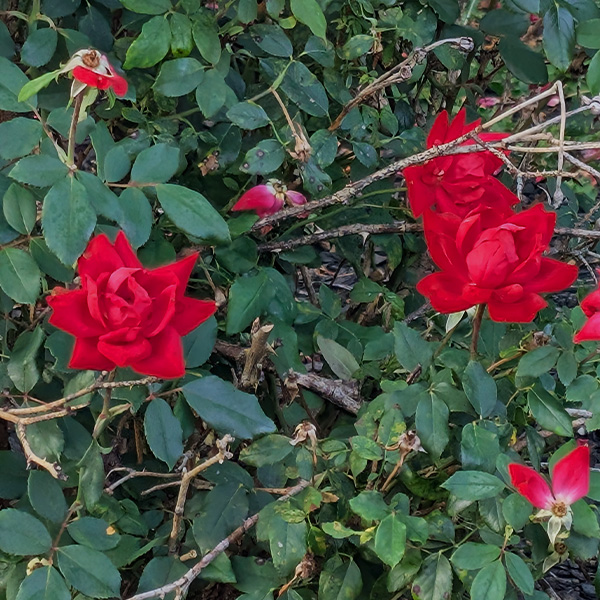
Rosa ‘Radrazz’
Taxonomy
Domain: Eukaryota
Kingdom: Plantae
Subkingdom: Tracheobionta
Superdivision: Spermatophyta
Division: Magnoliophyta
Class: Magnoliopsida
Clade: Eudicots
Clade: Rosids
Order: Rosales
Family: Rosaceae
Genus: Rosa
Cultivar: Rosa ‘Radrazz’ (trademarked Knock Out®)
Common Names by Region
- United States / Canada: Red Knock Out rose, Knock Out rose, shrub rose
- Trade designation: Knock Out® is the trademark; ‘Radrazz’ is the actual patented cultivar name (the “Rad-” prefix marks breeder William Radler’s introductions)
- General: Landscape shrub rose
Description
Quick ID
- Growth form: Rounded, bushy, self-supporting shrub rose, typically 3–4 feet tall and wide. Flowers scattered across the whole mound, not borne one-per-stem like a hybrid tea.
- Flowers: Cherry-to-brick red, loosely semi-double — roughly 5–11 petals around an open center, showing the yellow stamens as the bloom matures. About 3 inches across, carried in clusters.
- Bloom habit: Nearly continuous from late spring to frost, and self-cleaning — spent blooms drop on their own, so no deadheading is needed to keep it flowering.
- Foliage: Dark blue-green, glossy, disease-resistant; new growth often flushes burgundy-red.
- Fragrance: Minimal — this is a landscape workhorse bred for toughness and bloom, not scent.
Blooming
- Late spring through hard frost, in repeating flushes every 5–6 weeks. One of the longest bloom seasons of any rose.
Look-alikes
- The rest of the Knock Out® series: ‘Radrazz’ is the original single-red. The line now includes Double Knock Out (fuller, more petals), Pink, Blushing, Rainbow, Coral, and Sunny (yellow). A denser, many-petaled red bloom is likely Double Knock Out (‘Radtko’), not this one.
- Hybrid tea roses: Larger, high-centered, tightly double blooms borne singly on long stems — the florist-rose look. More fragrant, far more disease-prone, far more work.
- Drift® and other groundcover shrub roses: Lower and more spreading, smaller flowers.
Known Range
- Origin: A modern cultivated hybrid, bred by William Radler in Wisconsin and introduced in 2000. Not a wild plant; the genus Rosa is native across the Northern Hemisphere, but ‘Radrazz’ is a garden creation.
- In cultivation: Planted throughout the United States and Canada, hardy roughly USDA zones 4–10. Ubiquitous across Pennsylvania in home landscapes, commercial plantings, and municipal beds — it became the best-selling rose in North American history on the strength of its toughness.
Care / Habitat
Light
- Full sun — six-plus hours — for best bloom and disease resistance. Tolerates light shade with reduced flowering.
Soil
- Well-drained, average to fertile soil. Adaptable to a wide range of soils; dislikes soggy ground.
Water
- Moderate; drought-tolerant once established. Water at the base rather than overhead to keep foliage dry.
Pruning
- Low-maintenance by design. A single hard cutback in late winter/early spring to about a foot, removing dead and crossing canes, keeps it shapely — that’s essentially the whole annual job. No deadheading required.
Typical Habitat (when cultivated)
- Sunny beds, borders, foundation plantings, hedges, parking-lot islands, and mass landscape plantings — anywhere a tough, long-blooming shrub is wanted with minimal care.
Propagation / Reproduction
- Cuttings are the standard method, but note this is a patented cultivar — commercial propagation is legally restricted, and the trademark/patent protections have been actively enforced.
- Softwood or hardwood cuttings root readily for the home grower’s own use where permitted.
- Not grown from seed in the trade; seedlings won’t come true.
Pests / Diseases / Threats
- Bred for disease resistance — its landmark trait. Highly resistant to black spot and powdery mildew, the two diseases that make most roses high-maintenance.
- Rose rosette disease (RRD): the serious exception. This incurable virus, spread by a tiny mite, has hit Knock Out plantings hard in many regions precisely because they’re planted in such dense monocultures. Watch for witches’-broom growth, excessive red new growth, and thickened thorny canes — infected plants should be removed to protect neighbors.
- Japanese beetles and aphids turn up; usually cosmetic.
Additional Notes
Ecology & Use
- The single and semi-double forms (like this ‘Radrazz’) are far better for pollinators than the tightly double Knock Outs, because the open centers let bees reach the accessible pollen and stamens. If pollinator value matters, the original single-red is the one to plant.
- A genuine landscape revolution: by combining disease resistance, continuous bloom, cold-hardiness, and near-zero maintenance, ‘Radrazz’ made roses accessible to gardeners who’d given up on them — and reshaped the commercial nursery trade after 2000.
- The trade-off for that toughness is fragrance and refinement: it won’t give you the scent or the perfect high-centered bloom of a fine hybrid tea. It’s a workhorse, not a show horse — hence “basic beauty,” and that’s not an insult. It does exactly what it was built to do, reliably, for years.
Management
- Want maximum, trouble-free bloom? Full sun, one hard spring cutback, water at the base, and otherwise leave it alone.
- Want to protect it? Avoid planting in a dense single-cultivar mass (RRD’s favorite conditions), and pull any plant showing witches’-broom before the mite spreads it.
All Cernunnos Foundation materials are free to use for any educational purpose.
Post Views: 114