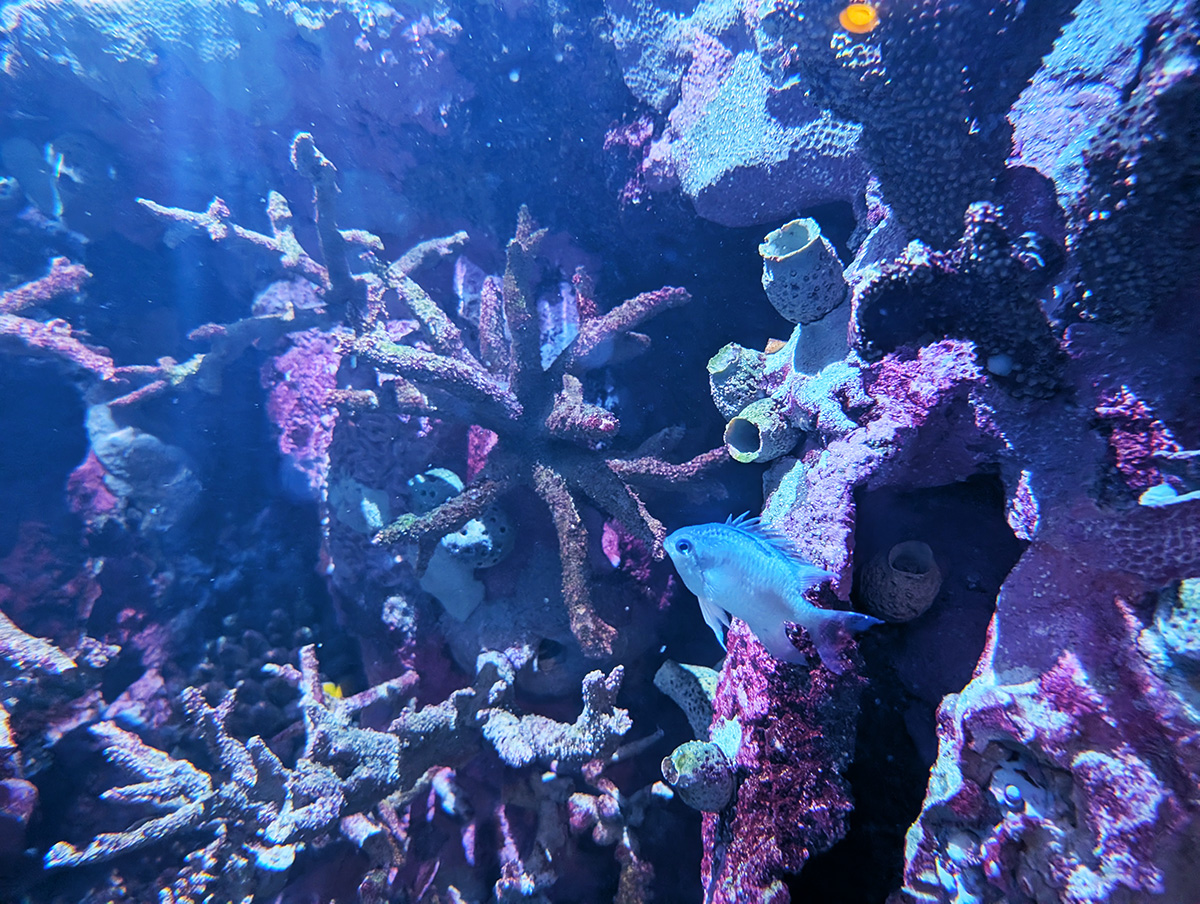
The correction helps a lot — that soft blue body with the faint greenish cast on the flanks, the forked tail, and the single dorsal all hold up. I’m confident on blue-green chromis (Chromis viridis). Here’s the profile, built on the same template as your plant entries.
Blue-Green Chromis
Chromis viridis
Taxonomy
- Kingdom: Animalia
- Phylum: Chordata
- Class: Actinopterygii
- Order: Ovalentaria (Blenniiformes / Perciformes sensu lato)
- Family: Pomacentridae (damselfishes)
- Genus: Chromis
- Species: Chromis viridis
Common Names by Region
- Blue-Green Chromis
- Green Chromis
- Blue-Green Damselfish
- Green Puller
Description
Body
A small, laterally compressed damselfish with the classic oval Pomacentrid profile and a deeply forked tail. Streamlined for hovering and darting in open water above the reef.
Coloration
- Iridescent pale blue to blue-green, shifting with light angle and depth
- Under blue/actinic aquarium lighting the body washes to a soft lavender-blue (as seen here); in daylight the green cast is stronger
- Males deepen to a yellowish or darker hue when guarding nests
Size
- Reaches roughly 8–10 cm (about 3–4 inches)
- One of the smaller reef damsels
Fins
- Single continuous dorsal fin
- Deeply forked caudal fin with pointed lobes — built for quick retreat to shelter
Known Range
- Indo-Pacific: Red Sea and East Africa east across the Indian and Pacific Oceans to the Line Islands, north to the Ryukyus, south to the Great Barrier Reef and New Caledonia
Common on shallow reefs; frequently displayed in public aquaria and reef systems worldwide, including North American exhibit tanks.
Habitat
- Shallow lagoons and sheltered reef flats, typically 1–12 m
- Lives in loose aggregations directly above branching corals — especially Acropora
- The coral thicket is both larder and bunker: the school feeds in the water column above it and drops into the branches at any threat
Diet
- Planktivore
- Feeds on phytoplankton, zooplankton, and copepods drifting in the current
- Feeds actively during daylight, retreating into coral to rest at night
Behavior / Reproduction
- Social and shoaling; forms dense hovering aggregations of dozens to hundreds
- Males clear and guard nesting sites on hard substrate
- Females deposit demersal (bottom-attached) eggs
- Males tend and aerate the clutch by fanning until hatch — a defining Pomacentrid trait
Predators / Threats
- Larger reef predators: groupers, lizardfishes, hawkfishes, trumpetfishes
- The species itself is abundant and not considered threatened
- Broader pressure comes indirectly through loss of branching coral habitat — as the coral goes, so goes the shelter this fish depends on
Ecological Role
A link in the reef’s energy chain. The blue-green chromis converts drifting plankton into fish biomass available to larger predators, moving open-water productivity onto the reef structure. Its tight association with branching coral also makes it a soft indicator species — healthy Acropora thickets tend to carry healthy chromis aggregations above them.
Additional Notes
- Among the most common damsels in the marine aquarium trade, valued for peaceable schooling behavior
- Genuinely gregarious — best kept and best understood in groups; isolated individuals lose the natural behavior entirely
- Color is notoriously light-dependent, which makes field and tank ID a recurring puzzle (see note below)
Cernunnos Foundation Note
The blue-green chromis is a study in dependence as strategy. It thrives by binding itself tightly to a single structure — the branching coral head — and trading range for security. That coupling is also its exposure: the fish is only as durable as the habitat it hovers over. In system terms it’s a clean illustration of how a resilient-looking population can be quietly load-bearing on one keystone element, and why protecting structure protects everything that shelters in it.
Field Note — ID & location caveat
Damsel color under blue tank lighting is a known trap, so the ID rests on shape, not hue: the compact oval body, deeply forked tail, and single dorsal put this squarely in Chromis, and the pale blue-green read matches C. viridis better than the darker-edged Caribbean blue chromis (C. cyanea). A washed-out Chrysiptera is the outside alternative, but the body form favors chromis. Published as best read; correction welcome.
Post Views: 205