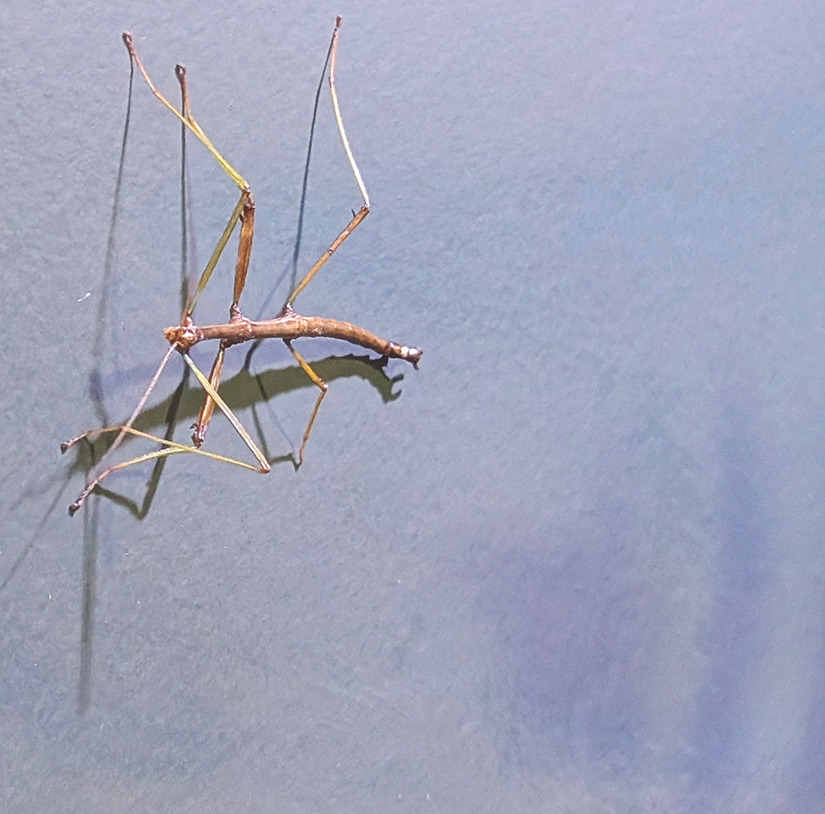
Diapheromera femorata
Taxonomy
- Domain: Eukaryota
- Kingdom: Animalia
- Phylum: Arthropoda
- Class: Insecta
- Order: Phasmatodea
- Family: Diapheromeridae
- Genus: Diapheromera
- Species: Diapheromera femorata
Common Names by Region
- United States / Canada: Northern walkingstick, common walkingstick, prairie alligator (regional/colloquial), devil’s darning needle (shared, confusingly, with damselflies)
- General: Stick insect, walking stick
Description
Quick ID
- Body: Long, slender, cylindrical, and twig-like — the whole animal is built to read as a stick. Adults run roughly 3–4 inches, females larger than males.
- Color: Variable brown to greenish, often shifting with maturity; this individual is a mottled brown-and-yellow-green, typical of a molting or maturing animal.
- Legs: Six extremely long, thread-thin legs. The front pair stretches straight forward alongside the head at rest, extending the twig illusion — a diagnostic phasmid posture visible here.
- Antennae: Long and thin, about two-thirds the body length in this species (a useful separator from short-antennae phasmids).
- Wingless: Northern walkingsticks are flightless in both sexes — no wings at any stage.
Range
- Widespread across eastern North America, from southern Canada through the eastern and central United States. Common throughout Pennsylvania in deciduous woodland and edge habitat.
Habitat & Behavior
- A creature of deciduous forests, woodland edges, and brushy clearings, where it lives among the foliage of its host trees.
- Masterful camouflage is its entire defense — it holds still and mimics a twig, and will sway gently to imitate a branch moving in the breeze. When disturbed it may drop straight to the ground and stay motionless.
- Slow-moving and nocturnal in its feeding, most active on warm summer and early-fall nights.
- Can shed and regenerate a lost leg across successive molts — a partial explanation for any odd leg proportions in a given individual.
Diet
- Herbivorous leaf-eater. Favors the foliage of oak and hazelnut, with black cherry, black locust, and other hardwoods also taken.
- In most years a harmless background browser; in occasional outbreak years, large local populations can defoliate patches of forest canopy, though lasting damage is rare.
Reproduction
- Females drop eggs singly to the forest floor, flicking them loose to fall among the leaf litter — the eggs resemble tiny seeds and are dispersed passively.
- Eggs typically overwinter (sometimes for two winters) before hatching, with nymphs emerging in spring to climb into the foliage.
- Nymphs mature through a series of molts across the summer. The species can reproduce sexually, and parthenogenesis (unfertilized development) is documented in the genus.
Pests / Threats / Notes
- No conservation concern — common and widespread.
- Preyed on by birds, and studied as classic textbook examples of crypsis (camouflage) and mimicry.
- Harmless to humans: no bite, no sting, no venom. The Northern walkingstick does not spray defensive chemicals, unlike some southern relatives.
Additional Notes
Ecology & Significance
- A model organism for camouflage — one of the clearest living demonstrations of protective mimicry in the North American insect fauna, and a reliable “wow” find for anyone who spots one resolving out of what looked like a bare twig.
- Its seed-like eggs are dispersed in part by ants, which collect them for a fatty external capsule (a capitulum) and discard the viable egg — an insect-plant-style mutualism run through an insect egg instead of a seed.
- Being flightless and slow, it depends entirely on stillness and disguise. This photo, with the animal fully in the open on a bare surface and casting a clear shadow, is the rare moment the disguise is stripped away and the architecture of the mimic is laid bare.
Field Note
- Found locally in western Pennsylvania. Encountered in the open on a smooth surface rather than in host foliage — an unusual, exposed vantage that shows the full leg span and forward-reaching front legs a foliage shot would hide.
Open Reference / Educational Use (CF Standard)
This profile is provided for open educational reference, field identification support, and art/illustration reference in the spirit of the Cernunnos Foundation field guide project. Reuse is encouraged with attribution to CF and your on-site page as the source.
Views: 249