
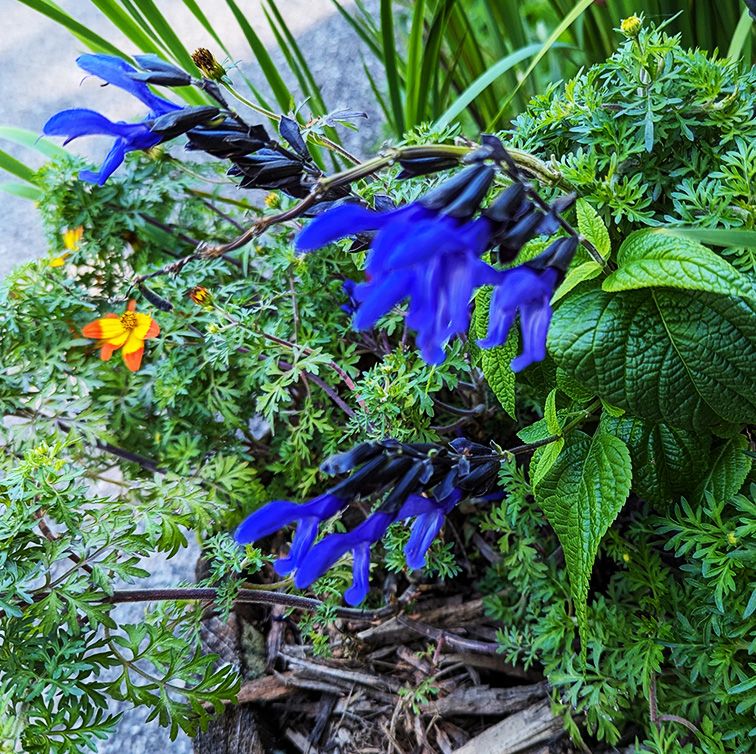
Salvia guaranitica ‘Black and Blue’
Taxonomy
Kingdom: Plantae
Clade: Tracheophytes
Clade: Angiosperms
Clade: Eudicots
Order: Lamiales
Family: Lamiaceae
Subfamily: Nepetoideae
Genus: Salvia
Species: Salvia guaranitica
Binomial Name: Salvia guaranitica A.St.-Hil. ex Benth., 1833
Cultivar: ‘Black and Blue’
Common Names by Region
Anise Sage / Anise-scented Sage (English, general)
Blue Anise Sage (English)
Hummingbird Sage (English, colloquial — shared with other species)
Brazilian Sage / Blue Brazilian Sage (English)
Sauge anisée (French)
Anis-Salbei (German)
Description
Growth Habit
Salvia guaranitica ‘Black and Blue’ is a tender perennial subshrub forming upright, bushy clumps on square, dark stems. The cultivar typically reaches 2.5–3.5 ft, shorter than the 5–6 ft the species can attain where fully hardy. It spreads through tuberous roots, rhizomes, and short underground runners, widening into colonies where winters are mild. After frost the plant blackens and dies to the ground, resprouting from the roots in spring where it survives.
Leaves
Leaves are opposite, ovate, and 2–5 inches long, with a wrinkled (rugose) surface, pointed tip, and lightly toothed margins. They are dark green above and paler beneath, and release a faint herbal-to-anise scent when crushed. The texture is soft and slightly puckered, giving the foliage a matte, hand-stitched look up close.
Flowers
The flowers are the defining feature. Two-lipped tubular corollas, cobalt to sapphire blue and about 2 inches long, carry a hooded upper lip and a shorter projecting lower lip. They emerge from near-black calyces on dark, almost black stems, the color contrast making the blue read as electric. Blooms are arranged on terminal and axillary spikes 10–15 inches long, facing one direction and tracking the sun through the day. Bloom period runs mid-summer to frost. The plant is a hummingbird magnet and also draws butterflies and long-tongued bees.
Seed Heads / Fruit
Fruit follows the Lamiaceae pattern: a cluster of small nutlets maturing inside the persistent calyx. ‘Black and Blue’ sets little viable seed and does not come true from seed, so spread is effectively all vegetative through tubers and runners.
Quick ID
Cobalt-blue tubular two-lipped flowers emerging from jet-black calyces — the defining tell
Very dark, nearly black flowering stems
Flowers carried on long, one-sided spikes that follow the sun
Ovate, wrinkled (rugose) dark green leaves, faintly aromatic when crushed
Upright clump-former that spreads by underground runners where hardy
Known Range
Native to southeastern Brazil, Paraguay, Uruguay, and northeastern Argentina. Grown worldwide as an ornamental. In North America it performs as a perennial across the warm South and West (roughly USDA zones 8–10), is root-hardy into zone 7 with mulch, and is treated as a summer annual or overwintered container plant in colder regions, including the northern US and Pennsylvania. It is not naturalized in the wild here, though where it survives the winter it expands freely by root within a bed.
Care / Habitat
Light: Full sun to part or filtered shade; afternoon shade prevents midday wilt in hot-summer sites, while deep shade thins the bloom and stretches the stems.
Soil: Rich, well-drained loam preferred; drainage matters most for surviving winter.
Moisture: Even moisture gives the best flowering; drought tolerant once established thanks to its tuberous roots.
USDA Zones: 8–10 reliably; zone 7 with protection; grown as an annual in zone 6 and colder.
Typical Habitat (cultivated): borders, cottage gardens, pollinator plantings, and large containers; thrives in warm microclimates and against south-facing foundations.
Propagation / Reproduction
Easiest from softwood tip cuttings, which root readily in summer. Established clumps divide cleanly, and the short runners and tuberous roots can be lifted and replanted in spring. The cultivar is propagated vegetatively only — seed will not reproduce ‘Black and Blue’ true. In cold zones, lift and store the tubers over winter, or keep a potted plant on the dry side indoors until it restarts in spring.
Pests / Diseases / Threats
Largely trouble-free and notably deer- and rabbit-resistant. Aphids, whitefly, spider mites, or powdery mildew show up occasionally in crowded, humid conditions. The main risk is crown and root rot in heavy, wet, poorly drained soil over winter — the usual cause of overwintering failure at the cold edge of its range. Excess sun and heat can also bring on temporary midday wilting.
Maintenance / Management
Deadhead spent spikes to keep new bloom coming through the season. Cut the plant to the ground once frost blackens it. Where it survives the winter, lift and divide every few years and pull stray runners to hold the clump in bounds; container planting or a root barrier limits its travel. A spring compost top-dressing or light feeding supports the long bloom run.
Additional Notes
‘Black and Blue’ is one of the most widely grown selections of Salvia guaranitica, valued for the high-contrast pairing of vivid blue corollas against inky calyces and stems, and it holds the Royal Horticultural Society Award of Garden Merit. The genus name Salvia derives from the Latin salvere, “to heal,” referencing the medicinal reputation of many sages; the epithet guaranitica honors the Guaraní people of its native South American range. True-blue flower color is uncommon among garden perennials and accounts for much of the plant’s appeal. It sits close to the larger ‘Black and Bloom’ and the purple-flowered ‘Amistad’, which share the dark-calyx look but differ in flower color and spike density. It is distinct from Salvia patens, the other plant sold as “blue sage,” which carries much larger, gaping single flowers in pairs from green calyces — the black calyx here settles the ID.
Field Notes (CF Observation)
Photographed in Geistown, Pennsylvania in summer, growing in a mulched bed against a stone margin. The cobalt blooms and black calyces stood out in full afternoon light, several spikes arching out over the neighboring foliage. An orange signet-type marigold with ferny foliage at lower left, and a strappy-leaved companion behind, framed the clump and gave an unplanned scale and color reference. Identification confirmed by the jet-black calyces and dark stems, the cobalt two-lipped flowers on one-sided spikes, and the ovate, wrinkled dark green leaves at right — the calyx color separating it cleanly from Salvia patens, under which the photo was originally filed.
All images and written content published on this site are provided freely for educational and artistic use. Attribution appreciated but not required. Knowledge grows when shared.